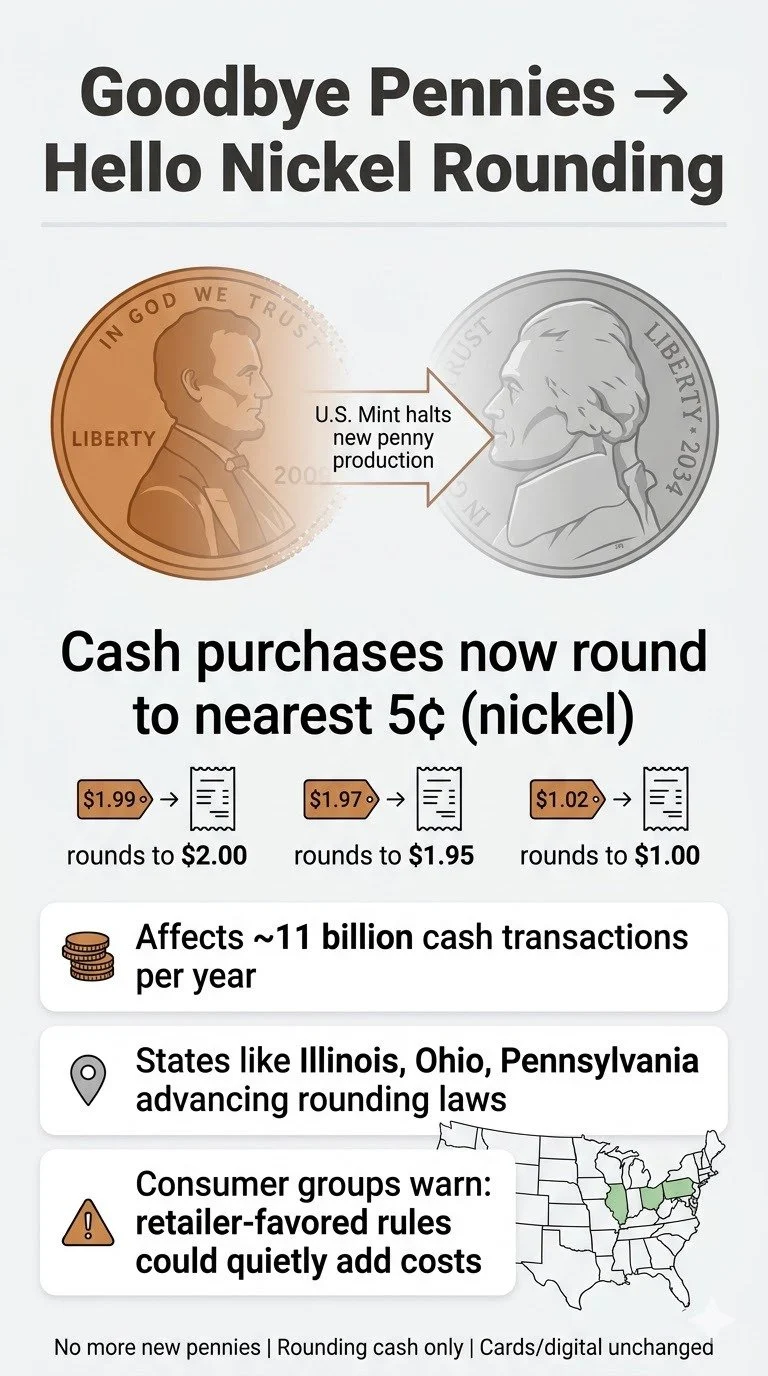
The humble copper-plated zinc disc that has defined American commerce for generations is quietly exiting the stage. Following the U.S. Mint’s decision to halt the production of new pennies, the American retail landscape is facing a logistical and economic pivot point. With the supply of one-cent coins dwindling, at least six state legislatures have rushed to introduce bills aimed at standardizing how retailers handle cash transactions, sparking a national debate over math, consumer rights, and the future of physical currency.
The Main Facts: A Digital Shift Meets Physical Reality
The decision by the U.S. Mint to cease production of the penny marks the end of an era, but it also creates a significant "change vacuum" at the point of sale. While digital payments—including credit cards, mobile wallets, and contactless transfers—calculate exact change electronically, cash remains a bedrock of the U.S. economy. According to 2023 Federal Reserve payment data, cash accounted for approximately 18 percent of all point-of-sale purchases, representing roughly 11 billion annual transactions.
In the absence of the penny, the "exact change" model is no longer sustainable for cash-based transactions. To prevent commerce from grinding to a halt, lawmakers are proposing a "rounding" system—a methodology where the final total of a cash purchase is adjusted to the nearest nickel. While the concept sounds simple, the implementation has opened a Pandora’s box of legislative, economic, and logistical challenges.
Chronology: From Mint Suspension to Legislative Action
The move to eliminate the penny did not happen overnight. For years, the cost of producing a penny has exceeded its face value, leading to persistent budgetary concerns within the federal government. As the Mint phased out production, the reality of a "penny-less" society moved from theoretical debate to practical necessity.
- Early 2024: The U.S. Mint confirms the cessation of new penny production, signaling that the existing circulating supply will be the last.
- March 2024: Retailers and financial analysts begin reporting regional shortages of one-cent coins, forcing small businesses to experiment with informal rounding policies.
- April 2024: Legislative filings in six states—including Illinois, Ohio, and Pennsylvania—are formally introduced, seeking to codify how businesses must round transactions.
- Late April 2024: The Illinois bill, which mandates rounding in favor of the consumer, advances out of committee with a scheduled floor vote for April 12.
- Present: National trade associations begin lobbying for federal intervention to prevent a "patchwork" of state regulations that could disrupt interstate commerce.
Supporting Data: The Economic Impact of Rounding
The core of the controversy lies in the math. If a total is $5.03, should it round down to $5.00 or up to $5.05? The difference seems negligible to an individual, but at the scale of 11 billion transactions, the aggregate impact is substantial.
Consumer advocacy groups have sounded the alarm, noting that if retailers were permitted to adopt a "round-up" policy, it could lead to a massive transfer of wealth. Estimates suggest that a consistent rounding-up policy could extract an extra two cents per transaction on average. Over the course of a year, this could equate to hundreds of millions of dollars shifting from the pockets of shoppers into the coffers of retail chains.
Conversely, some states are proposing "neutral" mathematical rounding (rounding to the nearest, with .03 becoming .05 and .02 becoming .00). Others, like Illinois, are taking a populist approach, mandating that the rounding must always favor the consumer. The Illinois proposal is particularly stringent, carrying fines of up to $500 per violation for businesses that fail to adhere to the pro-consumer rounding mandate.
Official Responses: A Call for Federal Guidance
The retail industry is caught in the middle of this legislative flurry. The National Retail Federation (NRF) and the Retail Industry Leaders Association (RILA) have issued strong statements warning against a state-by-state approach to the rounding problem.
"We need uniform standards, or you’ll have a retailer rounding down in Michigan and rounding up in Indiana," says Jason Miller, chief policy officer at the Retail Industry Leaders Association. "That creates chaos in daily operations and consumer confusion."
For a national chain, the prospect of having 50 different state laws—or even a handful of conflicting regional ones—is a software nightmare. Every point-of-sale (POS) system would need to be programmed individually for every state of operation. If a store in Ohio is required to use neutral rounding while a store in neighboring Pennsylvania must favor the consumer, the programming costs alone would be prohibitive for small businesses and complex for large corporations.
Retail industry groups are currently petitioning Congress to step in and provide federal guidance. They argue that commerce is inherently interstate; a consistent, nationwide standard is the only way to prevent "rounding arbitrage" and ensure that the transition away from the penny does not create a logistical bottleneck in the supply chain.
Implications: The Canadian Precedent and the Road Ahead
To understand what might happen in the U.S., economists often point to Canada. Our northern neighbor eliminated its penny in 2013 and successfully transitioned to a balanced rounding system. The Canadian experience provides a blueprint—and a sense of calm.
Studies of the Canadian transition indicated that the impact on individual consumers was effectively net-neutral. Over the course of a year, the average shopper lost or gained less than a single cent. Because the rounding occurred both up and down, the fluctuations balanced out over multiple transactions. Retailers in Canada reported minimal pushback, and the "shock" of the transition faded within weeks.
However, the U.S. presents a different set of challenges. Unlike Canada, where federal regulation provided a single, clear path, the U.S. is currently witnessing a fractured, state-level reaction. New York’s current proposal, which allows retailers to choose their own rounding method provided they post clear signage, highlights the potential for a "Wild West" of pricing policies. While transparency is a noble goal, it does little to alleviate the burden on consumers who may find themselves facing different pricing rules depending on which side of a city street they are standing on.
The Future of Physical Cash
The shift away from the penny is symbolic of a larger trend: the slow obsolescence of physical currency in an increasingly digital world. While the U.S. Mint’s halt of the penny is a logistical necessity, it also forces a conversation about the role of the nickel and the dime. If the penny disappears, how long until the nickel is deemed too expensive to produce?
For now, the focus remains on the immediate crisis of rounding. As the Illinois floor vote approaches on April 12, the eyes of the retail world are fixed on whether state governments can manage the transition, or if the federal government will be forced to intervene to save the retail industry from a fractured, state-led regulatory landscape.
For the American consumer, the end of the penny will likely be a non-event in terms of individual wealth, but the transition period promises to be a complex case study in governance. Whether through the efficiency of a uniform federal mandate or the messy laboratory of state-level experimentation, one thing is certain: the way we pay for a gallon of milk or a pack of gum is about to change forever. As retailers prepare to update their software and consumers prepare to see new, rounded totals at the register, the "penny-less" era is officially underway, testing the resilience of our commerce infrastructure and the ability of our lawmakers to find common ground in the smallest of margins.
About the Author