In an era defined by rapid technological disruption, the traditional in-plant print shop—often tucked away on a university campus or within a corporate headquarters—faces an existential imperative: adapt or fade into obsolescence. For Clara Garcia, Print Services supervisor at Del Mar College in Corpus Christi, Texas, the pressure to maintain relevance is not just a professional challenge; it is a commitment to the 20,000 students and the faculty who rely on her team for mission-critical communications.
To bridge the gap between legacy operations and the future of digital production, Garcia turns to the industry’s most significant annual event: the PRINTING United Expo. As the industry prepares for the 2026 gathering at the Las Vegas Convention Center, Garcia’s strategy serves as a blueprint for in-plant managers seeking to navigate an increasingly complex technological landscape.
The Strategic Imperative: Staying Relevant in a Digital Age
For institutions like Del Mar College, founded in 1935, the in-plant print shop serves as the heartbeat of campus operations. Garcia oversees a lean, high-efficiency team of three professionals tasked with managing a fleet that includes two monochrome and two color Konica Minolta AccurioPress printers, alongside a 54-inch HP Latex 315 print-and-cut device. While this hardware has served the college well, the horizon of print technology is shifting toward higher levels of automation, personalization, and specialized material handling.
“Attending PRINTING United Expo helps our college stay relevant with the latest industry trends, technology, and equipment,” Garcia explains. “As an in-plant print shop, our priority is to provide the best possible resources and services to support our students, faculty, and staff. The Expo allows us to explore new innovations, evaluate emerging technologies, and identify opportunities that can enhance our operations and better serve the college community.”
Chronology of a Transformation: From Routine to Innovation
The evolution of an in-plant shop does not happen overnight; it is the result of a deliberate, multi-year research strategy. For Garcia, the journey to the Expo is not merely a shopping trip for new machinery—it is a fact-finding mission designed to address specific institutional bottlenecks.
Phase 1: Pre-Show Assessment
Months before the Expo doors open, Garcia conducts an internal audit of the college’s print needs. She identifies areas where the current workflow is stalling—such as the high demand for durable campus signage or specialized promotional materials that require manual finishing.
Phase 2: On-Site Discovery
During the Expo, the experience transitions from passive observation to active investigation. Unlike a localized vendor demonstration, the Expo offers a "neutral ground" where hundreds of exhibitors compete for attention. This allows for direct, side-by-side comparisons of throughput speeds, ink-curing times, and color consistency.
Phase 3: Post-Expo Implementation
The value of the Expo is measured in the months following the event. It is during this time that the insights gathered—often about software workflow solutions or new finishing equipment—are presented to the college administration. These proposals often lead to capital investments that streamline the print shop’s output, effectively future-proofing the college’s internal document services.
Data-Driven Insights: The Scale of the PRINTING United Expo
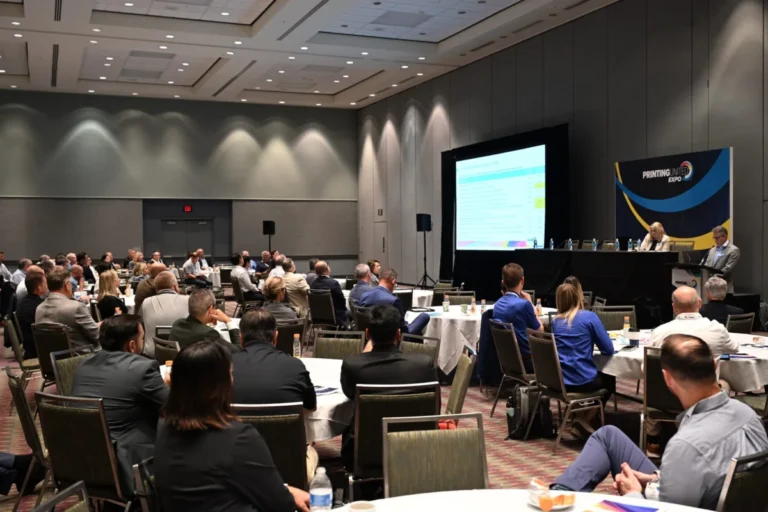
To understand why managers like Garcia prioritize this event, one must look at the sheer scale of the operation. Produced annually by the PRINTING United Alliance, the Expo has evolved into the definitive global gathering for the print and visual communications community.
In 2025, the numbers solidified the event’s status as an industry powerhouse:
- Global Reach: Over 30,000 registered attendees converged from 104 countries, highlighting the international nature of print innovation.
- Exhibitor Density: 838 exhibitors showcased cutting-edge advancements in hardware, substrates, and software workflow solutions.
- Infrastructure: The event occupied a staggering one million square feet of exhibit space at the convention center.
- Knowledge Transfer: Attendees had access to more than 100 educational sessions, ranging from technical workshops on color management to strategic seminars on business sustainability.
This density of information is critical. It provides the "big picture" view that is impossible to replicate in a single vendor meeting. "Attending the Expo gives me the opportunity to see a wide variety of equipment, technologies, and solutions from multiple manufacturers in one place," says Garcia. "It also exposes me to new ideas that I may not have otherwise considered."

Official Perspectives: The Value of "Unexpected" Innovation
A central theme in Garcia’s experience is the concept of "serendipitous discovery." While she enters the Expo with a roadmap—specifically looking for advancements in flatbed printer technology—she often finds that the most transformative ideas come from technologies she hadn’t originally intended to investigate.
"A flatbed printer was one of the technologies that unexpectedly grabbed my attention at a previous Expo," Garcia recalls. "It wasn’t something I had originally planned to research, but after seeing its capabilities firsthand, I realized the potential it had for expanding our large-format services. The ability to print directly onto a variety of materials creates new opportunities for signage, promotional products, and specialty applications that could benefit our college community."
This perspective is shared by many in the industry. The ability to witness a machine printing on wood, glass, or heavy plastics in real-time serves as a catalyst for new service offerings. For an in-plant manager, this means the ability to say "yes" to campus departments that previously had to outsource their specialty print needs to expensive commercial providers.
The Human Element: Networking as a Professional Resource
Beyond the gleaming white walls of the latest digital presses and the hum of high-speed cutters, the most durable output of the Expo is the network of peers. Running an in-plant shop can be an isolating experience, as managers often navigate unique budget constraints and institutional politics that differ significantly from those in the commercial print world.
"Networking at the Expo is one of the most valuable benefits of attending," Garcia emphasizes. "It provides an opportunity to discuss common challenges and share ideas. Building those professional relationships also creates resources when future challenges arise, making the experience beneficial long after the Expo ends."
Whether discussing strategies for managing print-on-demand services or troubleshooting common maintenance issues with similar equipment, these peer-to-peer conversations serve as a support system that enhances the resilience of the individual in-plant shop.
Implications for the Future of In-Plant Printing
As we look toward the 2026 Expo, scheduled for September 23-25 at the Las Vegas Convention Center, the implication for in-plant managers is clear: the role of the print professional is shifting from "operator" to "communications strategist."
The ability to identify, justify, and implement new technology—such as the flatbed printers currently on Garcia’s radar—is the differentiator between shops that thrive and those that are eventually outsourced. By leveraging the educational, networking, and technical resources available at large-scale industry events, managers ensure that their departments remain indispensable assets to their organizations.
The success of Del Mar College’s print operations is a testament to this proactive philosophy. By continuously seeking the intersection of innovation and institutional need, Garcia ensures that her shop does more than just print pages; it serves as a dynamic partner in the educational journey of every student at the college. As the technology continues to evolve, the "in-plant" is no longer just a room full of machines—it is a hub of technological possibility.
For more information on the upcoming event or to join the global print community, visit the PRINTING United Expo website to register.
About the Author