The backbone of the American economy is currently parked on the shoulder of the road. For the millions of commercial drivers who ensure that retail shelves remain stocked, hospitals are supplied, and manufacturing chains stay operational, the simple act of parking has become a daily high-stakes gamble. As a severe shortage of authorized parking spots continues to plague freight carriers, a new, comprehensive analysis from the logistics technology provider Trucker Path has cast a harsh light on the geography of this crisis, identifying exactly where the nation’s infrastructure is failing its drivers.
The Main Facts: A System at Its Breaking Point
The findings from Trucker Path, derived from the real-time activity of over one million active app users, confirm what many in the industry have long suspected: the demand for safe, regulated truck parking far outstrips the supply. By analyzing user inputs regarding truck stops, weigh station statuses, and, most crucially, the availability of parking, the data highlights a widening gap between federal regulatory requirements and physical infrastructure.
Under the stringent safety standards enforced by the Federal Motor Carrier Safety Administration (FMCSA), commercial drivers are legally mandated to adhere to strict Hours of Service (HOS) regulations. These rules dictate exactly how long a driver can remain behind the wheel before they are required to take a mandatory rest break. These windows are not suggestions; they are monitored with forensic precision via Electronic Logging Devices (ELDs).
The problem arises when the "clock runs out." When a driver reaches their maximum driving time in a region with no available parking, they face a dangerous dilemma: continue driving in violation of federal law, or pull over in unauthorized, unlit, and often unsafe locations, such as highway shoulders, abandoned lots, or commercial retail exit ramps. This lack of "safe harbor" is not merely a logistical inconvenience; it is a critical safety failure that impacts everyone on the road.
Chronology: The Evolution of a National Crisis
The current crisis did not emerge overnight. It is the result of decades of infrastructure stagnation coupled with a dramatic increase in freight volume.
The Pre-ELD Era
Before the widespread adoption of Electronic Logging Devices, the industry operated under a more flexible, albeit less transparent, paper-log system. While safety was always a concern, the rigidity of current federal monitoring has effectively eliminated the "buffer" time drivers once used to find a parking spot.
The Legislative Push
Over the past decade, the issue of truck parking has moved from a niche industry complaint to a central topic in Washington, D.C. Organizations like the Owner-Operator Independent Drivers Association (OOIDA) have spent years lobbying for federal funding to expand parking capacity. Their argument is consistent: if the government mandates rest, the government must ensure the infrastructure exists to facilitate that rest.
The Data Revolution
The current era, defined by platforms like Trucker Path, marks a shift toward data-driven advocacy. By leveraging the aggregated experiences of one million drivers, the industry can now move away from anecdotal evidence and toward empirical mapping. This shift has allowed for the identification of specific "deserts"—states where the parking-to-truck ratio is at its most critical.
Supporting Data: Mapping the Parking Deserts
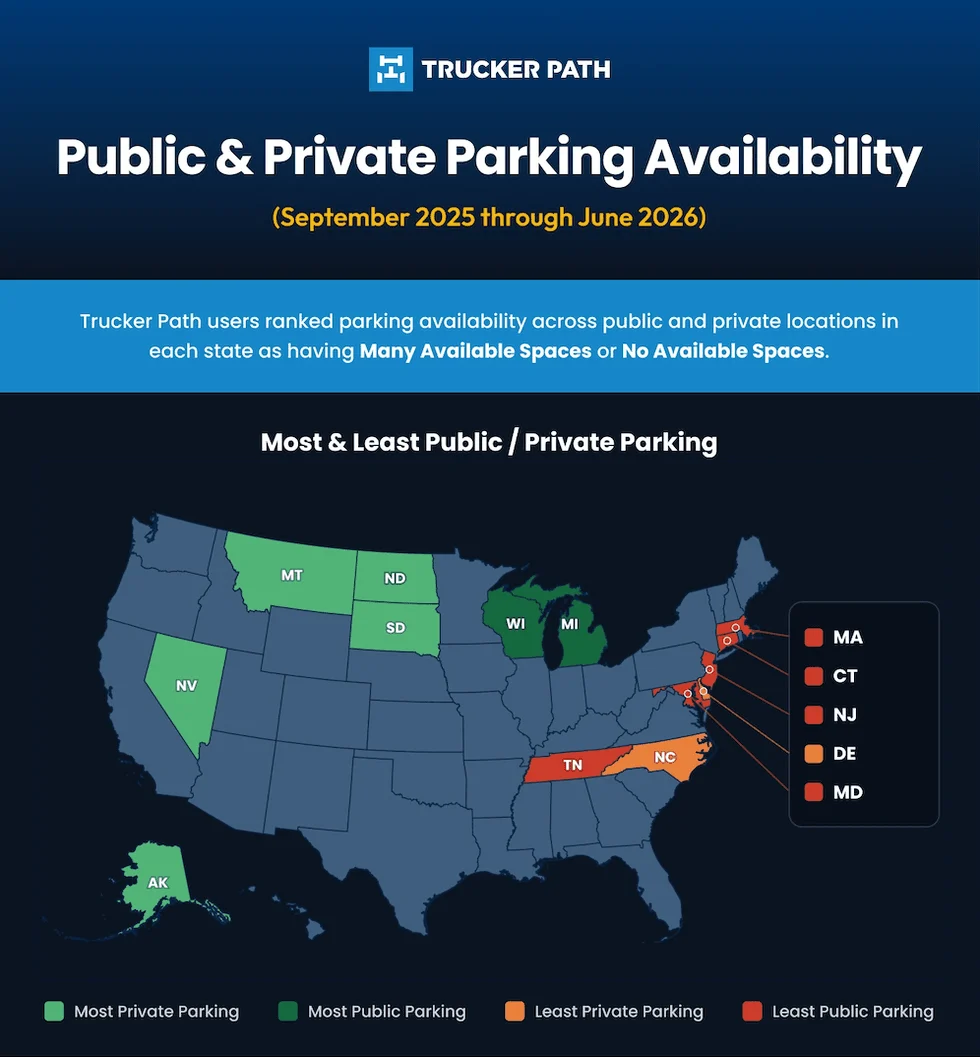
Trucker Path’s analysis categorizes parking into two distinct groups: public parking (highway rest stops) and private parking (commercial chains like Love’s, Pilot, and TA). The data reveals a stark contrast between regions.
States with the Most Acute Shortages
The report identifies a "Red Zone" of states where finding a spot is consistently difficult.
- Public Parking Deserts: Maryland, Tennessee, Connecticut, Massachusetts, and New Jersey lead the list for the fewest available public rest areas. These states, largely situated along the densely populated I-95 corridor, present a nightmare scenario for long-haul drivers who must navigate high-traffic, high-regulation zones with virtually no designated rest capacity.
- Private Parking Deserts: The situation is similarly dire for private parking, with Massachusetts, Delaware, New Jersey, Connecticut, and North Carolina rounding out the bottom five.
The "High-Supply" Regions
Conversely, the data highlights areas where infrastructure is more robust, though these are often regions with lower population density. Montana, Nevada, Wisconsin, South Dakota, and Michigan top the list for public parking availability. Alaska, North Dakota, Montana, South Dakota, and Nevada lead in private parking capacity. The correlation is clear: the states with the lowest population density and the most expansive highway networks tend to offer the most room for the trucking industry to breathe.
Official Responses and Industry Sentiment
The response from the trucking community has been one of grim vindication. Industry leaders have long argued that the lack of parking is a primary driver of the high turnover rate in the profession. "You can’t expect people to spend their lives on the road if they have to worry about where they are going to sleep every single night," says one regional fleet manager. "It’s a quality-of-life issue, and right now, the life of a trucker is being compromised by basic lack of access to a paved space."
From the regulatory side, the FMCSA has acknowledged the problem, often citing the need for "public-private partnerships." However, bureaucratic hurdles—such as environmental impact studies, land acquisition costs, and local zoning opposition—often stall the construction of new facilities. Even when funding is allocated, the "NIMBY" (Not In My Backyard) phenomenon frequently prevents new truck stops from being approved by local municipalities.
The Broader Implications: Safety, Supply Chains, and Recruitment
The ramifications of this crisis extend far beyond the cab of a tractor-trailer.
1. Safety and Security
The most immediate consequence is the risk to public safety. When drivers are forced to park on highway shoulders, they become high-speed hazards. Furthermore, the drivers themselves become targets for crime. Many rest stops are poorly lit, and illegal parking areas lack the security features of established, branded truck stops, leaving drivers vulnerable to theft and physical harm.
2. Supply Chain Integrity
A tired driver is a dangerous driver. The pressure to push through the exhaustion to reach a "safe" parking spot leads to increased accident rates. When accidents occur, they cause massive delays, impacting the "Just-in-Time" delivery model that currently keeps modern retail and manufacturing afloat. The inefficiency of the parking system essentially acts as a hidden tax on every item delivered to a store.
3. The Human Cost and Labor Shortage
The trucking industry is currently grappling with a significant shortage of qualified drivers. While pay and benefits are part of the equation, the day-to-day misery of being unable to park is a major deterrent to new recruits. If the industry wants to solve its labor crisis, it must address the fundamental working conditions of the drivers, starting with the ability to park legally and safely.
Conclusion: A Call for Infrastructure Investment
The data provided by Trucker Path is not merely a list of statistics; it is a map for future infrastructure investment. As the nation continues to debate the future of its highway system and the transition to autonomous or electric fleets, the "low-tech" reality of finding a place to park remains the industry’s most pressing concern.
Without a concerted, federally-backed effort to incentivize the development of new parking facilities—particularly in the high-demand, high-density corridors of the Northeast and Mid-Atlantic—the industry will remain in a state of precarious imbalance. The safety of our roads and the efficiency of our economy depend on the ability of our drivers to stop, rest, and recover. Until that is prioritized, the American trucking industry will continue to operate on the edge of the shoulder.
About the Author