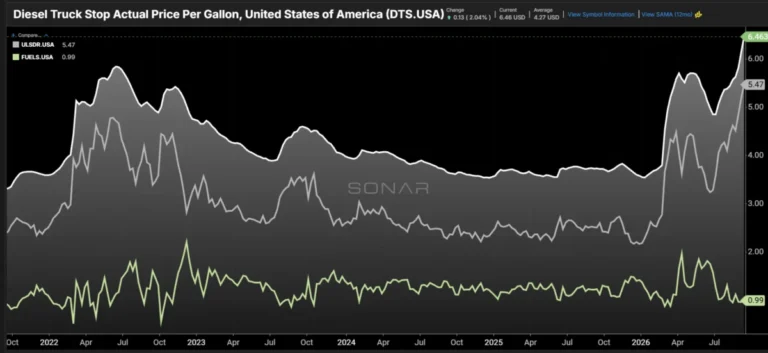
The global freight economy is facing an unprecedented energy crisis. A convergence of geopolitical instability in the Middle East and targeted kinetic strikes against critical energy infrastructure in Russia has effectively removed 8% of the world’s diesel supply from the market. For the trucking industry, shippers, and logistics providers, this isn’t merely a headline—it is a fundamental threat to operational viability.
Andy Lipow, president of Lipow Oil Associates, warns that the market is witnessing a "perfect storm" of supply constraints. With approximately 2 million barrels per day (bpd) of diesel offline, the logistics sector is bracing for a sustained period of high costs and volatility. As diesel prices climb, the ripple effects are being felt from the ports of Los Angeles to the heating oil tanks of the American Northeast.
Main Facts: The Anatomy of a Supply Shock
The current crisis is defined by a massive, simultaneous contraction in production and distribution. The loss of 2 million bpd of diesel is not a temporary fluctuation; it is a structural blow to a global economy that relies on distillates for the movement of virtually all consumer goods.
The Russian Refining Crisis
Russian refining capacity, previously a cornerstone of European energy stability, has become a primary target in the ongoing conflict with Ukraine. Recent intelligence and industry reports indicate that between 30% and 50% of Russia’s 6.5-million-bpd refining capacity is currently offline or operating at severely reduced rates.
Prior to these disruptions, Russia was a key exporter of 800,000 bpd of diesel. The shift in military tactics, which now includes large-scale drone strikes on energy infrastructure—including a single weekend operation involving 1,900 drones—has crippled facilities that are notoriously difficult to repair.
Middle Eastern Volatility
While the Russian situation unfolds in the north, the Middle East is facing its own set of disruptions. Houthi-led attacks have forced the shutdown of the East-West Pipeline in Saudi Arabia, which had been transporting 2.8 million bpd of crude oil. Furthermore, direct strikes on Red Sea refineries, such as the Jizan facility, have choked off an additional 200,000 bpd of diesel production. These incidents, combined with restricted tanker traffic through the Strait of Hormuz, have tightened the global supply of distillates to levels not seen in decades.
Chronology of the Disruption
The erosion of global energy security has occurred in a rapid, compounding sequence of events:
- Mid-July: Increased frequency of drone strikes on Russian refining facilities begins to show significant impacts on output, particularly affecting export-grade diesel.
- Late July: The Jizan refinery in Saudi Arabia is struck, marking a significant escalation in the targeting of downstream refining assets in the Middle East.
- Early August: The East-West Pipeline in Saudi Arabia ceases operations following sustained regional missile and drone activity.
- Mid-August: European refiners begin aggressively competing for non-Russian spot cargoes, leading to a massive spike in buying pressure that draws heavily from U.S. Gulf Coast inventories.
- Present Day: Global distillate stocks reach multi-decade lows. The U.S. East Coast, in particular, reports its lowest diesel inventory levels for this time of year since the Energy Information Administration (EIA) began tracking the data in 1982.
Supporting Data: Why This Matters to Logistics
The disparity between crude oil prices and diesel prices—known as the "crack spread"—reveals the true nature of this crisis. While crude is trading at approximately $103 per barrel, the market is pricing diesel at an equivalent of $270 per barrel, compared to $188 for gasoline.
The Cost of Transport
For carriers and logistics managers, these numbers translate directly into operating costs that are increasingly difficult to pass on to shippers. In California, where container volume at the ports of Los Angeles and Long Beach accounts for 40% of all U.S. imports, diesel prices are flirting with the $8.50 per gallon threshold.
The Inventory Crisis
Domestic refineries in the United States are already operating near 100% capacity. There is virtually no slack in the system to ramp up production to compensate for global shortfalls. With winter approaching, the situation is expected to worsen. Homeowners in the Northeast, who rely on heating oil—a product virtually identical to diesel—are facing a reality where a standard 150-gallon delivery could cost upwards of $1,000.
Official Responses and Expert Analysis
Industry analysts, including Andy Lipow, emphasize that the repair timeline for the damaged Russian infrastructure is not measured in weeks, but in months or years. Because Russia is under heavy international sanctions, the specialized parts and Western engineering expertise required to fix these refineries are largely inaccessible.
"It’s going to take months, if not years, to repair this equipment, especially when Russia is under sanctions from the United States and Europe," Lipow noted.
The European response has been equally desperate. Poland’s PKN Orlen, for instance, has moved to purchase 15 to 16 crude cargoes just to replace lost contracted volumes from Saudi Arabia. This scramble for supply is placing an enormous burden on the U.S. Gulf Coast, which is currently exporting 3 to 4 million bpd of crude to satisfy global demand, leaving even less supply available for domestic refining.
Implications for the Global Economy
The rise in diesel prices acts as a "stealth tax" on every facet of the consumer economy. Because diesel is the primary fuel for the entire supply chain—from ocean vessels to heavy-duty trucks to the final-mile delivery vans—these costs are baked into the price of every item on a store shelf.
The Impact on Trucking and Freight
For the trucking industry, the current environment is one of extreme risk management. Carriers that operate on thin margins are being forced to choose between absorbing the cost of fuel or risking the loss of contracts by raising freight rates. The brokerage community is similarly impacted, as they navigate fraud exposure, carrier liability, and insurance gaps in an environment where the fundamental cost of movement is skyrocketing.
The Consumer Outlook
While the consumer may not see the direct impact of a $103 barrel of oil at the pump in the same way they do gasoline, the inflationary pressure of rising diesel prices is unavoidable. As logistics costs rise, the "delivered price" of food, construction materials, and retail goods will continue to climb.
Strategic Recommendations
In the face of this uncertainty, logistics managers are urged to:
- Re-evaluate Fuel Surcharges: Ensure that fuel surcharge agreements are dynamic enough to reflect current volatility.
- Focus on Efficiency: Optimize routing and load planning to minimize deadhead miles.
- Monitor Energy Markets: Stay informed on geopolitical developments in the Middle East and Eastern Europe, as these remain the primary drivers of supply chain energy costs.
As the industry looks toward the upcoming F3: Future of Freight Festival and other critical industry gatherings, the focus will undoubtedly remain on resilience. The ability to navigate this energy-constrained environment will define the winners and losers of the next fiscal year. The "diesel squeeze" is not merely an energy issue; it is the single most significant challenge to the stability of the global freight market today.
About the Author