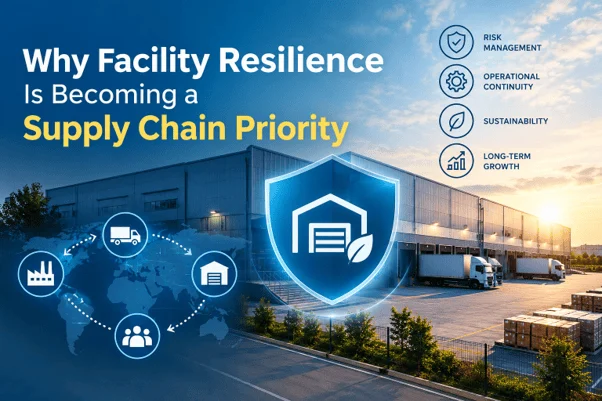
In the high-stakes world of global logistics, executive attention is almost exclusively tethered to the "Big Four" of supply chain management: transportation routes, inventory velocity, supplier reliability, and labor availability. When a fulfillment center slows down, the knee-jerk reaction is to audit the carrier, investigate the supplier, or adjust the warehouse management software (WMS).
Rarely does the scrutiny turn to the concrete, steel, and electrical copper of the building itself. Yet, as supply chains grow increasingly brittle under the pressure of just-in-time delivery expectations, the physical facility has emerged as a critical—and often overlooked—single point of failure. A warehouse is not merely a container for goods; it is the heartbeat of the logistics network. When the building fails, the supply chain stops, regardless of how sophisticated the digital tracking or how robust the transportation fleet.
The Foundation of Fulfillment: Physical Resilience Defined
Facility resilience refers to the ability of a distribution center to withstand, adapt to, and recover from disruptive events, whether they are environmental, mechanical, or structural. While executives often view building maintenance as a line item for the facilities department, it is, in reality, a core component of risk management.
A single fire door failing to latch, an overloaded electrical panel, or a neglected roof leak is not just a maintenance headache—it is a threat to the balance sheet. In an era where 24-hour fulfillment is the standard, a facility shutdown of even 48 hours can create a ripple effect that compromises customer commitments, triggers contractual penalties, and damages brand reputation.
Chronology of Neglect: How Small Issues Evolve into Catastrophes
The decline of a facility’s operational capacity rarely happens overnight. It follows a predictable, often ignored, trajectory that leads from minor annoyance to full-scale disruption.
Phase 1: The "Manageable" Defect
The cycle begins with a deferred maintenance item—a flickering light in the loading dock, a slightly misaligned conveyor belt, or a minor crack in the warehouse slab. Because the operation is at high capacity, managers prioritize throughput over repair. The mindset is: "We’ll fix it during the next slow period."
Phase 2: The Latent Risk
As the maintenance is pushed back, the surrounding systems begin to compensate. Electrical panels run hotter, floor traffic patterns become inefficient, and safety systems (like alarms or automated fire suppression) go un-inspected. The facility is now operating in a state of "brittle equilibrium," where the margin for error has effectively vanished.
Phase 3: The Systemic Failure
A trigger event occurs. It may be a localized power surge, a minor equipment malfunction, or a regulatory audit that reveals a critical violation. Because the infrastructure has been degraded, the failure is not isolated. A localized electrical issue forces a total grid shutdown to prevent fire; a faulty loading dock leveler halts all outbound shipping.
Phase 4: Operational Paralysis
The downtime begins. Inventory is trapped behind locked or malfunctioning security doors; outbound shipments are rerouted; and the facility’s WMS loses connectivity. What was once a $500 repair bill now results in tens of thousands of dollars in lost productivity and expedited shipping costs to rectify customer delays.
The Technology Gap: Modern Demands on Legacy Architecture
One of the most pressing challenges in the current logistics landscape is the "technological mismatch." Many distribution centers currently in use were constructed in an era defined by manual labor and basic rack storage. Today, those same buildings are being retrofitted to host high-speed robotics, high-density automated storage and retrieval systems (AS/RS), and 5G-connected inventory tracking.
Structural Stressors
Modern automation places immense pressure on legacy floor slabs. Robotic units require perfectly level, high-tolerance flooring to function without error. Furthermore, high-density racking increases the "fire load" of the building, often necessitating a complete overhaul of fire suppression systems to meet modern safety codes.
Electrical and Digital Infrastructure
The electrical demands of charging stations for autonomous mobile robots (AMRs) and the constant connectivity required for IoT-enabled inventory management systems often exceed the original design capacity of older facilities. When a building’s electrical backbone is pushed to its limit, the risk of fire or power-related downtime increases exponentially. Without a comprehensive structural audit, these "productivity upgrades" can ironically become the catalyst for the next major facility failure.
Supporting Data: The Cost of Deferred Maintenance
Industry research consistently shows that the cost of proactive maintenance is a fraction of the cost of reactive repair. According to recent facility management metrics, the "Failure Multiplier"—the ratio of reactive repair costs to proactive maintenance—is estimated at 4:1.
- Downtime Costs: In high-volume environments, a single hour of unplanned downtime can cost a mid-sized facility between $10,000 and $50,000, depending on the value of the inventory and the sensitivity of the shipping deadlines.
- Safety Incidents: Occupational Safety and Health Administration (OSHA) data indicates that warehouse-related injuries frequently stem from poor facility maintenance—damaged flooring causing trips, poorly lit areas, or blocked emergency egress routes.
- Regulatory Fines: With the increasing scrutiny of global trade regulations, failing to maintain fire and life-safety systems (such as sprinkler systems and exit signage) can result in heavy fines and, in extreme cases, the revocation of operating licenses.
Official Perspectives on Risk Mitigation
Industry experts and risk management consultants are increasingly vocal about the need for a "Unified Facility Strategy."
"We are seeing a shift in how C-suite executives view the warehouse," says a lead consultant at a major global logistics firm. "It is no longer just a real estate asset; it is a vital part of the continuity plan. Organizations that treat facility inspections as a compliance box-checking exercise are at a massive competitive disadvantage. You must treat a fire door inspection with the same level of urgency as a supply chain audit."
The consensus among safety professionals is that facility resilience must be centralized. By standardizing maintenance schedules and inspection criteria across all regional hubs, companies can identify systemic risks before they manifest in a single location. This consistency allows for "predictive maintenance," where data from one site—such as a specific model of dock leveler showing signs of wear—can trigger proactive inspections at all other sites using the same equipment.
Implications for the Future: Building a Resilient Network
As logistics networks become more interconnected, the isolation of a facility failure is a myth. A bottleneck in one node of the network forces rerouting, which in turn stresses secondary facilities. This "domino effect" means that a localized maintenance failure in a warehouse in the Midwest can result in delayed deliveries for customers on the East Coast.
To build a truly resilient supply chain, organizations must embrace three pillars of facility health:
- Standardized Benchmarking: Establish a "Golden Standard" for facility health that applies to every warehouse in the network, regardless of age or location. This includes mandatory quarterly reviews of electrical, structural, and life-safety systems.
- Integrated Planning: Ensure that safety and facilities teams are present at the table during supply chain strategy meetings. If the company plans to increase throughput or introduce new automation, the physical facility must be vetted for its capacity to handle that change.
- Technology-Driven Maintenance: Utilize sensor-based monitoring to track the health of critical infrastructure. IoT-enabled sensors on HVAC systems, electrical panels, and dock doors can provide real-time data on performance, allowing teams to address issues before they result in downtime.
Conclusion: The Warehouse as a Competitive Advantage
In the competitive landscape of modern commerce, resilience is the new efficiency. While the industry remains focused on the speed of transit and the accuracy of algorithms, the companies that will survive the next wave of supply chain volatility are those that understand the ground beneath their feet.
By prioritizing the physical integrity of the warehouse, logistics leaders can transform their facilities from potential points of failure into the bedrock of their operations. A well-maintained, resilient facility does not just keep the lights on—it ensures that when the market demands speed, the infrastructure is ready to deliver. The cost of maintenance is an investment; the cost of failure is an existential threat. It is time for the industry to look inside the building and recognize that the most sophisticated supply chain in the world is only as strong as the warehouse that supports it.
About the Author