For CEOs of private companies, the annual ritual of determining executive bonuses is often viewed as a simple equation: when the company succeeds, the leadership team is rewarded. New data, however, suggests this common approach may be fundamentally flawed. While bonuses rise in lockstep with profitability, a deeper analysis reveals a critical disconnect between broad financial performance and the specific, value-driving contributions of individual C-suite executives.
As businesses navigate increasingly complex economic landscapes, CEOs are facing a pressing strategic challenge: how to move beyond "profit-sharing" and toward a compensation philosophy that truly incentivizes the behaviors required for long-term, sustainable growth.
The State of Executive Pay: A Data-Driven Overview
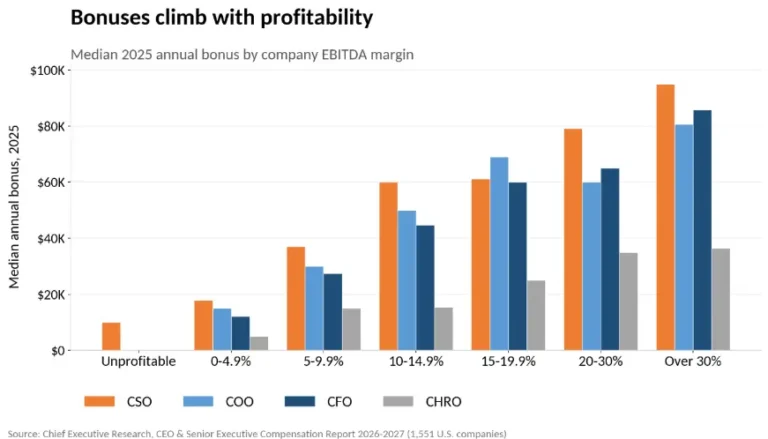
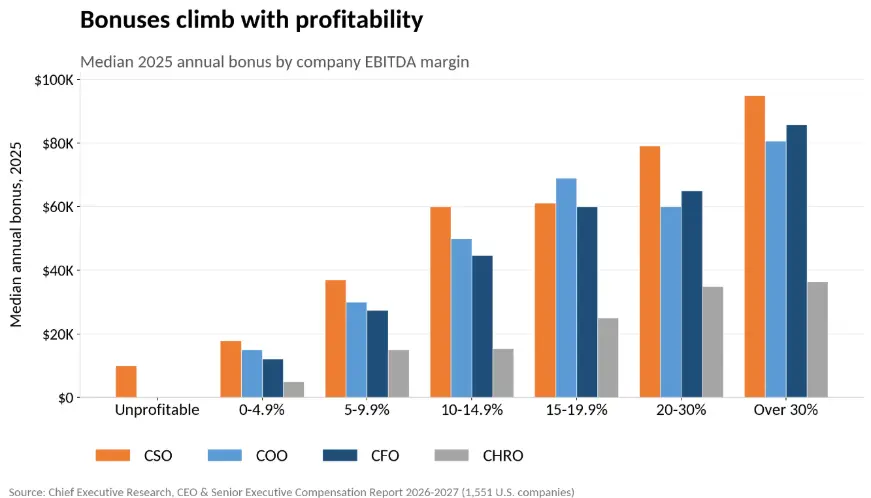
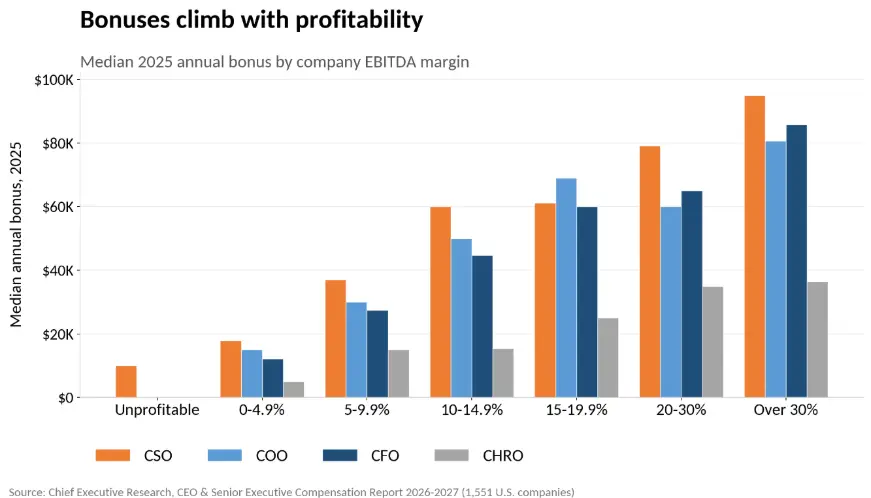
The latest compensation study from Chief Executive Group Research, which analyzed data from 1,551 U.S. companies, paints a clear picture of the current landscape. There is a near-linear correlation between a company’s EBITDA margins and the size of its leadership bonuses.
The Profitability Correlation
At companies that failed to turn a profit in 2025, the median CFO, COO, and CHRO received no bonus whatsoever. Conversely, as margins climbed, so did the payouts. At businesses reporting EBITDA margins exceeding 30 percent, the median bonus for a CFO reached $85,842, while COOs saw median payouts of $80,625, and CHROs received $36,503.
This pattern is not limited to the financial or operational wings of the business. Chief Sales Officers (CSOs) also see their fortunes tied tightly to the bottom line. At unprofitable firms, the median CSO bonus was just $10,103; at companies with 30%+ EBITDA margins, that figure surged to $95,000.
The Revenue Growth Factor
Revenue growth acts as a secondary engine for bonus inflation. At companies with flat revenue, the median CFO bonus sits at a modest $20,000. As companies scale—achieving growth rates of 20 percent or more—that median bonus jumps to $59,000. Similar scaling is seen across the C-suite, proving that current private-company compensation models are overwhelmingly tethered to top-line and bottom-line expansion.
The Chronology of an Incentive Gap
The evolution of modern compensation has been largely defined by a shift toward objective, quantifiable financial targets. In the early 2000s, the push for transparency led many private boards to adopt "formulaic" bonus structures, replacing subjective, performance-review-based payouts with hard EBITDA and revenue goals.
- The Era of Simplification: To avoid the perception of bias, boards moved toward blanket company-wide metrics. If the company hit its target, everyone got paid.
- The Efficiency Focus: During the 2010s, as private equity influence grew, the focus shifted entirely to margin expansion and cash-flow efficiency.
- The Current Disconnect: Today, we are seeing the unintended consequences of this approach. While these formulas are easy to calculate, they often fail to account for the nuance of individual roles. A CFO might be an absolute rockstar in liquidity management during a year of flat revenue, yet they are penalized by a bonus structure that only recognizes revenue growth.
Beyond the Bottom Line: Why Uniform Metrics Fail
Relying exclusively on company-wide financial metrics can be a dangerous game. When bonuses are tied strictly to EBITDA, the company essentially "outsources" the evaluation of its senior leaders to the market or to luck.
The Case of the Misaligned Incentive
Consider a COO tasked with streamlining production. They successfully reduce waste, improve quality, and shorten lead times. However, if the company’s primary sales channel suffers due to a macroeconomic downturn, the COO’s bonus—tied to EBITDA—will likely shrink. In this scenario, the company is effectively punishing the executive for doing their job well during a difficult season.
Conversely, a company might exceed its profit targets due to a sudden, lucky surge in market demand—a "rising tide" that lifts all boats. In this case, executives receive high bonuses for results that were driven by external factors rather than their own strategic initiatives. This creates a "fairness" issue: are the executives being paid for their strategic impact, or are they simply being gifted a share of market volatility?
Role-Specific Performance Measures
To align compensation with actual performance, CEOs must decouple individual bonuses from broad, company-wide goals. A more robust framework incorporates role-specific KPIs:
- The CFO: Beyond EBITDA, they should be measured on capital allocation, financing costs, the accuracy of financial forecasting, and the strength of internal financial controls.
- The COO: Performance should be tied to operational efficiency, productivity ratios, quality-control metrics, and the successful execution of capital projects or digital transformations.
- The CHRO: This role requires a shift toward talent-focused metrics, such as the retention rate of high-potential employees, the success of leadership succession plans, and the measurable improvement in workforce productivity.
- The CSO: Beyond pure revenue, compensation should reflect pricing discipline, customer acquisition costs (CAC), and the long-term profitability of the client portfolio.
The Risk of Short-Termism: The "Current-Year" Trap
Perhaps the most significant flaw in the current bonus culture is the obsession with annual results. Annual bonuses are, by definition, short-term instruments. They are excellent for driving immediate sales or cost-cutting, but they are disastrous if they discourage long-term investment.
If an executive knows that their bonus is entirely dependent on this year’s EBITDA, they have a rational incentive to slash R&D, defer maintenance, or skip training initiatives—all of which save money now but hollow out the company for the future.
The Role of Long-Term Incentives (LTIs)
To mitigate this, companies must integrate long-term incentives such as:
- Equity-based awards: Giving leaders a stake in the long-term value of the firm.
- Multiyear performance plans: Setting targets that require 3-to-5-year horizons.
- Deferred cash incentives: Bonuses that vest over time, contingent on the business remaining healthy and hitting future milestones.
Strategic Implications: Redesigning the Roadmap
For the CEO, the path forward requires a shift in philosophy. The goal is no longer to "keep executives happy" by linking their pay to the company’s general success; it is to build a culture of accountability where every leader understands exactly what they are being paid to influence.
Implementing a Tiered Compensation Model
Effective compensation plans should generally be structured in three tiers:
- The Foundation: A base salary that remains competitive for the role’s market value.
- The Strategic Lever: An annual bonus linked to specific, role-based KPIs that reflect the individual’s contribution to the year’s strategic objectives.
- The Wealth Builder: A long-term incentive plan (LTIP) that ties the executive to the company’s multi-year vision, ensuring that they are as interested in the company’s health in 2030 as they are in the results of 2025.
Conclusion: Paying for Performance vs. Paying for Results
There is a profound distinction between paying executives more because the company performed well and paying them in ways that actively encourage the company to perform better. The former is a reward system; the latter is a strategy.
As you review your executive compensation plan, ask the difficult questions. Does this bonus structure reward the specific behaviors I need to survive the next five years, or is it simply a passive dividend based on the last twelve months of profit?
True leadership requires the courage to move beyond the ease of a simple, one-size-fits-all formula. By tailoring incentives to the unique, value-creating contributions of each senior leader, CEOs can ensure that their compensation program is not just a cost center, but a powerful engine for sustained competitive advantage. The data is clear: profitability and bonuses are linked, but excellence is built on something far more precise.
About the Author