The manufacturing sector, often regarded as the bellwether of the broader U.S. economy, faced a complex psychological landscape in November 2026. According to the latest CEO Confidence Index from Chief Executive—which polled 435 U.S. chief executives between November 3 and 5—manufacturing leaders grew increasingly cautious as they navigated a confluence of political transition and persistent macroeconomic pressures.
While the headline numbers indicate the lowest confidence reading of the year, a closer look at the data reveals a sector characterized by a "wait-and-see" approach, bolstered by pockets of industrial strength and a distinct "midterm bounce" that arrived once the political dust settled.
Main Facts: A Sector at a Crossroads
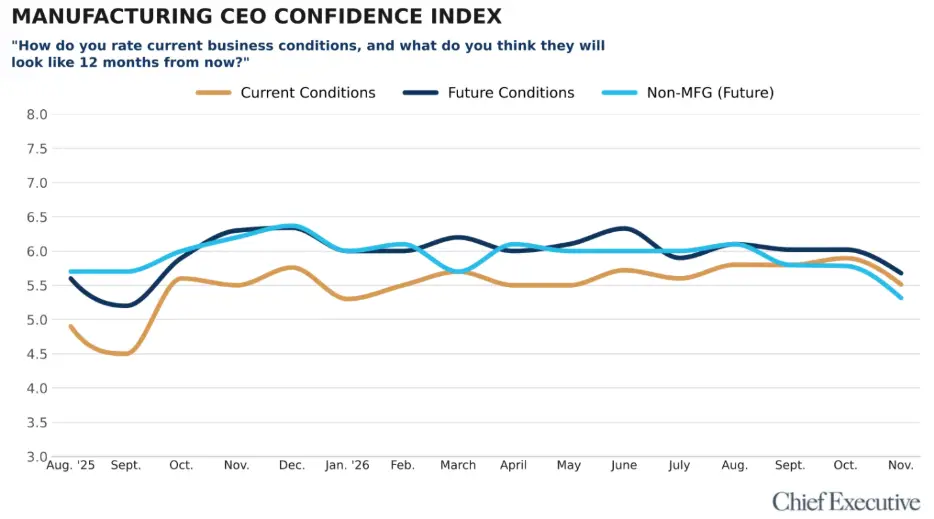
The November survey paints a picture of a manufacturing landscape that is holding steady despite a palpable dip in sentiment. Current business conditions were rated at 5.5 out of 10, a 7 percent decline from October’s 5.9 and the lowest point recorded since May 2026. The 12-month forecast for the sector similarly retreated, dropping 6 percent to 5.7, sitting below the year-to-date average of 6.1.
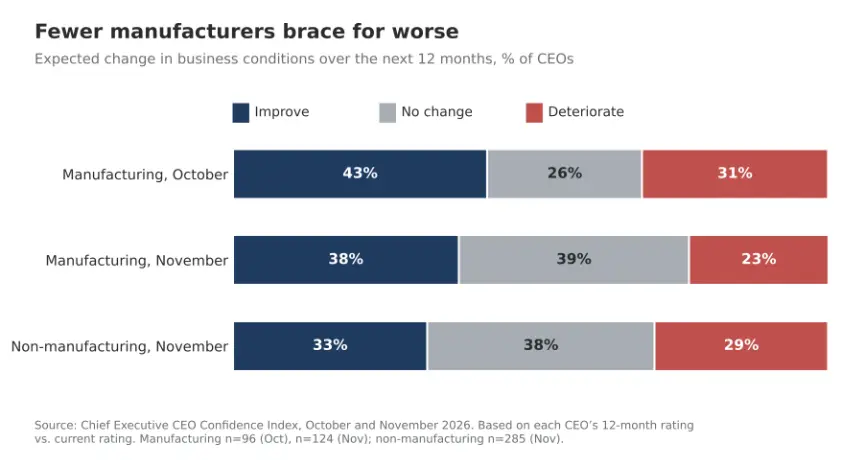
Despite these softening numbers, the manufacturing sector continues to outperform non-manufacturing industries, which saw an 8 percent decline on both current and future sentiment metrics. The primary takeaway from the November data is not one of impending collapse, but rather a strategic pause. Many CEOs are shifting their expectations from "growth" to "maintenance," with 39 percent of respondents now expecting conditions to remain flat over the next year—a significant jump from 26 percent in October.
Chronology: The Impact of the Midterm Election
The most compelling narrative to emerge from the November index is the timing of the response. The survey was fielded during the immediate aftermath of the midterm elections, providing a real-time look at how political clarity influences executive decision-making.
Pre-Election Anxiety
CEOs who submitted their responses on November 3, prior to the finalization of midterm results, were notably more pessimistic. Their 12-month outlook hovered at a 5.5. The uncertainty surrounding the legislative landscape acted as a drag on sentiment, with many leaders citing concerns over potential shifts in trade policy, tax structures, and the regulatory environment.
The Post-Election Sentiment Shift
Once the election results were known, a clear shift in perspective occurred. Respondents who weighed in after the results were announced rated their 12-month outlook at 5.9. Furthermore, 43 percent of these "post-result" respondents expressed optimism that conditions would improve, compared to only 34 percent of those who had responded earlier. The election results appear to have provided a psychological floor for the manufacturing sector, allowing leaders to trade "uncertainty" for "strategy."
Supporting Data: Disparities and Drivers
The manufacturing sector is not a monolith, and the data reveals deep fractures between industrial manufacturing and consumer goods production.
Consumer Goods vs. Industrial
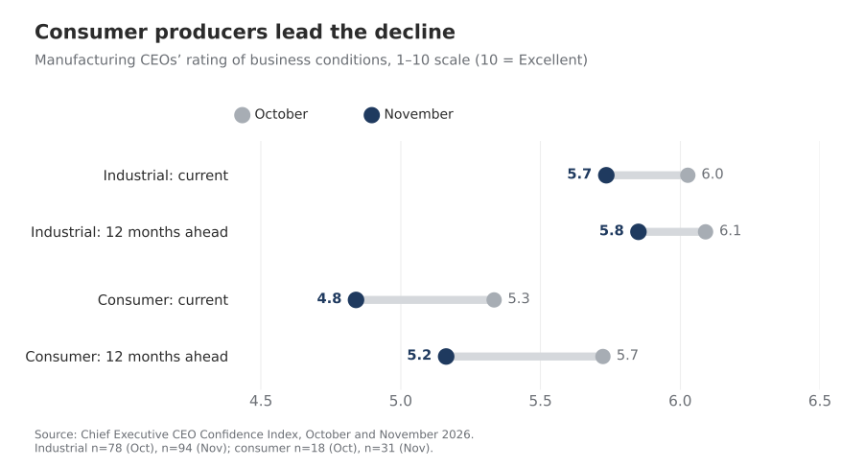
Consumer goods producers are bearing the brunt of the current economic slowdown. Their rating of current conditions plummeted by 9 percent to 4.8, while their year-ahead forecast dropped 10 percent to 5.2. This aligns with broader market observations that, while consumers are still spending, they have become increasingly selective and price-sensitive.
Conversely, industrial manufacturers remain more resilient. Their ratings slipped only marginally to 5.7 and 5.8, respectively. This divergence highlights a bifurcated economy: while the average household is tightening its belt on discretionary goods, the industrial engine—fueled by data centers, semiconductor production, aerospace, and defense—continues to hum.
Inflation and Interest Rates
Cost pressures remain the most significant headwind. Approximately 20 percent of CEOs cited inflation and rising input costs—ranging from raw steel to fuel—as primary concerns. Interest rates also loom large. As Jim Nelson, CEO of Parr Instrument Company, noted: “Rising interest rates will slow the economy in 2027.” The expectation for higher operating expenses has spiked, with 82 percent of manufacturers now anticipating increased costs in 2027, compared to 65 percent just one month prior.
Official Responses: The Leadership Perspective
The qualitative feedback from the survey reveals a cohort of leaders who are balancing defensive caution with long-term investment.
- The Bullish Industrialist: Scott Wood of LISI Aerospace Fasteners North America remains firmly optimistic, rating current conditions at a 10. He points to high demand in defense, space, and aerospace as the primary drivers of his company’s continued growth, effectively insulating his operations from broader economic volatility.
- The Prudent Strategist: Many CEOs are choosing to look past the monthly data fluctuations. As the CEO of a mid-size, family-owned industrial manufacturer remarked: “Experience, judgment, and the willingness to trust your gut still matter. Sometimes leadership means making a decision before the numbers can fully justify it.”
- The Inflation Skeptic: The consensus among those fearing a downturn is centered on the compounding impact of interest rates and lingering tariff policies. For these leaders, the “uncertainty” of the political climate remains a risk factor that prevents them from fully committing to aggressive expansion.
Implications: Strategic Planning for 2027
Despite the dip in confidence, the data for 2027 remains surprisingly robust. There is a distinct disconnect between the "gloomier" sentiment and the actual capital allocation plans of these firms.
Revenue and Profit Stability
Seventy-five percent of manufacturers expect to close out 2026 with higher revenues than in 2025, and 67 percent expect higher profits. This suggests that while CEOs may be worried about the environment, they remain confident in their internal operations.
Capital Expenditure vs. Payroll
A critical trend for 2027 is the reallocation of capital. While expectations for hiring have slipped by 4 percent—suggesting a temporary freeze on payroll expansion—capital expenditure (capex) plans have seen a 13 percent increase since October. This indicates that manufacturers are prioritizing automation, technology, and facility upgrades over headcount expansion. In an environment of rising labor costs and inflation, firms are choosing to invest in efficiency rather than manual capacity.
The Recession Forecast
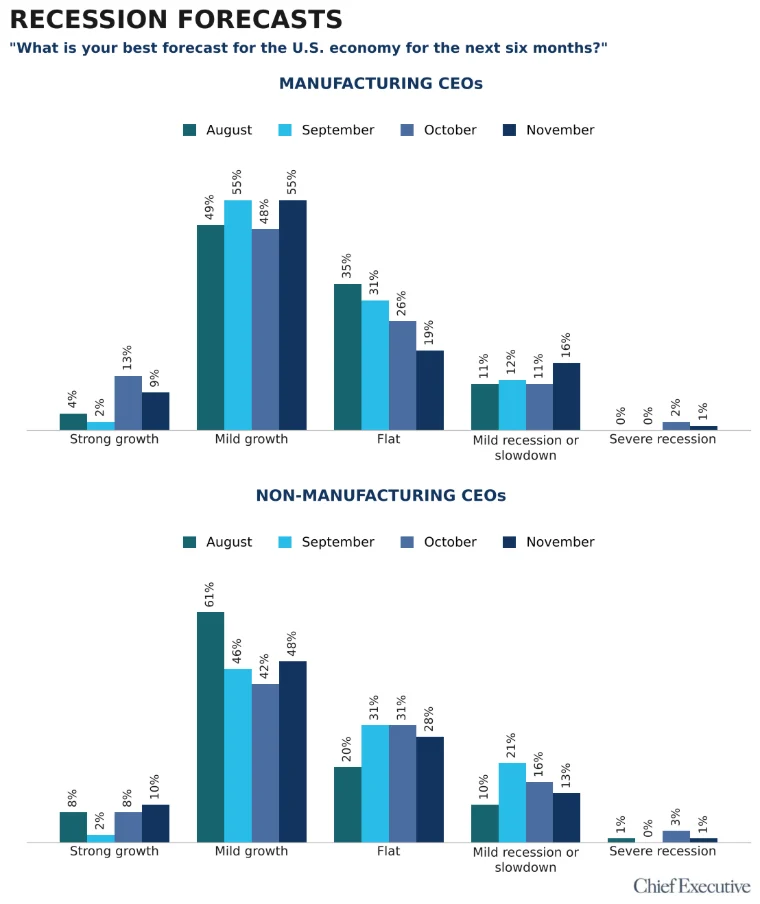
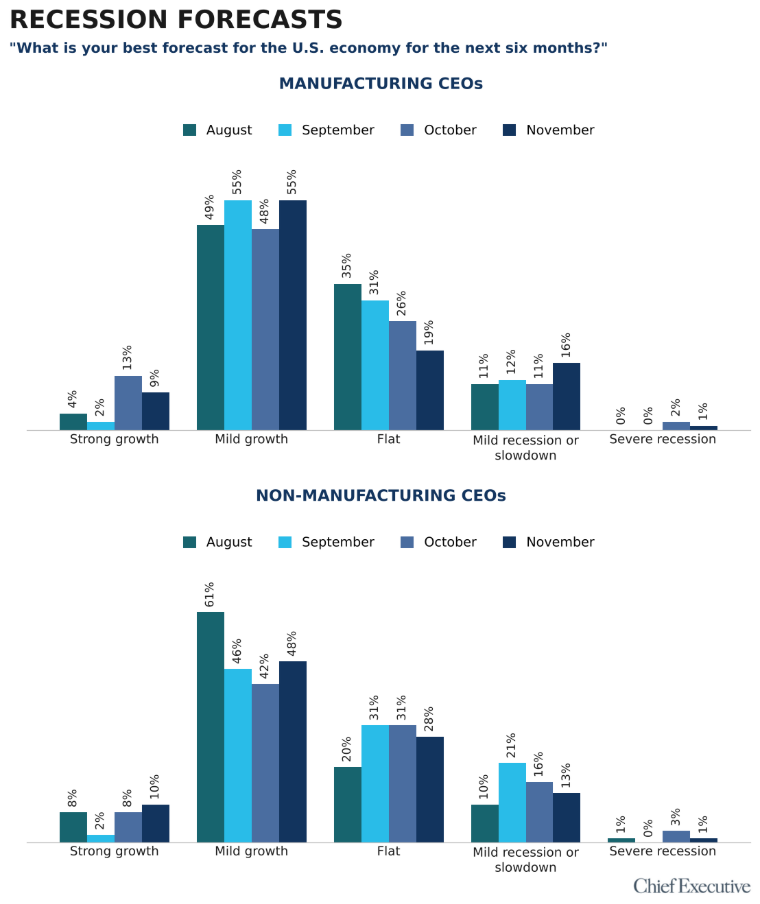
There is a notable increase in recession anxiety, with 17 percent of manufacturers forecasting a recession, up from 14 percent. However, this is largely concentrated in the consumer goods segment, where 29 percent of respondents anticipate a downturn. The broader manufacturing sector remains more bullish on growth (64 percent) than non-manufacturing counterparts (58 percent).
Conclusion: Navigating the "Wait-and-See" Era
The November 2026 CEO Confidence Index reveals a manufacturing sector that is transitionary. The initial drop in sentiment, largely driven by the pre-election fog, suggests that political certainty is a primary prerequisite for industrial confidence.
As we look toward 2027, the data suggests that the sector is entering a period of "productive caution." Manufacturers are bracing for higher operating costs and interest rate-driven headwinds, yet their willingness to increase capital spending indicates a long-term commitment to growth. The divide between consumer-facing and industrial-facing firms will likely widen, as the latter continues to benefit from secular trends in infrastructure and technology. Ultimately, the resilience of the manufacturing sector will depend on its ability to navigate the transition from a post-pandemic recovery phase to a new, higher-interest-rate equilibrium. For the modern CEO, the directive is clear: keep the balance sheet strong, prioritize efficiency over expansion, and wait for the macro data to catch up with the industrial demand.
About the Author