For decades, the career trajectory of a private equity (PE)-backed CEO was viewed as the "gold standard" for executive compensation. The narrative was seductive and straightforward: executives would trade the relative stability of a traditional corporate role for the high-stakes, high-reward environment of a PE-owned firm. By embracing aggressive performance targets and catalyzing rapid enterprise value growth, these leaders stood to capture a significantly larger slice of the financial upside.
For years, this promise held true, with PE-backed CEOs consistently commanding a massive premium over their peers in the broader private sector. However, a new comprehensive analysis from Chief Executive Group Research reveals that this historical advantage has undergone a dramatic contraction. As the gap between PE-backed compensation and the broader private-company median narrows, the executive search landscape—and the strategies used to attract top-tier talent—are facing a profound shift.
The Shrinking Gap: A Statistical Deep Dive
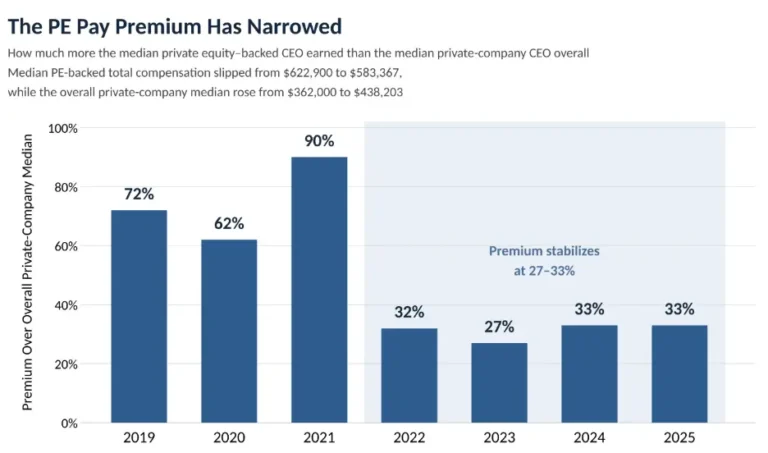
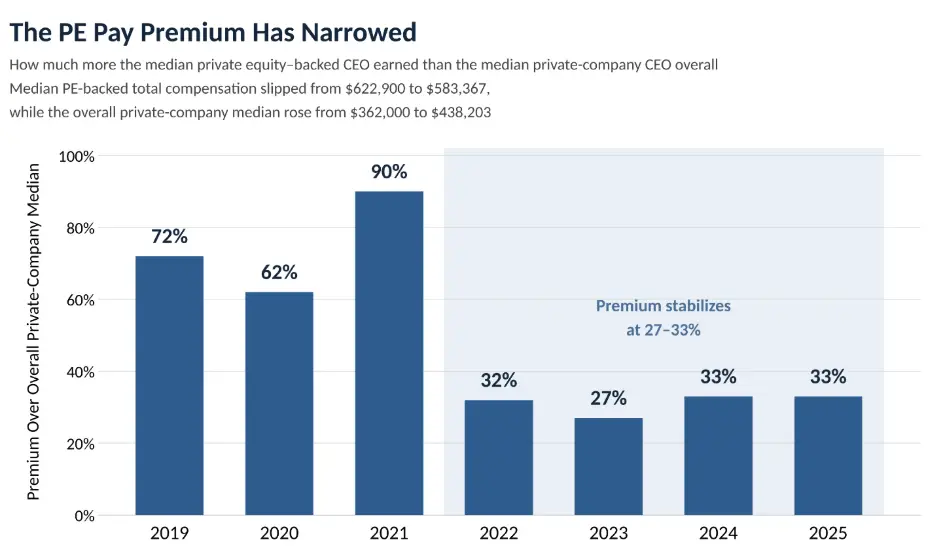
The data, spanning seven years from 2019 through 2025, suggests that the "PE premium" is no longer the vast gulf it once was. In 2019, the median CEO of a private equity-backed company earned 72 percent more than the median private-company CEO overall. By 2025, that premium had plummeted to a mere 33 percent.
This isn’t merely a case of market correction; it represents a fundamental recalibration of how executive value is being measured and rewarded. To understand the scale of this change, one must look at the raw numbers provided by the seven-year longitudinal study:
- 2019: The median PE-backed CEO earned $622,900 compared to $362,000 for the overall sample (a 72% premium).
- 2020: The premium remained robust at 62%, even amidst the onset of global economic volatility.
- 2021: The zenith of the PE premium occurred here, with PE-backed CEOs earning $844,500 against $445,000 for the broader sample—a staggering 90% gap.
- 2022: The turning point. Median PE-backed compensation fell to $546,000, slashing the premium to 32%.
- 2023–2025: A period of stabilization. The premium hovered at 27% in 2023, rising back to 33% in 2024 and maintaining that 33% level through 2025.
What these numbers demonstrate is that the pre-pandemic era of massive compensation disparities has effectively ended. While PE-backed executives still earn more, the "super-premium" that once defined the sector has been halved.
Chronology of a Market Shift: From 2019 to the Present
The evolution of these compensation figures mirrors the broader economic climate of the early 2020s.
The Pre-Pandemic Baseline (2019)
In 2019, the private equity model was firing on all cylinders. Low interest rates and a buoyant M&A environment allowed PE firms to pursue aggressive growth strategies. Compensation packages were heavily weighted toward equity, reflecting an environment where valuations were consistently trending upward.
The Pandemic Volatility (2020–2021)
The pandemic initially brought uncertainty, but 2021 proved to be an outlier year. As the economy roared back to life, transaction activity reached fever pitch. The 90% premium seen in 2021 was likely driven by a combination of rapid business recoveries and, crucially, the "paper gains" from equity appreciation. Executives who held equity in companies experiencing rapid valuation growth saw their total compensation inflate significantly.
The Post-Correction Era (2022–2025)
The sharp drop in 2022 marked the end of the "easy money" era. As interest rates climbed and market valuations cooled, the equity appreciation component of compensation packages became less reliable. The stabilization of the premium at approximately 33% suggests that we have entered a new "new normal." PE firms are no longer paying for potential in the same way they were during the post-2020 bull market; they are instead focusing on more disciplined, performance-based structures.
Analyzing the Components: Why the Premium Diminished
The critical question for human resources professionals and boards of directors is simple: Are PE firms becoming less generous, or has the nature of executive pay evolved?
The data suggests that the answer is nuanced. Total compensation is a complex cocktail of base salary, annual bonuses, benefits, perks, and—most importantly—equity grants and long-term incentive plans (LTIPs).
The Volatility of Equity Participation
Equity appreciation is the primary culprit behind the volatility observed in the data. Unlike base salary, which is relatively sticky, the value of executive equity stakes is tethered to market conditions. When business valuations rise, equity-heavy packages look magnificent. When market conditions tighten or capital becomes more expensive, those same packages can lose significant paper value.
However, even when controlling for these equity fluctuations, researchers have noted that the core premium has diminished. This indicates that PE firms are becoming more cautious in how they structure initial grants and more rigorous in their performance benchmarks.
Structural Changes in Deal-Making
There is also a shift in the philosophy of PE investment. As the competition for quality assets has intensified, the cost of acquisition has risen. To maintain internal rates of return (IRRs), PE firms are often forced to be more conservative with their "human capital" budgets. The days of offering outsized, equity-rich packages to lure top talent from the C-suite are being tempered by a need for fiscal discipline across the portfolio.
Implications for Talent Acquisition and Retention
The narrowing of this premium presents a significant challenge for private equity firms. If the financial gap between a PE-backed CEO role and a traditional private company role continues to shrink, the "allure" of the high-risk PE environment may lose its competitive edge.
The Talent War
PE-backed roles are notoriously demanding. They require a specific type of leader—one capable of executing a turnaround, scaling rapidly, or managing an exit strategy within a compressed three-to-five-year timeframe. If the financial reward for this high-pressure, high-intensity work is only marginally better than the compensation at a standard private firm, why would top-tier talent choose the PE route?
Shifting the Value Proposition
For PE firms, the implications are clear: it is time to move beyond the dollar sign.
- Transparency and Communication: Firms must become better at communicating the incentive value of their packages. Executives need to see a clear, realistic path to wealth creation, rather than being dazzled by the prospect of a high, but volatile, equity grant.
- Alignment of Outcomes: Compensation must be more tightly aligned with achievable, objective business outcomes. If the upside is lower, the risk profile must also be managed to ensure that the executive feels in control of their potential earnings.
- Holistic Compensation: Beyond cash and equity, firms should emphasize the professional growth, networking opportunities, and the prestige of "PE-backed" experience as part of the total reward package.
Conclusion: A New Era of Leadership Compensation
The era of the runaway PE compensation premium appears to be behind us. As the data from Chief Executive Group Research illustrates, the 33 percent premium represents a stable, albeit more modest, landscape.
For the CEO, the focus must shift from chasing the highest possible immediate compensation to evaluating the true value creation potential of a partnership. For the PE firm, the challenge is to craft a compensation philosophy that recognizes the current economic realities while still attracting the high-caliber leadership necessary to thrive in a competitive market.
Ultimately, the most successful firms will be those that transition from relying on the "PE premium" as a recruiting tool to building a culture of shared success, where the opportunity to create long-term, sustainable value remains the primary driver of executive talent acquisition.
For more detailed benchmarks categorized by company size, specific industry, and ownership structure, please explore the latest CEO & Senior Executive Compensation Report from Chief Executive Group Research.
About the Author