In the high-stakes world of American commerce, uncertainty is often viewed as the primary adversary of growth. For months, U.S. corporate leaders have navigated a labyrinth of shifting tariff policies, economic volatility, and unpredictable government initiatives. However, as the dust settles on the recent midterm elections, a new sentiment has emerged within the corner offices of the nation’s largest firms: a cautious, collective sigh of relief.
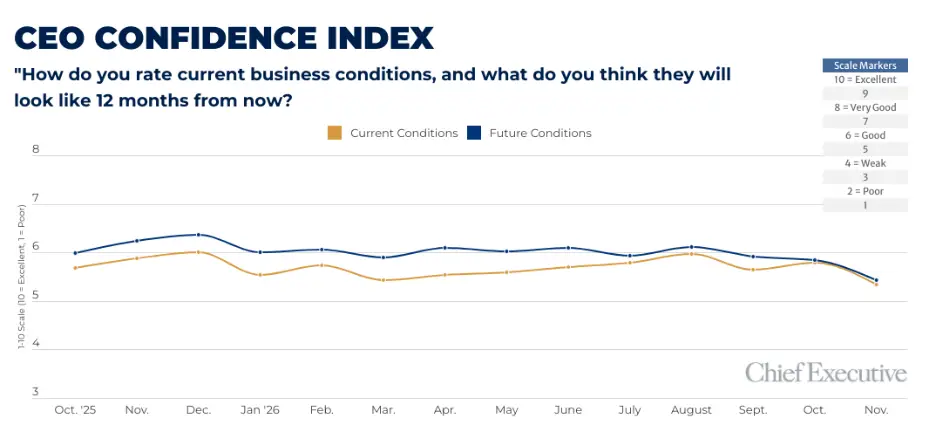
According to the latest Chief Executive Confidence Index for November, while overall business sentiment remains at a 14-month low, the immediate post-election period provided a distinct, measurable boost to morale. For many CEOs, the results of the midterms are less about partisan victory and more about the restoration of predictability. As one executive noted, “The election is over, so hopefully we can find some stability. Things should start moving again.”
Main Facts: A Tale of Two Surveys
The November survey, conducted between November 3 and November 5 among 435 U.S. CEOs, captures a snapshot of a business community in transition. The headline numbers are undeniably sobering: current business conditions were rated at 5.3 out of 10, marking an 8 percent decline from October. Similarly, the 12-month forecast fell 7 percent to 5.4.
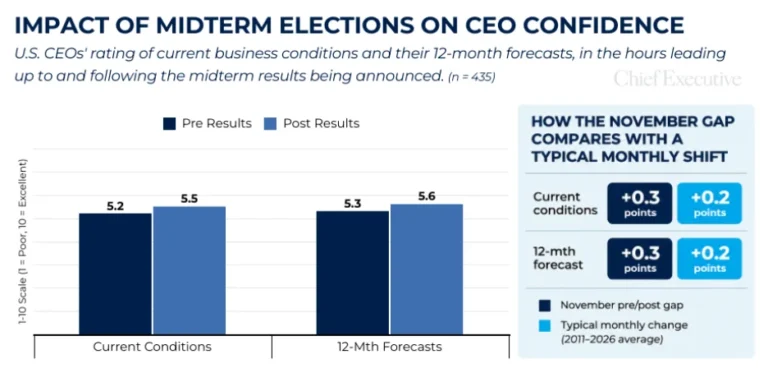
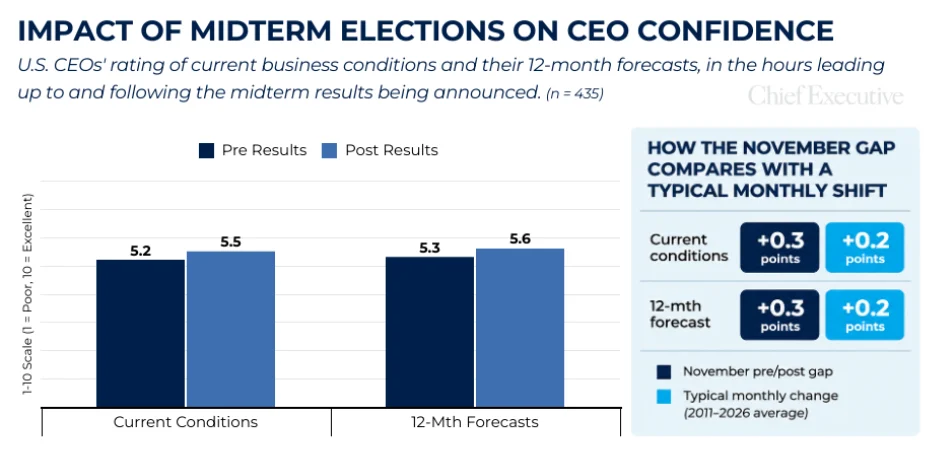
Yet, these aggregate numbers mask a fascinating divergence. By segmenting the data based on when responses were submitted—specifically before and after the midterm election results began to materialize—a clear trend emerges. CEOs who weighed in after the results were finalized provided significantly higher ratings for both current conditions (5.5) and future forecasts (5.6) compared to their counterparts who responded earlier in the week (5.2 and 5.3, respectively).
This three-tenths-of-a-point swing is statistically significant. Given that the Chief Executive Index historically fluctuates by only two-tenths of a point month-to-month, the post-election bounce suggests that clarity—regardless of the specific outcome—is the most precious commodity for corporate decision-makers.
Chronology: The Timeline of Sentiment
The trajectory of the November survey mirrors the rapid pace of the news cycle. The survey opened on November 3, just as the nation braced for the results.
- Pre-Results (November 3): Early respondents were characterized by a wait-and-see attitude. Many expressed deep frustration with the "chaotic initiatives" coming out of Washington. The prevailing sentiment was one of paralysis; business leaders were holding back capital expenditures and hiring decisions, waiting for the political landscape to clarify.
- The Inflection Point (Evening of November 3 – November 5): As results trickled in and the balance of power in Congress began to crystallize, the tone of the feedback shifted. The focus transitioned from "what will happen" to "now we know what to do."
- Post-Election Analysis: By the end of the survey period, the narrative had solidified. While some respondents remained pessimistic, fearing that the new political alignment would lead to gridlock, a larger plurality expressed relief that the period of campaigning—and the resulting market volatility—had concluded.
Supporting Data: Confidence, Growth, and Cost Pressures
Despite the dip in general confidence, the underlying data regarding corporate growth remains surprisingly resilient. CEOs are not necessarily bracing for a recession; rather, they are recalibrating their expectations for a slower, more predictable business environment.
The Growth Paradox
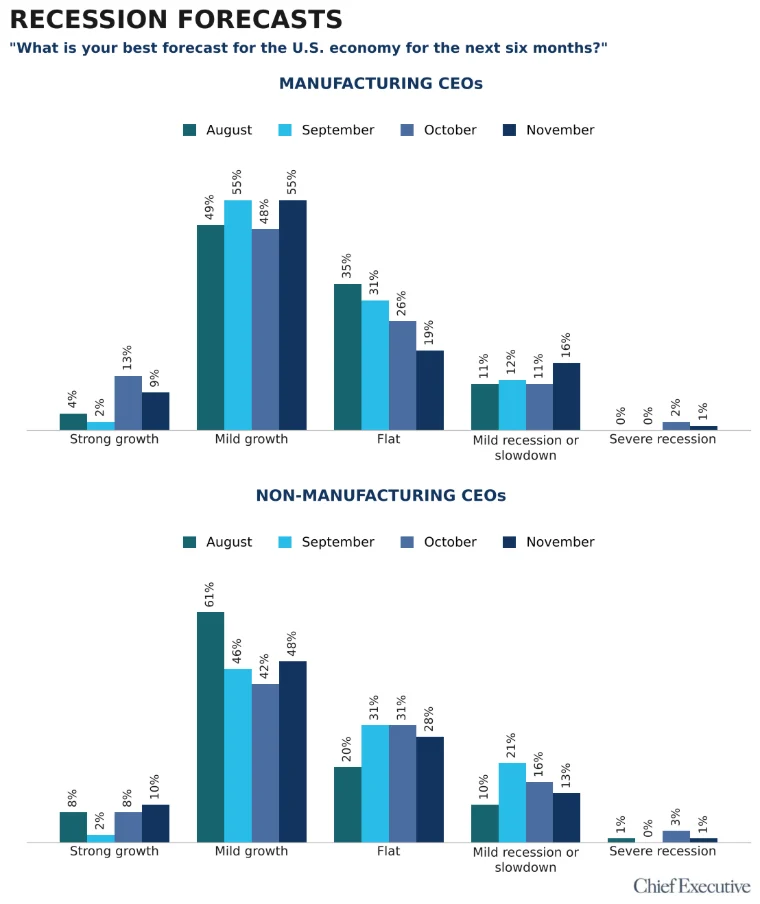
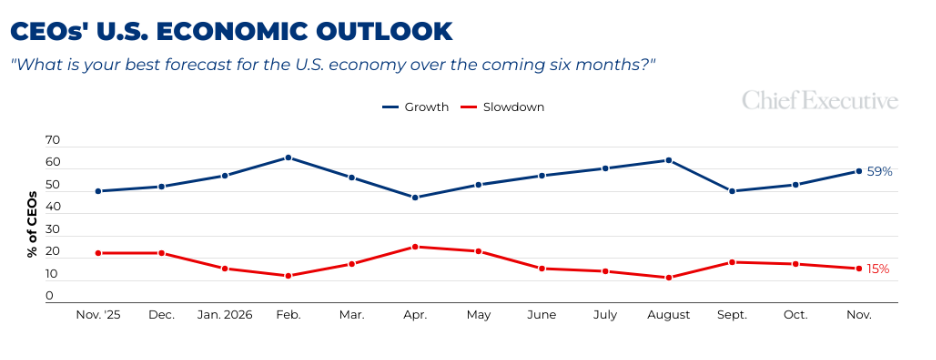
While current sentiment is at a 14-month nadir—reminiscent of the dark days of September 2025—the long-term outlook is far from apocalyptic. Six out of 10 CEOs now anticipate U.S. economic growth over the next six months, an increase from 53 percent in October. This optimism is notably higher among those who responded post-election (63 percent).
Capital and Headcount
Corporate commitment to expansion remains robust. Despite inflationary pressures and geopolitical instability, the data shows:
- Capital Spending: 54 percent of CEOs plan to increase investment in the coming year.
- Headcount: 52 percent of leaders expect to expand their workforce.
- Operating Expenses: Nearly eight in 10 CEOs expect costs to rise, though the majority anticipate these increases to remain under 10 percent, suggesting that companies have successfully priced in the current inflationary environment.
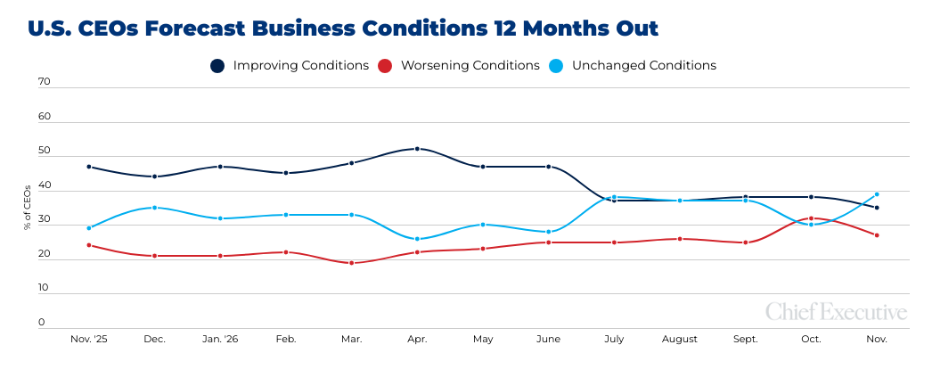
The shift toward "no change" is also telling. The number of CEOs predicting that conditions will remain flat rose from 30 percent in October to 39 percent in November. While this suggests a lack of exuberance, it also indicates a lack of panic.
Official Responses: The CEO Perspective
The qualitative data—the comments submitted alongside the numerical ratings—provides the most revealing look into the mindset of the American C-suite.
One CEO of a family-owned manufacturer encapsulated the relief felt by many: "The midterm election is over, and the balance of power is in place. At least we know what we should probably do." For this executive, the ideology of the winners mattered less than the finality of the process.
Others focused on the structural benefits of a divided or rebalanced government. "Presidential initiatives will be balanced by a more functional Congress," remarked one respondent. This reflects a deep-seated desire for checks and balances, which many CEOs believe prevents radical, disruptive policy swings that can wreak havoc on long-term planning.
However, the optimism was not universal. A vocal minority remains concerned about the legislative friction ahead. "Election results create uncertainty and gridlock," one executive lamented. Another went further, suggesting that the political environment has become inherently hostile to business growth, forecasting a sharp decline in conditions as partisan investigations take center stage.
There is also a segment of the leadership class looking outward. Some respondents expressed hope that the new political reality would lead to a thawing of international trade tensions and a more stable global footprint. "The elections will surely change the direction of the country, and we should be out of war by then," one CEO noted, linking domestic political outcomes directly to global stability.
Implications: A New Era of Pragmatism
The implications of this survey are profound for the broader economy. We are witnessing a transition from a period of "political anxiety" to one of "pragmatic adjustment."
1. The Death of the "Wait-and-See" Strategy
The primary takeaway is that the uncertainty tax has been reduced. When CEOs say, "at least we know what we should do," they are signaling a return to capital deployment. We can expect to see a thawing of the "frozen" balance sheets that characterized the months leading up to the midterms.
2. The Persistence of Operational Headwinds
Despite the post-election relief, the index remains low for a reason. The structural challenges identified in September 2025—tariff uncertainty, supply chain friction, and a cooling global economy—have not vanished. CEOs are entering 2027 with their eyes wide open, expecting higher operating expenses and a challenging margin environment.
3. The Shift in Political Expectations
The business community’s reaction highlights a departure from traditional party-line loyalty. CEOs are increasingly evaluating the political landscape through the lens of institutional stability. If a specific political outcome promises a "boring" or "stable" legislative environment, it is increasingly being rewarded by the markets and the executive class, even if that outcome does not align with their preferred tax or regulatory agenda.
4. Forecasting for 2027
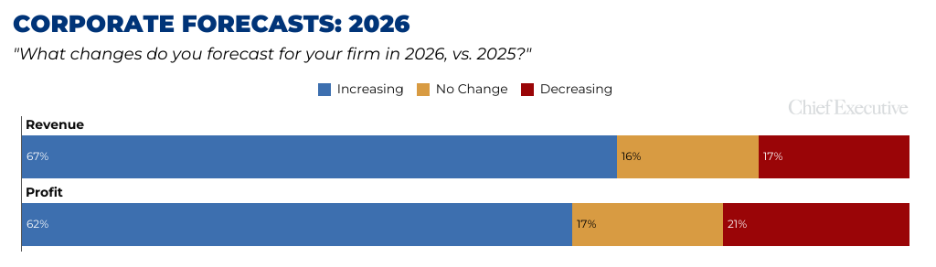
Looking ahead, the jump in expectations for revenue and profit in 2027—reaching 80 percent and 74 percent respectively—suggests that while CEOs are skeptical of the macro-environment, they are highly confident in their own operational agility. They are betting on themselves, not on Washington.
Conclusion
The November 2026 Chief Executive survey serves as a vital reminder that in the American economy, the heartbeat of business is tied as much to the rhythm of political stability as it is to the mechanics of supply and demand. The "silver lining" identified by the survey is a testament to the resilience of the American corporate sector.
While the 14-month low in confidence serves as a warning, the pivot in post-election sentiment is a signal of endurance. CEOs have learned to operate in a world of high-velocity change and high-stakes politics. As they move forward, the focus will shift away from the noise of the campaign trail and back toward the fundamentals: innovation, market expansion, and the long-term stewardship of their organizations. The midterms may not have solved the nation’s economic problems, but for the leaders at the helm of the U.S. economy, they have provided the one thing they needed most to begin: a roadmap.
About the Author