In the rapidly evolving landscape of digital finance and speculative betting, prediction markets have emerged as a significant, albeit controversial, force. Platforms like Polymarket and Kalshi, which allow users to wager on the outcomes of real-world events ranging from presidential elections to major sporting upsets, have seen a meteoric rise in popularity. By April 2026, the combined monthly trading volume on these two industry leaders had surged to nearly $24 billion, signaling a shift in how individuals engage with news, politics, and uncertainty.
As these platforms command increasing financial influence, the Pew Research Center has conducted a rigorous examination of the “prediction economy.” By analyzing the activity of 11,989 unique accounts on Polymarket over a six-week window from May 7 to June 19, 2026, researchers have pulled back the curtain on the habits, risks, and profiles of the individuals driving this multi-billion-dollar market.
The Mechanics of the Modern Speculator
Prediction markets function by allowing participants to buy and sell "shares" in the outcome of specific events. If a user predicts correctly, the value of their position rises; if they are wrong, the value drops to zero. Because these markets use stablecoins—specifically USD Coin (USDC), which is pegged 1:1 to the U.S. dollar—the barrier to entry is relatively low, and the volatility is tied to the event rather than the currency itself.
The Pew Research analysis provides the most comprehensive look yet at the "typical" user. The median participant is not necessarily a high-frequency whale or a professional hedge fund manager, but rather a more modest participant. During the six-week study period, the average trader placed 46 trades across 10 active days. Perhaps most notably, the median trade value was just $6.50, suggesting that for many, these platforms function more as a hobbyist’s tool for engagement than a primary investment vehicle.

Chronology of the Study: A Six-Week Snapshot
To understand the lifecycle of a trader’s activity, the researchers tracked nearly 12,000 accounts across 10 high-volume events. The study was structured into 15 distinct data collection points between May 7 and June 19, 2026.
- Early May: The research team sampled active wallets by identifying 10 high-interest events. These events were chosen to capture a diverse range of topics, ensuring that the findings were not skewed toward a single category like sports or politics.
- Mid-Study (Late May): As trading volume spiked in correlation with various real-world news cycles, the data confirmed that participants were highly responsive to live events.
- Late June: The final data collection concluded, allowing researchers to aggregate the total number of trades, net profits, and losses for the nearly 12,000 participants identified at the start of the study.
This methodical tracking allowed the team to filter out "noise" and focus on the sustained behavior of active users, identifying a clear divide between the casual observer and the high-volume professional-style trader.
Supporting Data: The Anatomy of Profit and Loss
One of the most striking findings from the report is the relative stability of the "average" user’s portfolio. Despite the high-stakes nature of betting on geopolitical and social outcomes, the majority of traders effectively broke even.
The Distribution of Trading Activity
While the median user is relatively quiet, there is a "power law" distribution of activity:
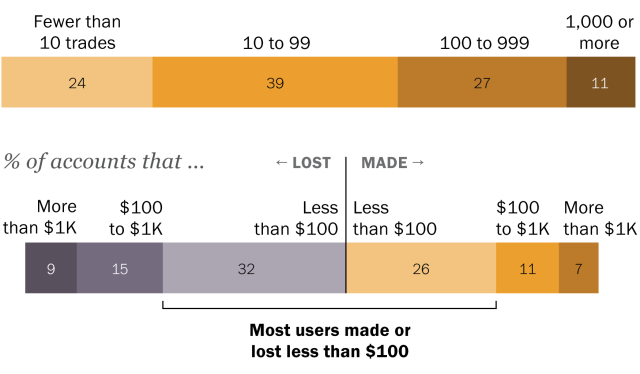
- The Casuals (24%): These users placed fewer than 10 trades over the six-week period.
- The Mid-Range (39%): These traders accounted for the bulk of the activity, placing between 10 and 99 trades.
- The Power Users (11%): A dedicated cohort of users placed over 1,000 trades in just 42 days, representing the most aggressive segment of the market.
Gains and Losses
When examining the financial outcomes, the data paints a picture of a largely zero-sum environment. Over 58% of traders either made or lost less than $100 during the study period. However, for the outliers, the volatility was significant: 9% of accounts lost more than $1,000, while 7% managed to secure profits exceeding $1,000. These figures suggest that while the platforms are accessible to the masses, they possess the capacity for significant capital redistribution.
Topic Specialization: Sports vs. Politics vs. Crypto
The research highlights a clear trend toward specialization. The "typical" Polymarket user is not a generalist; they are a specialist. On average, a user places roughly 75% of their total trades within a single category.
- Sports Traders: These are the most active cohort, with a median of 69 trades over the six-week period. They also tend to put more capital at risk, with an average trade size of $9.
- Crypto Traders: These users are frequent, with a median of 59 trades, but their average trade size is significantly smaller—less than $4.
- Politics Traders: This group is the most conservative in terms of frequency, with a median of just 13 trades. However, they demonstrate a higher average trade value ($6) than the crypto segment, reflecting the high-stakes, long-tail nature of political forecasting.
Official Responses and Industry Context
While Polymarket and Kalshi have not issued formal rebuttals to the study, the industry has long maintained that prediction markets serve a vital social function: the aggregation of information. By assigning a numerical probability to the likelihood of an event, these markets can—in theory—provide a more accurate "wisdom of the crowd" forecast than traditional polling or expert commentary.
However, the Pew Research Center’s findings serve as a necessary counterweight to this narrative. By highlighting that a significant portion of activity is driven by a small group of high-frequency traders, the research raises questions about whether these markets represent a democratic consensus or the collective bias of a specific subset of the internet-savvy population.

Implications: The Future of the Prediction Economy
The implications of this data are profound for regulators and observers alike. As prediction markets continue to integrate into the mainstream, three primary issues come to the forefront:
- Consumer Protection: With 9% of users losing over $1,000 in just six weeks, the platforms are clearly functioning as a form of high-risk gambling. The lack of traditional financial oversight on these decentralized platforms poses potential risks for less sophisticated retail users.
- Market Integrity: The fact that power users dominate the volume suggests that the "prices" on these markets are highly influenced by a small, active minority. If these users possess superior information—or simply more capital—the market’s ability to act as a neutral forecaster is potentially compromised.
- Societal Impact: As these platforms grow, they create a financial incentive for individuals to root for—or against—real-world outcomes. This "gamification" of tragedy, politics, and social change is a departure from traditional financial investing and could have unpredictable consequences for social cohesion.
In conclusion, the Pew Research Center’s analysis illuminates a burgeoning digital subculture that is as complex as it is volatile. While the "average" user remains a modest participant, the presence of highly active, high-volume traders suggests that prediction markets are becoming a sophisticated, if speculative, ecosystem. As the industry matures, the tension between its utility as an information-gathering tool and its reality as a high-risk betting arena will likely define the next stage of the prediction economy.
Kaitlyn Radde, a computational social science assistant at Pew Research Center, led the data collection and analysis for this study, providing a vital baseline for future inquiries into the digital betting landscape.
About the Author