In a comprehensive new study, the Pew Research Center has unveiled a granular look into the hearts and minds of populations living in Israel and the West Bank and East Jerusalem. Amidst the backdrop of historical volatility and the ongoing regional instability, the research seeks to answer a profound, existential question: “Do you think a way can be found for Israel and an independent Palestinian state to coexist peacefully with each other, or not?”
The report, which utilizes data from nationally representative surveys conducted in the spring of 2026, moves beyond simple binary "yes" or "no" statistics. By inviting respondents to explain their reasoning in their own words, the Center has provided a qualitative map of the anxieties, hopes, and hardened positions that define the current era of the Israeli-Palestinian conflict.
Main Facts: A Methodology of Nuance
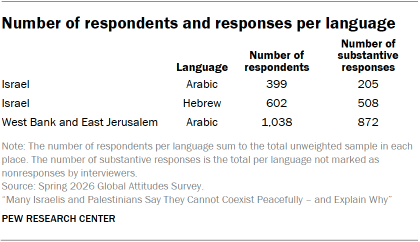
The research is built upon two distinct surveys conducted under the direction of Gallup. Between April 5 and May 6, 2026, researchers surveyed 1,001 Israeli adults. Simultaneously, from March 30 to April 28, 2026, 1,038 Palestinian adults in the West Bank and East Jerusalem were interviewed. All interviews were conducted face-to-face, ensuring that the data captures the raw sentiment of the population rather than relying on digital or telephonic polling, which can often exclude marginalized or less-connected demographics.
Crucially, the study is not intended to provide a singular, unified "opinion" of either side. Instead, it serves as a linguistic and thematic analysis of over 1,500 substantive responses. Because these responses were gathered in Arabic and Hebrew, the Center utilized cApStAn, a professional translation firm, to ensure that the nuanced, often emotionally charged language of the participants was preserved during the transition into English.
The researchers employed a rigorous "open coding" methodology. Three independent researchers analyzed the translated responses to identify recurring themes, testing their codebook against a random sample of 149 responses before proceeding to the full set. Each response was double-coded to ensure reliability, and discrepancies were reviewed and reconciled, resulting in a robust taxonomy of what citizens believe—and why they believe it.
Chronology: The Context of 2026
To understand the responses, one must look at the timeline of the survey’s development and the atmosphere in which it was administered.

- Late March – Early May 2026: The survey window. This period follows months of intense regional uncertainty. The inclusion of themes such as the war in Gaza and the impact of the October 7th attacks suggests that the respondents’ views were deeply shaped by the immediate, violent history of the preceding eighteen months.
- Methodological Development: Following the data collection, Pew researchers undertook a meticulous process of codebook development. This involved reading, categorizing, and refining the definitions of what "peace" or "conflict" means to different segments of the population.
- September 2026: The formal publication of the findings. By releasing this data, the Pew Research Center provides a benchmark for international observers to gauge the depth of the ideological divide, as well as the persistence of pockets of optimism for a diplomatic future.
Supporting Data: Themes of Division and Hope
The qualitative data reveals a stark contrast in the "codebook" of conflict. When asked if coexistence is possible, those who answered in the affirmative often cited the "inevitability of peace"—the pragmatic belief that since neither population is going anywhere, they must eventually find a way to live side-by-side to minimize harm.
The "Yes" Contingent: Pragmatism and Diplomacy
The "Yes" responses were categorized into four primary themes:
- Interest in Peace: A focus on the tangible benefits of stability, interpersonal relationships, and historical examples of past coexistence.
- Inevitability: A fatalistic view that constant warfare is unsustainable and that international pressure will eventually force a resolution.
- Diplomatic Solutions: An emphasis on the formal recognition of Palestinian statehood and the rejection of the "one-state" model in favor of a two-state framework.
- Conditionality: A significant portion of respondents added "if" to their answer. These respondents argued that peace is possible if there is a change in leadership, if both sides make compromises, or if there is significant international intervention.
The "No" Contingent: Deep-Seated Distrust
Conversely, the "No" responses were marked by themes of profound alienation and historical trauma:
- Fundamental Incompatibility: A belief that religious, cultural, and ideological differences are irreconcilable.
- Violence and Trauma: Explicit mentions of the October 7th attacks and the subsequent war in Gaza, which have created deep psychological wounds.
- Land and Occupation: For Palestinians, this often involved the material reality of the occupation, including checkpoints and settler activity. For Israelis, this often touched on the fear that a Palestinian state would serve as a launchpad for further violence.
- Distrust: A pervasive sense that the "other side" are liars, traitors, or fundamentally incapable of keeping their word.
Official Responses and Item Nonresponse
A notable feature of the study is the rate of "item nonresponse." In Israel, 20% of respondents did not provide an answer to the initial question. This figure is particularly telling when broken down by demographic: 14% of Jewish respondents declined to answer, compared to a significant 46% of Arab respondents. This high nonresponse rate among Arab citizens in Israel highlights the potential discomfort or fear associated with expressing political views on such a sensitive topic in the current climate.
In the West Bank and East Jerusalem, the nonresponse rate was lower, at 10%. However, the existence of these "silent" respondents suggests that the survey results capture the views of those most willing to engage with the discourse, potentially leaving the voices of the most cautious or fearful unrepresented.
Implications: The Path Forward
The findings of this report present a sobering picture for policymakers and international diplomats. The data suggests that the barrier to peace is not merely a lack of technical proposals or border maps; it is a profound crisis of belief.
1. The Erosion of Trust
The themes of "distrust" and "fundamental incompatibility" suggest that any future peace initiative will face a massive psychological hurdle. Diplomatic efforts that focus solely on "land for peace" may fail if they do not address the narrative of hatred and the loss of faith in the "other" that has permeated both societies.
2. The Role of Leadership
The frequent mention of "leadership" in the codebook indicates that citizens are looking to their governments to articulate a vision of the future. The current absence of such a vision, or the presence of leadership seen as actively hostile to the "other," reinforces the sentiment that peace is impossible.
3. The Necessity of Interpersonal Reconciliation
The "Interest in peace" category, which relies on interpersonal relationships as proof that coexistence can work, suggests that grassroots efforts may be more resilient than high-level diplomatic ones. When people speak from personal experience rather than abstract political ideology, they are more likely to envision a peaceful future.
4. The Burden of History
Finally, the explicit mention of October 7th and the Gaza war shows that the conflict is not static. Historical trauma is being actively used to justify the rejection of coexistence. For peace to become a viable, commonly held belief, there must be a way to address these grievances—or at least a way to prevent the cycles of violence from continually resetting the clock on public opinion.
In conclusion, the Pew Research Center’s 2026 study does not offer a solution, but it offers a mirror. It forces us to look at the complexity of a reality where the desire for peace is often overshadowed by the fear of annihilation. As the international community continues to search for a way to resolve this enduring conflict, these voices—the skeptical, the hopeful, and the cautious—remain the most important, and often the most overlooked, part of the equation.
About the Author