In a powerful demonstration of market resilience, Knight-Swift Transportation (NYSE: KNX) delivered a robust second-quarter performance that significantly outpaced Wall Street expectations. As the nation’s largest asset-based truckload (TL) carrier, Knight-Swift serves as a bellwether for the broader logistics economy. The company’s latest results suggest that the long-awaited stabilization—and subsequent tightening—of the domestic freight landscape is finally taking hold.
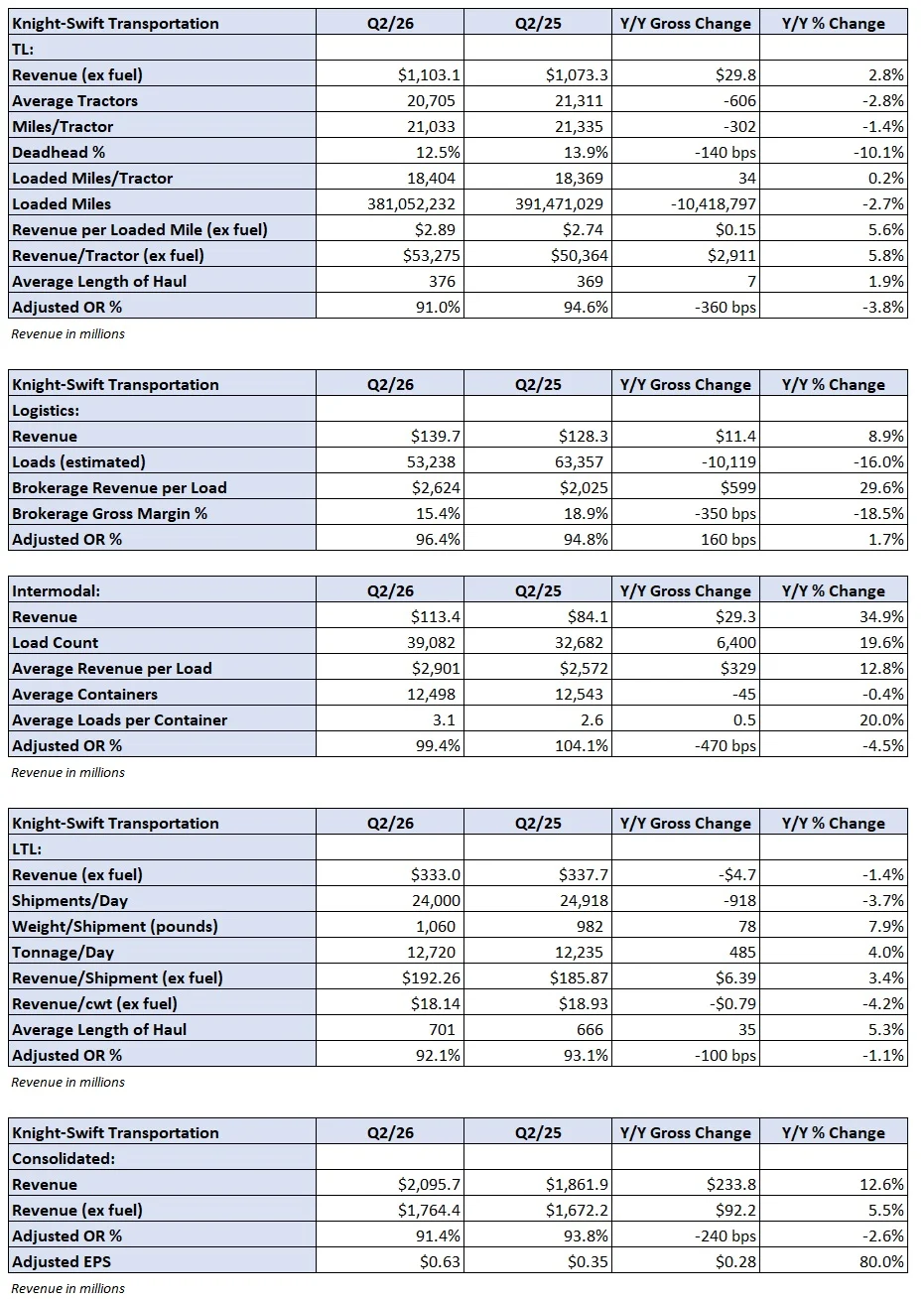
The Phoenix-based transportation titan reported adjusted earnings per share (EPS) of 63 cents, a remarkable jump of 28 cents year-over-year. This figure not only crushed analyst consensus estimates by 12 cents but also soared well above the company’s own management guidance range of 45 to 49 cents. Revenue for the quarter hit $2.1 billion, a 13% increase compared to the same period last year, further signaling that the company is effectively navigating the volatile currents of the North American supply chain.
Chronology of the Quarter: A Story of Acceleration
The narrative of Knight-Swift’s second quarter is one of accelerating momentum. According to executive commentary, the early weeks of the quarter showed moderate activity, but as the period progressed, the fundamental drivers of the truckload market shifted toward a tighter supply-demand balance.
By mid-quarter, several key metrics began to swing in favor of carriers. Tightening capacity, largely driven by supply-side constraints, allowed for significant upward pressure on spot rates. Simultaneously, tender rejection rates—a critical indicator of how much freight is being turned away by carriers due to capacity constraints—began to climb. This environment strengthened Knight-Swift’s hand during contractual negotiations, allowing the company to secure more favorable terms as the quarter closed.
This trajectory has instilled significant confidence in leadership regarding the remainder of the year. The company issued third-quarter adjusted EPS guidance of 71 to 77 cents, comfortably exceeding the 71-cent consensus estimate held by analysts at the time of the release. This bullish outlook reflects management’s belief that the current tightening cycle is not merely a temporary blip but a sustainable shift in market conditions.
Supporting Data: A Deep Dive into Operational Performance
To understand the scale of Knight-Swift’s success, one must look beneath the headline revenue figures. The company’s diversified business model—encompassing truckload, less-than-truckload (LTL), logistics, and intermodal—provides a granular view of the current industrial climate.
Truckload (TL) Segment
The core truckload division remained the company’s powerhouse, generating $1.1 billion in revenue, a 3% increase year-over-year. This growth is particularly impressive when considering that the average number of trucks in service declined by 3%. Instead, the division relied on a 6% increase in revenue per tractor, a testament to improved pricing power and operational efficiency. The unit achieved an adjusted operating ratio (OR) of 91%, an improvement of 360 basis points compared to the previous year, highlighting the company’s ability to extract more value from a leaner asset base.
Less-Than-Truckload (LTL)
The LTL segment faced a more nuanced environment. While revenue dipped 1% to $333 million, operational efficiency gains were notable. Tonnage increased by 4%, but this was offset by a 4% decline in yield. The company observed that while the number of shipments per day fell by 4%, the weight per shipment surged by 8%. While higher weights naturally exert pressure on yield metrics, Knight-Swift managed to mitigate this through a 5% increase in the average length of haul. The result was a 100-basis-point improvement in the adjusted OR, which reached 92.1%.

Logistics and Brokerage
The logistics segment saw a 9% revenue increase, with brokerage revenue per load rising by an impressive 30%. However, this growth came at a cost. Elevated purchased transportation expenses caused a 350-basis-point erosion in gross margin. Consequently, the segment’s adjusted OR stood at 96.4%, reflecting a 160-basis-point deterioration year-over-year as the company navigated a more expensive third-party capacity market.
Intermodal
Perhaps the most encouraging news came from the intermodal division, which officially returned to profitability. Recording an adjusted OR of 99.4%, the segment capitalized on a 35% revenue increase. This was driven by a 20% surge in volume and a 13% increase in revenue per load, proving that Knight-Swift’s strategy to revitalize its intermodal service is yielding tangible results.
Official Responses: Leadership Perspectives
In the wake of the earnings release, Knight-Swift CEO Adam Miller emphasized the structural changes within the market. "The second quarter saw a continued and rapid progression in truckload market conditions," Miller stated. He noted that the confluence of supply-driven tightening, rising spot rates, and increased tender rejection rates has created a more favorable environment for the company’s core business.
Management has maintained a disciplined approach to capital allocation, even as they navigate the complexities of deal-related restructuring and non-cash impairment costs. The second-quarter earnings report benefited from lower interest expenses and higher gains on equipment sales, which provided a 5-cent tailwind. These non-operating gains, combined with strong operational execution, have created a robust financial cushion for the firm.
Implications for the Broader Economy
Knight-Swift’s performance offers profound implications for the U.S. freight sector and the broader economy. As the nation’s largest asset-based carrier, the company’s ability to command higher rates and manage capacity serves as a bellwether for the industrial and retail sectors.
- Inflationary Pressures: The increase in spot rates and the rising cost of brokerage transportation suggest that the deflationary period for freight costs may be ending. Shippers should anticipate a sustained increase in transportation budgets as the market continues to tighten.
- Supply Chain Tightening: The rise in tender rejection rates indicates that capacity is becoming harder to secure. This often leads to inventory replenishment challenges for retailers and manufacturers who rely on just-in-time delivery models.
- Sector Consolidation: The performance of Knight-Swift’s diverse segments highlights the necessity of scale. Smaller carriers struggling with rising operational costs may find it increasingly difficult to compete, potentially leading to further consolidation within the trucking industry.
- Economic Health: Since freight is a derived demand, the surge in volume—particularly in the intermodal segment—suggests that underlying demand for goods remains resilient despite macroeconomic headwinds.
Looking Ahead: The Future of Freight
As the industry prepares for the final half of the year, all eyes are on the upcoming "F3: Future of Freight Festival" and associated industry symposiums. These events will serve as a gathering point for leaders to discuss the implications of this earnings season and the path forward.
The issues facing the sector—fraud exposure, carrier liability, FMCSA regulatory updates, and the persistent threat of cargo theft—are no longer just operational concerns; they are critical boardroom issues that define long-term viability. As Knight-Swift demonstrated, companies that can balance these risks while maintaining operational excellence are the ones best positioned to thrive in an increasingly complex logistics environment.
For investors and industry participants alike, the second quarter of 2026 marks a turning point. The industry has moved past the "recovery" phase and into a "tightening" phase, characterized by higher pricing power for carriers and a more challenging environment for shippers. Knight-Swift’s ability to deliver against this backdrop is a powerful testament to its operational maturity and strategic foresight. As we head toward the end of the year, the focus will remain on whether this supply-driven tightness can be sustained, or if macroeconomic factors will intervene to temper the current momentum. For now, however, the road ahead for Knight-Swift looks remarkably clear.
About the Author