In a move that signals a profound transformation in its corporate philosophy, Tesla Inc. has officially pledged to achieve net-zero emissions across its global operations and value chain by 2040. This announcement, detailed in the company’s 2025 Impact Report, marks the first time the world’s most valuable automaker has tethered its environmental aspirations to a specific, time-bound deadline.
For a company that has long positioned itself as the vanguard of the renewable energy revolution, the absence of a formal net-zero target had become an increasingly conspicuous gap in its corporate governance. By setting a 2040 finish line, Tesla is not only aligning itself with the more ambitious end of the Paris Agreement goals but is also challenging the traditional automotive industry to accelerate its own decarbonization efforts.
Main Facts: A Paradigm Shift in Corporate Strategy
The 2040 net-zero commitment represents more than just a date on a calendar; it signifies a departure from Tesla’s historical skepticism toward standardized environmental, social, and governance (ESG) frameworks. For years, CEO Elon Musk has been a vocal critic of ESG metrics, famously labeling them "the Devil Incarnate" and "a scam" that rewards companies for superficial compliance while ignoring the actual environmental impact of their products.
The Scope of the Commitment
Tesla’s new strategy is built on three primary pillars:
- Net Zero by 2040: A company-wide goal encompassing Scope 1, 2, and 3 emissions.
- Renewable Operations: A pledge to achieve 100% renewable electricity usage across all global operations "well before" the 2040 deadline.
- Supercharger Decarbonization: A continued commitment to match the electricity load of the global Supercharger network with 100% renewable energy.
Furthermore, Tesla has announced it will align its future climate reporting with the standards set by the IFRS Foundation’s International Sustainability Standards Board (ISSB). This move is particularly significant, as it suggests Tesla is moving away from its idiosyncratic reporting style toward a more transparent, comparable format that institutional investors have long demanded.
The "Avoided Emissions" Philosophy
Despite this shift toward operational accountability, Tesla maintains its core argument: the primary value of an EV company should be measured by the emissions its products prevent. In its latest report, Tesla estimates that its fleet avoided approximately 37 million metric tons of CO2 equivalent (tCO2e) in 2025 alone. The company calculates that each Tesla vehicle avoids an average of 32 tCO2e over its lifetime compared to an internal combustion engine (ICE) equivalent.
Chronology: The Evolution of Tesla’s Climate Disclosures
To understand the weight of the 2040 pledge, one must look at the evolution of Tesla’s relationship with climate reporting over the last decade.
- 2010–2018: The Product-Centric Era. During its early growth phase, Tesla focused almost exclusively on the "mission" of accelerating the transition to sustainable energy. Formal emissions reporting was minimal, as the company argued that its very existence was a net benefit to the planet.
- 2019–2021: Rising Pressure. As Tesla’s market capitalization soared, institutional investors began demanding more rigorous data. While the company released annual "Impact Reports," they lacked the standardized metrics used by competitors. During this period, Tesla famously remained a holdout from the CDP (formerly the Carbon Disclosure Project), a stance it maintains today.
- 2022: The Scope 3 Breakthrough. For the first time, Tesla disclosed its Scope 3 emissions—the indirect emissions that occur in a company’s value chain, including the mining of raw materials and the end-of-life treatment of products. This was a pivotal moment, as Scope 3 typically accounts for the vast majority of an automaker’s footprint.
- 2023–2024: Incremental Steps. Tesla began discussing reduction plans for its manufacturing facilities (Gigafactories) and battery supply chains but stopped short of setting a hard deadline for total decarbonization.
- 2025: The 2040 Pledge. The current Impact Report codifies the 2040 target, positioning Tesla ahead of many traditional rivals who have targeted 2050 for net-zero status.
Supporting Data: The Emissions Reality
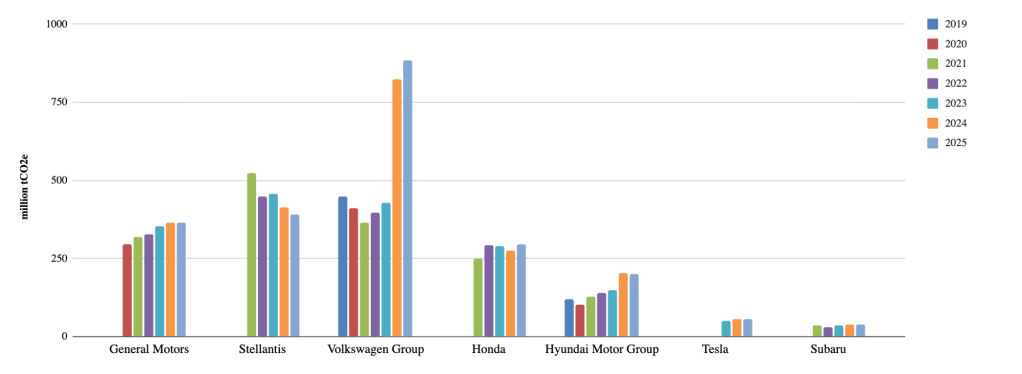
While the 2040 target is ambitious, Tesla’s current data highlights the immense scale of the challenge. As the company has scaled production to millions of vehicles per year, its absolute emissions have naturally followed an upward trajectory.
Current Emissions Profile (2023–2025 Trends)
According to the latest figures, Tesla’s operational footprint is expanding alongside its market share:
- Scope 1 (Direct Operations): Emissions from manufacturing and direct fuel use have grown by 43% since 2023. This is largely attributed to the ramp-up of new production lines at Giga Texas and Giga Berlin.
- Scope 2 (Purchased Electricity): These emissions have surged by 80%. While Tesla is increasing its use of renewables, the sheer volume of power required to run massive industrial complexes continues to outpace its current green energy procurement in certain regions.
- Scope 3 (Value Chain): At 56 million metric tons of tCO2e, Scope 3 represents the lion’s share of Tesla’s footprint. This figure is up 14% year-over-year, reflecting the carbon-intensive nature of battery mineral extraction and steel production.
The Efficiency Paradox
Despite rising absolute emissions, Tesla remains one of the most efficient manufacturers on a per-vehicle basis. Data from the International Council on Clean Transportation (ICCT) ranked Tesla at the top of its 2025 automaker ratings, citing its superior drivetrain efficiency and the high percentage of renewable energy used in its primary battery assembly plants.
However, data provided by DitchCarbon, a specialist Scope 3 platform, indicates that Tesla is not unique in this struggle. Across the automotive sector, value-chain emissions are rising as manufacturers transition from small-scale EV production to mass-market output. The "embodied carbon" in an EV—the emissions generated before the car even hits the road—remains higher than that of a traditional gasoline car, primarily due to the battery.
Official Responses and Expert Critique
The reaction to Tesla’s 2040 pledge has been a mix of cautious optimism and pointed criticism. While the commitment is welcomed, climate policy experts highlight several missing components.
The NewClimate Institute’s Perspective
Frederic Hans, a senior climate policy advisor at the NewClimate Institute, notes that while the target is a positive step, the "how" remains dangerously vague. "We agree that traditional target-setting frameworks centered on absolute emission reduction can disadvantage innovators entering a market while favoring incumbents," Hans stated.
However, Hans argues that Tesla’s refusal to set "transition targets" is a weakness. Transition targets involve specific goals for the procurement of low-carbon materials, such as "green steel" or "green aluminum." In a 2025 study, the NewClimate Institute found that while legacy companies like Ford and General Motors have set specific targets for sustainable steel and aluminum, Tesla has yet to follow suit.
The "Near-Term" Gap
A major point of contention among analysts is Tesla’s lack of a 2030 interim goal. Most climate scientists and the Science Based Targets initiative (SBTi) argue that without a significant reduction goal for the current decade, a 2040 or 2050 target is essentially a "kick-the-can" exercise. Tesla has not yet provided a year-by-year roadmap for how it will bend the curve of its rising Scope 1 and 2 emissions.
Implications: The Road to 2040
Tesla’s commitment to net zero by 2040 has profound implications for the global supply chain, the energy sector, and the competitive landscape of the automotive industry.
1. Decarbonizing the Supply Chain
To hit its 2040 goal, Tesla must solve the "Scope 3 Problem." This means fundamentally changing how lithium, nickel, and cobalt are mined and processed. We can expect Tesla to deepen its vertical integration, potentially investing directly in "green mining" technologies or refineries that use geothermal or solar power rather than fossil fuels. The company’s lithium refinery in Texas is a precursor to this strategy.
2. The Green Steel Challenge
Steel and aluminum are the second-largest contributors to an EV’s manufacturing footprint after the battery. Tesla’s move toward the "Cybertruck" and other stainless-steel intensive designs creates a massive demand for high-grade metals. Achieving net zero will require Tesla to lead the transition toward hydrogen-based steelmaking or other carbon-neutral smelting processes, likely through long-term "offtake" agreements that provide the financial certainty needed for metal producers to decarbonize.
3. Pressure on the Global Grid
Tesla’s commitment to matching Supercharger load with renewables puts it in a unique position as both an energy consumer and an energy provider. As the network grows, Tesla will likely become one of the world’s largest purchasers of Power Purchase Agreements (PPAs). This creates a "flywheel effect" where Tesla’s growth directly finances the construction of new solar and wind farms globally.
4. A New Standard for "Incumbents"
By setting a 2040 date, Tesla has effectively shortened the timeline for the entire industry. If the most valuable carmaker in the world claims it can reach net zero in 15 years, it becomes increasingly difficult for legacy automakers to justify 2050 targets. This could lead to a "race to the top" in climate ambition, driven by investor pressure and regulatory requirements in the EU and California.
5. Transparency and Governance
The alignment with IFRS standards suggests that Tesla is preparing for a new era of regulatory scrutiny. As the SEC in the United States and the CSRD in Europe mandate more rigorous climate disclosures, Tesla’s pivot ensures it remains "investable" for ESG-focused funds, which manage trillions of dollars in assets.
Conclusion
Tesla’s 2040 net-zero pledge is a landmark moment that bridges the gap between Elon Musk’s "disruptor" ethos and the practical realities of global climate governance. While the company’s emissions are currently rising—a byproduct of its meteoric growth—the establishment of a time-bound goal provides a yardstick by which the company can finally be held accountable.
The challenge ahead is Herculean. Decarbonizing a global supply chain that spans from Australian mines to German factories requires more than just innovation; it requires a systemic overhaul of industrial processes that have remained unchanged for a century. However, if any company has proven it can rewrite the rules of an industry through sheer force of will and engineering prowess, it is Tesla. The world will be watching to see if 2040 is a genuine destination or merely a distant horizon.
About the Author