The global supply chain is currently traversing one of its most volatile periods in recent memory. Beset by macroeconomic instability, shifting consumer demand, and the transformative pressure of artificial intelligence (AI), the warehousing and distribution sector has reached a definitive inflection point. As organizations struggle to reconcile ambitious long-term growth strategies with the unforgiving realities of daily operations, the industry is being forced to rewrite its playbook.
These findings emerge from the 23rd annual "DC Measures" report, a comprehensive industry study conducted by the Warehousing Education and Research Council (WERC) in partnership with DC Velocity. The report paints a picture of a sector in transition—one where the traditional metrics of success are being tested by a new set of digital and economic variables.
Main Facts: The Great Disconnect
At the heart of the current warehouse dilemma lies a growing "strategic gap." The WERC report highlights a palpable tension between the executive suite’s vision for the future and the tactical reality on the warehouse floor.
Organizations are currently juggling three competing pressures:
- Cost Containment: With profit margins tightening, facilities are under immense pressure to reduce operational overhead without compromising throughput.
- Flow Efficiency: Maintaining the velocity of goods remains a primary goal, yet global disruptions have made predictable supply chains a luxury of the past.
- Customer Expectations: As e-commerce continues to normalize rapid, transparent delivery, the cost of failing to meet customer expectations has never been higher.
The report reveals that this "triple threat" has created a disconnect. While companies have stated strategies—such as digital transformation or sustainability—the operational focus remains locked on reactive firefighting. This suggests that the current "warehouse playbook" is no longer aligned with the agility required in the 2020s.
Chronology: From Stability to Volatility
To understand the current state of the industry, one must look at the evolution of logistics over the last decade.
- 2015–2019: The Efficiency Era. During this period, the focus was largely on lean operations and the optimization of existing workflows. Metrics were stable, and the primary driver was cost reduction through incremental automation.
- 2020–2022: The Pandemic Disruption. The global health crisis shifted the priority from cost-efficiency to survival and capacity. "Just-in-time" inventory models were abandoned for "just-in-case" strategies, causing a ballooning of inventory metrics that the industry is still working to recalibrate.
- 2023–2024: The AI Awakening. The rapid emergence of generative AI and machine learning tools began to change the conversation. Data moved from being a byproduct of operations to the primary asset for forecasting and labor management.
- 2025–2026: The Inflection Point. Today, we are in a phase of "Strategic Re-evaluation." The "DC Measures" report indicates that firms are no longer looking for mere incremental improvements but are instead questioning the fundamental metrics they use to define a "successful" warehouse.
Supporting Data: The Metrics of Change
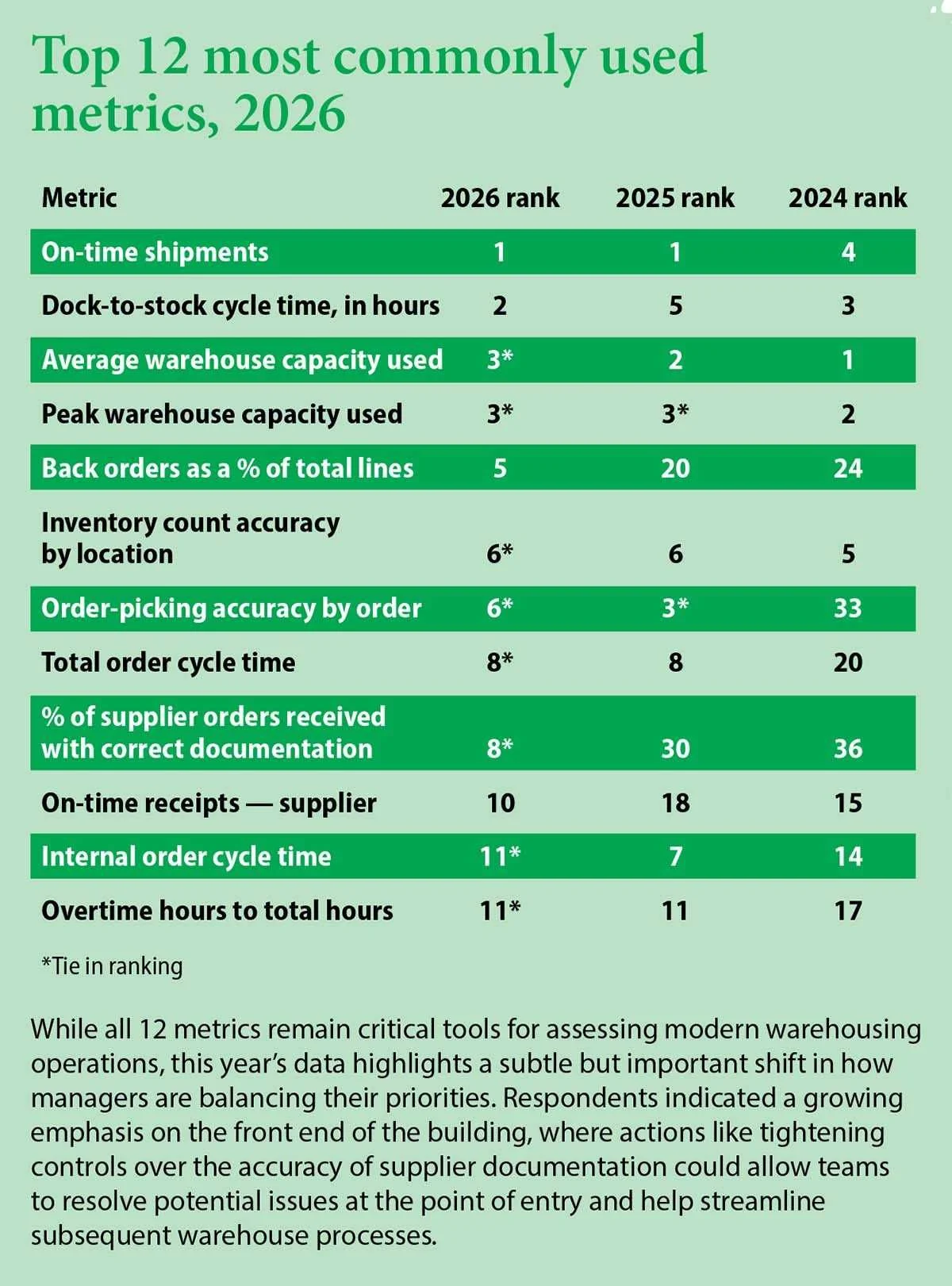
The "DC Measures" study is widely regarded as the definitive benchmark for the industry. By surveying members of WERC and readers of DC Velocity, the study tracks how facilities perform across critical key performance indicators (KPIs).
The Key Performance Categories
The report breaks down metrics into five distinct categories:
- Customer Metrics: Tracking order fill rates, on-time delivery, and perfect order percentages.
- Operational Metrics: Measuring throughput, inventory turnover, and storage capacity utilization.
- Financial Metrics: Focusing on the cost of storage, labor costs as a percentage of sales, and total distribution costs.
- Quality Metrics: Identifying error rates and return processing efficiency.
- Cycle Time Metrics: Assessing how quickly a product moves from receiving to shipping.
The 2026 data reveals that while traditional metrics like "order accuracy" remain high, the cost to achieve those results is rising at an unsustainable rate. Interestingly, the report shows that firms using AI-enabled forecasting tools are beginning to see a divergence in performance, with early adopters managing to decouple cost increases from throughput volatility more effectively than their peers.
Official Perspectives: Expert Analysis
The rigor behind this year’s data collection ensures its relevance for logistics professionals. The study was spearheaded by Donnie F. Williams Jr., an associate professor at the University of Arkansas, and Dr. Karl B. Manrodt, a professor of logistics at Georgia College & State University.

Their analysis underscores that the challenge is not a lack of data, but a lack of synthesis. "Organizations are drowning in metrics," Dr. Manrodt has noted in previous discussions regarding the study. "The difficulty lies in deciding which metrics are ‘vanity’ metrics and which are truly ‘strategic’ metrics that drive decision-making in an AI-integrated environment."
The partnership between WERC and DC Velocity serves as a bridge between the academic rigors of supply chain management and the practical, day-to-day hurdles faced by warehouse managers. The full 2026 results, available at werc.org/metrics, provide a granular look at how specific sectors—from cold storage to apparel—are adjusting their benchmarks to stay competitive.
Implications: The Future of Warehouse Strategy
The findings of the 23rd annual report carry several profound implications for the industry.
1. The Death of the "One-Size-Fits-All" Metric
The era of relying on a standard set of warehouse KPIs is ending. As facilities become more specialized—handling everything from fragile electronics to oversized furniture—the metrics must become customized. Organizations that fail to tailor their benchmarks to their specific business model will likely find themselves over-investing in the wrong areas.
2. AI as a Strategic Partner, Not a Tool
The most successful organizations identified in the report are those that have moved past using AI for simple task automation. Instead, they are integrating AI into their strategic planning. This means using predictive analytics to reconfigure warehouse layouts dynamically based on seasonal trends or real-time labor availability.
3. Bridging the "Execution Gap"
To resolve the disconnect between strategy and operations, leadership teams must foster better communication between the C-suite and the warehouse floor. Strategies that look good in a boardroom often fail because they do not account for the physical constraints of the facility. The "DC Measures" report suggests that the most successful firms are those that incorporate operational feedback into their high-level growth strategies early in the planning phase.
4. Human Capital in the Age of Automation
Perhaps the most significant, though often overlooked, implication of the study is the changing nature of warehouse labor. As AI takes over routine data analysis and process oversight, the role of the warehouse worker is shifting toward high-level problem-solving. Companies that treat their workforce as a strategic asset—investing in training for AI-integrated systems—are seeing higher retention rates and better performance across the board.
Conclusion: A Call to Action
The 23rd "DC Measures" report is more than a collection of data; it is a wake-up call. The volatility of the current market is not an anomaly—it is the new baseline. As the industry moves forward, the "playbook" cannot be a static document. It must be a dynamic, data-driven framework that allows for rapid pivots in the face of economic uncertainty.
For logistics managers and executives, the path forward is clear: audit your current metrics, identify where they diverge from your company’s long-term strategy, and leverage the latest in AI and operational technology to bridge that gap. The facilities that win in the next decade will not necessarily be the ones with the most advanced robots, but the ones with the most advanced strategies—those that can successfully translate high-level business goals into precise, actionable, and sustainable operational reality.
For more detailed performance data and to benchmark your facility against industry peers, visit the full 2026 "DC Measures" report at werc.org/metrics.
About the Author