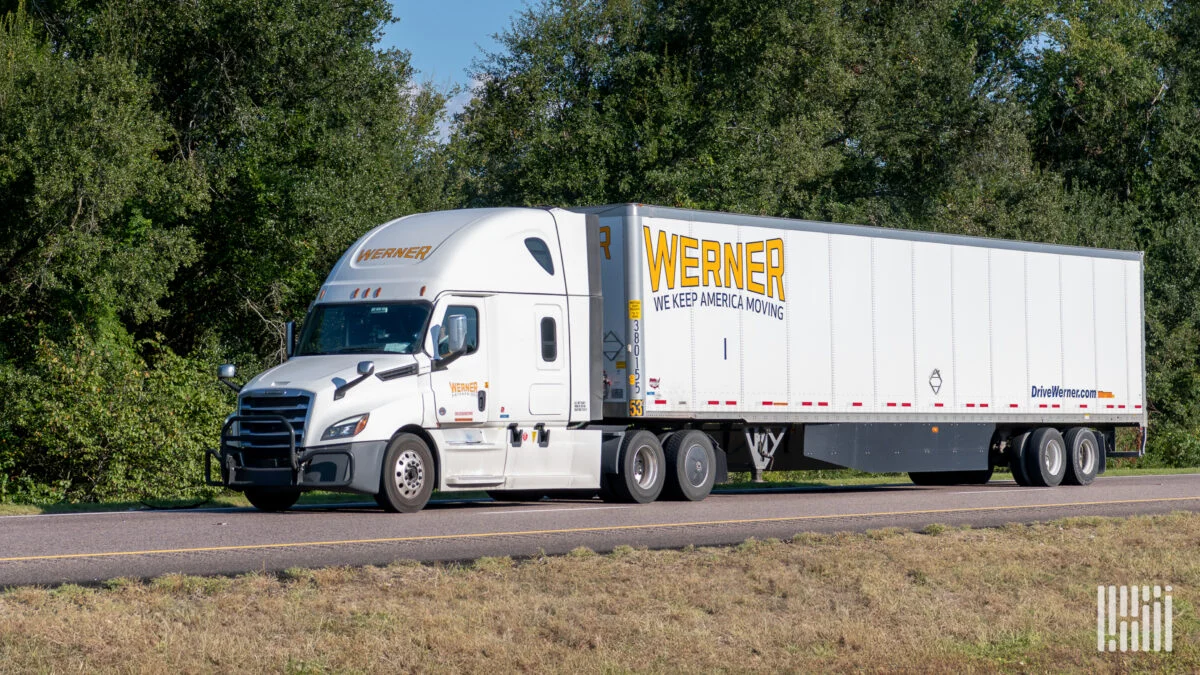
In a landscape defined by years of industry volatility, Werner Enterprises (NASDAQ: WERN) has emerged as a bellwether for the trucking sector’s recovery. Following the release of its second-quarter 2026 earnings on Tuesday, the Omaha-based carrier has solidified its position as a "pure play" leader, delivering a report that suggests the long-awaited freight cycle upturn is finally gaining momentum.
For CEO Derek Leathers, the earnings report serves as both a validation of strategic foresight and a signal of shifting tides within the North American supply chain. With the company’s stock having surged roughly 54% year-to-date prior to a recent market-wide cooling, the pressure on Werner to deliver tangible growth was significant. The results provided just that, marked by improved margins and a bullish outlook for the remainder of the year.
The Evolution of the Freight Cycle: A Chronology of Anticipation
The current state of the trucking market did not happen overnight; it is the culmination of a multi-year "cleansing" process. During Werner’s second-quarter earnings call in 2025, Leathers famously positioned himself as a contrarian, suggesting that the industry’s recovery would be driven more by a systemic contraction of supply than by a sudden surge in demand.
A year later, Leathers’ "supply-driven up-cycle" thesis appears to have been remarkably accurate. Reflecting on the past 12 months, the company has navigated a turbulent macroeconomic environment to arrive at a point of relative stability and growth.
"We’ve said all along, we think it’s going to be a supply-driven up cycle, if you will, more than demand," Leathers reiterated during this week’s call. He characterized the current state of the industry as being only in "the third inning" of a structural shift. This shift, he noted, is the direct result of thousands of drivers and small carriers exiting the market, unable to sustain operations amidst mounting regulatory and economic pressures.
Regulatory Pressure and the "Shadow Capacity" Crackdown
A central theme of the 2026 report is the role of federal oversight in thinning the ranks of available carriers. Leathers specifically pointed to the intensifying regulatory environment—specifically regarding non-domiciled Commercial Driver’s Licenses (CDLs), stricter English language proficiency enforcement, and rigorous crackdowns on cabotage.
However, perhaps the most critical factor in the current supply squeeze is the Federal Motor Carrier Safety Administration’s (FMCSA) systematic withdrawal of Electronic Logging Device (ELD) approvals. By purging substandard or non-compliant devices, the FMCSA is effectively dismantling "shadow capacity"—unregulated or poorly monitored carriers that previously undercut rates and distorted market data. Leathers noted that roughly one-third of all ELD options are either gone or currently on the way out, a development that is compounding structural supply contractions and forcing a more disciplined market.
"Enforcement efforts are continuing," Leathers remarked. "In our view, greater agency collaboration and the exchange of data, combined with the utilization of technology, will further accelerate enforcement from here."
Liability Risks and the "Post-Montgomery" Landscape
The shift in market dynamics is further exacerbated by the legal environment. The fallout from the landmark Montgomery vs. Caribe decision has fundamentally changed how shippers and brokers interact with carriers. Recent high-profile litigation—most notably a massive nuclear verdict against C.H. Robinson handed down by a Dallas jury—has sent shockwaves through the industry.
For a carrier like Werner, which prides itself on safety, compliance, and a long-standing reputation, this shift acts as a powerful tailwind. Shippers are increasingly abandoning low-cost, high-risk, small-scale carriers in favor of established, institutional players who can guarantee safety and mitigate liability.
"Montgomery has resulted in shippers and brokers taking an even more cautious view of who they do business with," Leathers said. "That plays directly into Werner’s strengths, given our strong track record and reputation."
Supporting Data: Operational Performance Metrics
The financial data released on Tuesday paints a picture of a company optimizing its core operations. Werner’s adjusted operating margin for its total trucking operations climbed to 4.6%, a significant improvement over the 2.5% reported a year prior.
The most striking highlight, however, was the performance of the One-Way segment. While the Dedicated segment remains the company’s revenue engine—generating $434 million compared to One-Way’s $138 million—the growth in the One-Way division is telling. Revenue per truck per week in the One-Way segment surged from $4,787 in the second quarter of 2025 to $6,114 in the most recent quarter.
This dramatic jump serves as evidence that Werner is successfully squeezing higher yields out of its assets. By contrast, the Dedicated segment, which is inherently more stable, saw a more moderate rise in revenue per truck per week, moving from $4,542 to $4,789.
The Impact of the FirstFleet Acquisition
A critical component of this year’s growth is the integration of FirstFleet, which Werner acquired for $245 million earlier this year. This acquisition expanded Werner’s footprint significantly, bringing the total number of trucks in the Dedicated segment to 6,976, up from 4,855 in the same period last year.
Leathers expressed confidence in the integration process, noting that synergy realization is currently ahead of schedule. With a 98% customer renewal rate on the vast majority of the acquired portfolio, the acquisition appears to be a major success in bolstering Werner’s market share in the reliable, dedicated-service sector.
Expert Analysis: The Road to Margin Expansion
Despite the optimistic tone, the market remains cautious. Ariel Rosa, an analyst with Citi, noted in a post-earnings assessment that while the results were solid, they reflect a company still in the midst of a transition. With an adjusted operating ratio of 97%, Werner is still contending with the operational costs inherent in its ongoing restructuring and cost-cutting initiatives.
The market, however, is clearly looking ahead. Werner has revised its 2026 forecast upward, signaling management’s belief that the most difficult days of the cycle are behind them. The company now expects Dedicated revenue per truck per week to grow by 3% to 5%, a step up from its previous guidance of flat-to-3% growth. Furthermore, revenue per truck per mile is projected to grow by 10% to 13%, a massive increase over the original 1% to 4% forecast.
Implications for the Future: A Tightening Labor Market
As the market tightens, the battle for high-quality drivers has become the next major hurdle. Werner continues to lean on its Roadmaster Drivers School to maintain its talent pipeline, though Leathers admitted that recruiting is becoming increasingly difficult.
"Clearly, qualified driver hires are more difficult as we look forward," Leathers stated. "The market is tightening."
The company is pivoting its recruitment strategy to focus on two fronts: the internal training of new drivers and the aggressive poaching of experienced professionals. By emphasizing the lifestyle benefits of its Dedicated operations—which often offer more frequent home time than traditional over-the-road (OTR) roles—Werner hopes to position itself as an employer of choice in an era of labor scarcity.
"We’ve got the right kind of jobs to be positioned in the market today, and we’re going to continue to lean into that," Leathers concluded.
Conclusion: A New Normal
Werner’s second-quarter earnings provide a clear narrative: the trucking industry is moving away from the chaotic, oversupplied environment of the post-pandemic era toward a more disciplined, regulatory-heavy, and high-stakes landscape. For Werner Enterprises, the strategy of focusing on dedicated operations, leveraging regulatory tailwinds, and prioritizing asset productivity seems to be paying dividends.
As the "third inning" of this cycle continues, the company’s ability to maintain its margin expansion and successfully integrate its new acquisitions will be the true test. For now, however, the numbers speak for themselves: Werner has successfully navigated the downturn, and the road ahead looks increasingly clear.
About the Author