In a significant leap forward for industrial automation, global logistics titan FedEx Corp. has officially announced the expansion of its pilot program utilizing autonomous trailer loading systems. Partnering with robotics innovator Dexterity Inc., FedEx is transitioning from limited testing to a production-level deployment at its Hagerstown Hub in Maryland. This move marks a pivotal shift in how the world’s largest parcel carriers address one of the most persistent bottlenecks in the supply chain: the physically demanding, error-prone, and labor-intensive process of loading trailers.
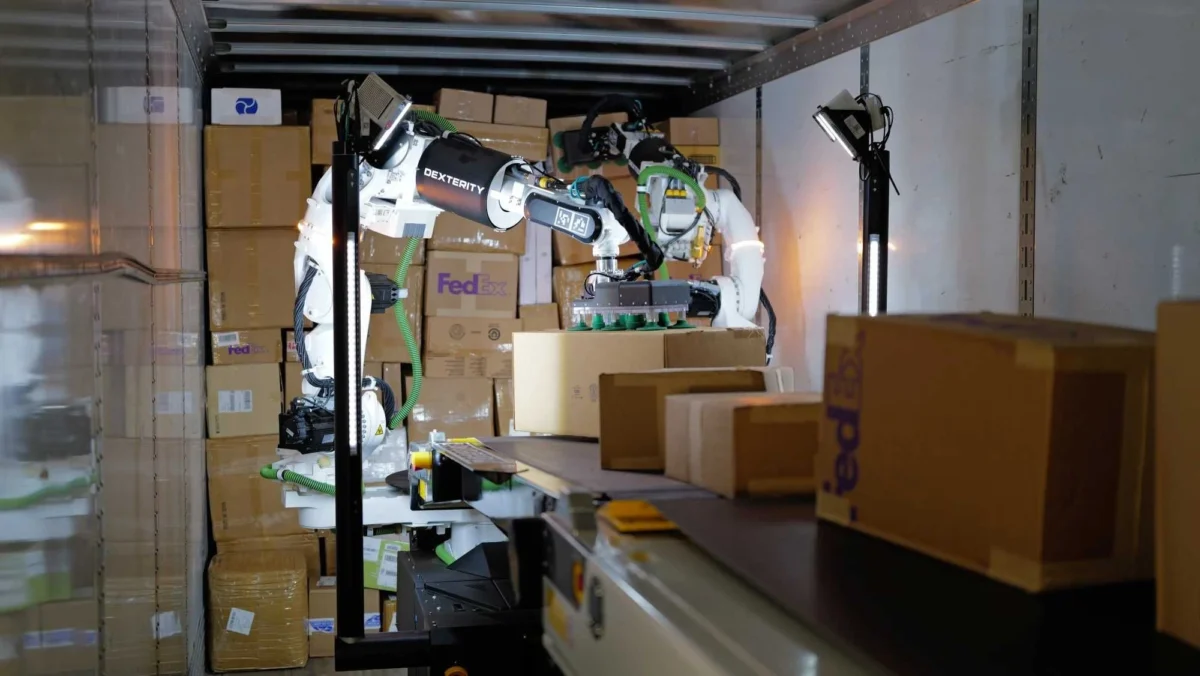
The expansion centers on the deployment of Dexterity’s "Foresight" world model—a sophisticated form of physical artificial intelligence—and its dual-armed "Mech" robots. As FedEx integrates these systems into its broader operational infrastructure, the company is not merely automating a single task; it is fundamentally rethinking the architecture of its hub-and-spoke distribution network.
The Core Facts: Automating the Last Frontier of the Warehouse
Trailer loading has long been the "holy grail" of warehouse automation. Unlike sorting packages on a conveyor belt or picking items from a shelf, loading a trailer is a dynamic, unstructured, and highly constrained environment. It requires the ability to navigate confined spaces, recognize varied package sizes and weights, and stack them in a way that maximizes volume without compromising the structural integrity of the load.
FedEx processes tens of thousands of trailers every single day across its U.S. network. Traditionally, this workflow has relied entirely on human labor, which is subject to fatigue, physical strain, and high turnover rates. By deploying Dexterity’s "Mech" robots, FedEx aims to address these operational challenges directly.
Key Technological Components:
- The Mech Robot: A compact, dual-armed superhumanoid robot specifically engineered for heavy-duty industrial tasks. Despite its industrial power, the robot is sized to navigate the cramped interiors of standard trailers.
- Foresight World Model: Unlike traditional programmed robotics that follow rigid paths, Foresight is a "Physical AI" model. It allows the robot to perceive its environment in real-time, anticipate the movement of objects, and make autonomous decisions on how to handle parcels of varying shapes, sizes, and weights.
- Operational Integration: The expansion at the Hagerstown Hub is not just about the robots; it is about how these machines "talk" to the hub’s management software. This includes destination planning, trailer assignment, and maintenance scheduling, ensuring the robots function as a seamless part of the facility’s ecosystem.
Chronology: From Pilot to Production
The collaboration between FedEx and Dexterity did not happen overnight. It is the result of a calculated, multi-year approach to testing and validation.
Phase 1: Conceptualization and Initial Pilots
Several years ago, FedEx began exploring advanced robotics to solve "the loading dock problem." Recognizing that traditional automation (such as static gantry cranes) lacked the dexterity required for variable parcel sizes, the company sought a partner capable of developing AI-driven solutions. Dexterity, an emerging leader in robotics software, was identified as the key collaborator.
Phase 2: The Hagerstown Testing Ground
The Hagerstown Hub in Maryland served as the primary sandbox for the Dexterity "Mech" systems. In this initial pilot, engineers focused on "edge cases"—scenarios where the robot had to handle crushed boxes, irregular shapes, or tight, cluttered spaces. The goal was to prove that the AI could handle these variables as efficiently as a human worker.
Phase 3: Scaling to Production
Following the successful validation of the technology, FedEx announced this week that it is scaling the program. This phase represents a departure from the "test" environment to a "production" environment, where the robots will operate alongside human staff on a daily, ongoing basis. This shift signifies that the technology has met FedEx’s rigorous standards for safety, reliability, and throughput.
Supporting Data: Why AI is Essential to Modern Logistics
The logistics industry is facing a dual crisis: a shrinking labor pool and the relentless rise of e-commerce demand. Data from industry analysts suggests that the cost of manual labor in distribution centers has risen by nearly 20% over the past three years.
The Productivity Gap
Manual loading is not just slow; it is the primary source of injury in warehouse environments. Repetitive motion, heavy lifting, and the hazards associated with dock operations contribute to high workers’ compensation claims.
- Throughput Metrics: Preliminary data from the Dexterity pilot suggests that the Mech systems can maintain consistent loading rates throughout an entire shift, whereas human performance typically dips after the first four hours of labor.
- Load Density: AI-driven loading allows for more intelligent stacking. By using computer vision to analyze the interior of the trailer, the system can maximize cubic utilization, potentially reducing the number of trailers required for a specific volume of packages—a direct benefit to FedEx’s sustainability goals and fuel costs.
Official Responses: Aligning Strategy and Innovation
The leadership at both FedEx and Dexterity view this project as a milestone in the "Physical AI" revolution.
Kawal Preet, Executive Vice President of Planning, Engineering, and Transformation at FedEx, stated:
"This expanded collaboration with Dexterity reflects our commitment to advancing capabilities that improve how we operate today while helping prepare our network for the future. As we continue evaluating and deploying physical AI in real-world environments, we see opportunities to enhance the speed, reliability, and flexibility of our network, creating long-term value for our business and customers."
For FedEx, the "Physical AI" narrative is crucial. It differentiates the company from competitors who may be relying on legacy automation that is too brittle to handle the rapid changes of the modern supply chain.
Dexterity’s perspective:
By positioning its "Foresight" world model as the "brain" behind the "Mech" body, Dexterity is emphasizing that the hardware is only as good as the software. The company has highlighted that its platform is designed to learn from each trailer it loads, meaning the system becomes more efficient the longer it operates.
Implications: The Future of the Logistics Workforce
The deployment of autonomous loading systems raises inevitable questions regarding the future of work. However, industry experts and FedEx leadership frame this as a "co-bot" evolution rather than a total replacement.
1. Shift in Human Roles
As robots handle the repetitive, strenuous task of lifting and stacking, the human workforce is increasingly tasked with higher-level oversight. Workers are being upskilled to manage robotic fleets, perform system diagnostics, and handle exceptions that require human judgment—such as damaged packages or unusual shipping requirements.
2. Operational Reliability
In an era of "on-demand" expectations, FedEx cannot afford downtime. Autonomous systems are designed to operate around the clock, providing a level of operational continuity that is independent of shift changes or labor shortages. This reliability is expected to stabilize costs for the company, potentially leading to more competitive shipping rates for end-consumers.
3. Broadening the Scope of Physical AI
If the Hagerstown scale-up proves successful, it is highly likely that FedEx will deploy similar systems across its global hub network. This could create a ripple effect in the robotics industry. As Dexterity proves its "Foresight" model in one of the most difficult environments in the world (the loading dock), the technology will likely become the gold standard for other logistics players, potentially accelerating the automation of the entire supply chain.
Conclusion: A New Era of Logistics
The expansion of the Dexterity pilot at the FedEx Hagerstown Hub is more than just a procurement of new machinery. It is a fundamental statement about the direction of the global logistics industry. By embracing Physical AI, FedEx is acknowledging that the future of shipping is not found in bigger warehouses or faster planes alone, but in the intelligent, autonomous systems that fill the gaps between the two.
As these robots begin to handle thousands of parcels daily in Maryland, the logistics industry will be watching closely. If the "Mech" and "Foresight" combination can reliably manage the chaos of a trailer loading dock, it will signal that the era of full-scale autonomous logistics is no longer a futuristic dream—it is an operational reality. FedEx, by taking this calculated risk, is positioning itself at the vanguard of a technological transformation that will redefine the efficiency, safety, and capability of the global supply chain for decades to come.
About the Author