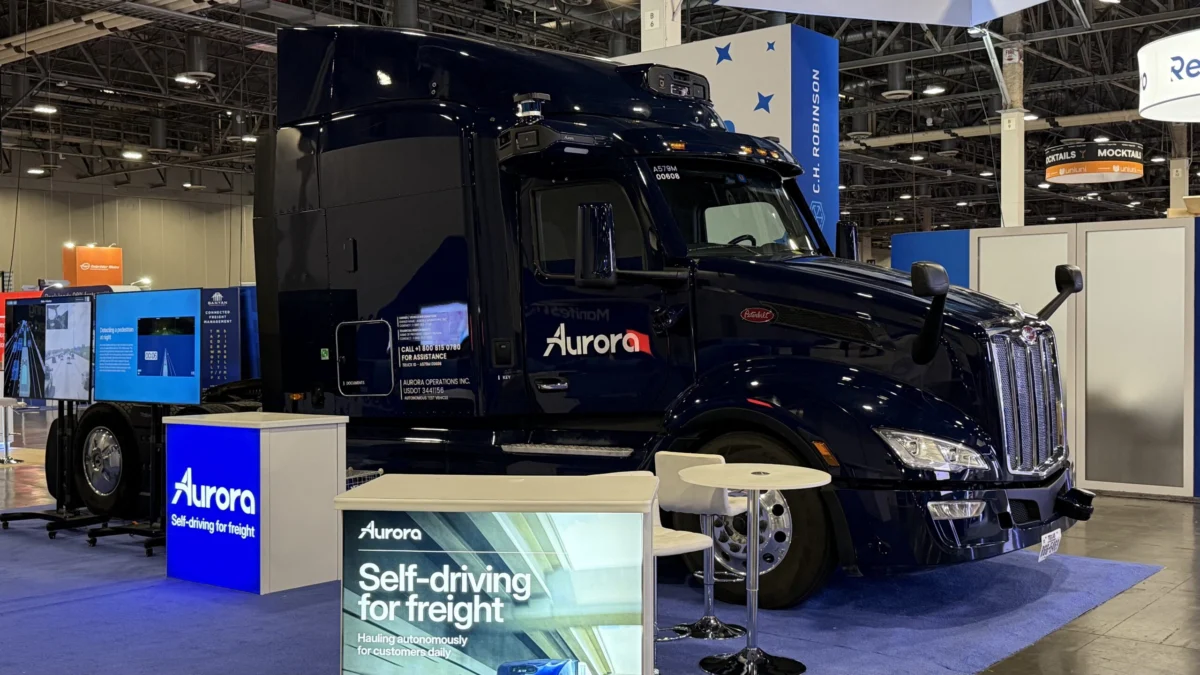
As the logistics industry stands on the precipice of a seismic shift, Aurora Innovation (NASDAQ: AUR) has moved from the realm of experimental technology to the hard math of commercial logistics. In its second-quarter earnings report released Wednesday, the autonomous trucking developer provided a granular look at the economics intended to define the next decade of freight transport. Facing a net loss of $270 million—or 14 cents per share—Aurora is betting heavily that its dual-model approach will unlock a new standard for asset utilization and safety in the U.S. trucking market.
The Financial Landscape: Balancing Innovation and Burn
Aurora’s second-quarter results underscore the immense capital requirements inherent in developing artificial intelligence for heavy-duty vehicles. While the $270 million loss exceeded the average analyst estimate of 12 cents per share, the company’s revenue growth tells a different story. Revenue reached $2 million, doubling from $1 million in the same period last year.
Management attributes this 100% growth to increased utilization of their pilot programs, broader geographical expansion, and the application of higher fuel surcharges on their current operations. To sustain this trajectory, Aurora remains in a state of high-intensity investment. The company utilized $225 million in operating cash during the quarter, though it maintains a robust liquidity position of approximately $1.2 billion in cash and short-term investments. This runway, according to the company’s recent Form 10-Q, is sufficient to support operations for at least the next 12 months, even as it prepares for an ambitious manufacturing ramp-up.
A Two-Pronged Strategy: TaaS vs. DaaS
At the heart of Aurora’s commercial strategy are two distinct business models: Transportation-as-a-Service (TaaS) and Driver-as-a-Service (DaaS). These models represent not just different billing structures, but fundamentally different relationships between the technology provider and the carrier.
Transportation-as-a-Service (TaaS)
Currently, Aurora operates primarily under the TaaS model. In this setup, Aurora acts as the carrier of record. It holds the U.S. Department of Transportation (DOT) operating authority, maintains the trucks, manages the insurance, and bills the customer a comprehensive, full-service rate. Chief Financial Officer David Maday noted that this model commands a premium, with a revenue outlook exceeding $2 per mile. It is the "turnkey" solution designed to prove the efficacy of the Aurora Driver in real-world, long-haul environments.
Driver-as-a-Service (DaaS)
Looking toward 2027, Aurora plans to transition its customer base to the DaaS model. Under this subscription-based framework, the carrier takes back the reins of fleet ownership. The customer manages and maintains the physical assets, while subscribing to the "Aurora Driver"—the software and hardware suite—as a service. This model targets a price point of $0.85-plus per mile. While this revenue per mile is lower, Aurora expects the cost and margin structure to shift accordingly, favoring higher scalability once the technology is proven at scale.
The Roadmap to 2027: A Controlled Transition
Aurora is not forcing a "big bang" cutover. Instead, the company is positioning its current TaaS partners to evolve into DaaS subscribers. A primary template for this transition is the memorandum of understanding (MOU) with Hirschbach Motor Lines. The Iowa-based refrigerated carrier is expected to introduce 500 autonomous tractors into its fleet between 2027 and 2028.
"Customers want to own these assets," said CEO Chris Urmson. "They want to see the benefit from it." By working with established, mid-sized carriers like Hirschbach, Aurora aims to create a repeatable framework for logistics firms that are wary of outsourcing their entire operation but eager to integrate autonomous technology into their existing portfolios.
Comparative Economics: Challenging the Traditional Fleet Cost
To understand the viability of Aurora’s pricing, one must look at the current industry benchmarks. According to the American Transportation Research Institute (ATRI), the average cost to operate a heavy-duty truck in 2025 reached an all-time high of $2.336 per mile. Of that figure, driver compensation—wages and benefits—accounts for $1.028 per mile.
Aurora’s DaaS target of $0.85 per mile is roughly 17% lower than the current cost of human driver compensation. While this appears to be a clear win, industry analysts caution that the comparison is not entirely apples-to-apples. The ATRI figures reflect historical operational costs across various sectors, while Aurora’s figures are prospective targets. Furthermore, the efficiency of autonomous systems is heavily dependent on "up-time." Aurora’s business model relies on the potential for 24/7 operation, which significantly increases annual mileage compared to the 85,991-mile annual average reported by ATRI. Aurora’s math assumes closer to 200,000 miles per truck, an assumption that will require rigorous testing in the coming years.
Manufacturing and Supply Chain Hurdles
The transition from lab to highway requires iron-clad manufacturing capabilities. Aurora has partnered with Roush to build a dedicated assembly facility, with an annual production target of 1,000 trucks expected to be reached in October.
The company is currently rolling out its second-generation hardware kit, which it claims reduces total hardware costs by more than 50%. This kit is designed for a one-million-mile service life, a critical benchmark for achieving unit economic profitability. However, the path is not without risk. Aurora has identified its reliance on AUMOVIO (formerly Continental) as a single-source supplier for its third-generation hardware, due for production in late 2027. The company explicitly acknowledged in its 10-Q that it may be unable to find alternative suppliers if AUMOVIO fails to deliver, a significant operational vulnerability.
Safety, Liability, and the "Human-in-the-Loop" Factor
Safety remains the ultimate metric for success. Aurora reports that it has logged nearly 440,000 driverless miles as of June 30, with a 100% on-time record and no collisions attributed to its system.
While the technology has performed well, the realities of road travel occasionally intervene. CEO Chris Urmson highlighted a recent incident in July where an Aurora truck, operating in manual mode, was struck by a vehicle that ran a red light. While the truck suffered significant damage, simulations confirmed that the Aurora Driver, had it been engaged, would have detected the vehicle six seconds earlier and successfully taken evasive action. This anecdote serves as a key selling point for the company: the argument that autonomous systems are not just about cost-cutting, but about an objective increase in road safety and risk reduction.
Strategic Implications: The Future of Long-Haul Freight
As Aurora marches toward its goal of an $80 million annualized revenue run rate for its TaaS business by the end of 2026, the company is effectively forcing a conversation about the necessity of autonomy. Urmson’s assertion is bold: "This technology is so impactful… that if you’re not using our stuff in the next five years, you just won’t be competitive in long haul."
For the carriers currently testing the system—including Charger Logistics, Value Truck, and Detmar Logistics—the primary driver is not the replacement of labor, but the optimization of capacity. In a freight market defined by volatile demand and tight margins, the ability to keep a truck moving 24/7 is a game-changer.
As the calendar approaches 2027, the focus for Aurora will shift from the successful execution of its pilot programs to the brutal reality of large-scale fleet integration. Whether the company can maintain its current safety record while navigating the complexities of mass manufacturing and the transition to the DaaS model will determine if it becomes the backbone of the next generation of logistics or remains a high-tech experiment in a traditional industry. For now, the financial markets are watching with cautious optimism, waiting to see if the promise of the $0.85-per-mile future can withstand the pressures of the present.
About the Author