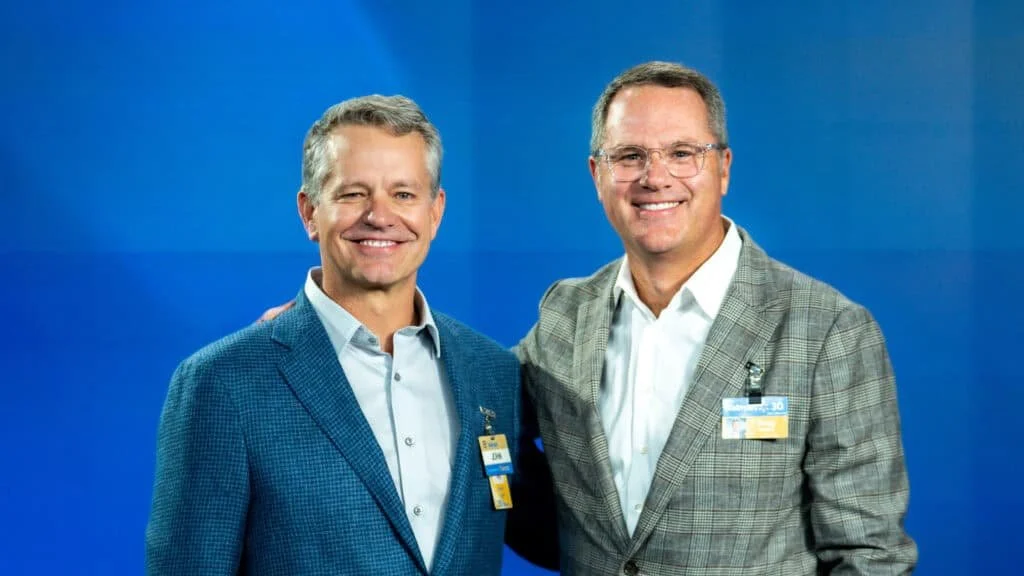
BENTONVILLE, AR – The global retail landscape shifted on its axis this Thursday as Walmart, the world’s largest company by revenue, announced a seismic transition in its executive leadership. Doug McMillon, the architect of Walmart’s modern digital evolution, will retire as Chief Executive Officer after an 11-year tenure. His successor is John Furner, the current President and CEO of Walmart U.S., who will officially assume the top post on February 1, 2026.
This transition marks only the sixth CEO change in the company’s storied 63-year history, signaling a deliberate, multi-year succession plan designed to ensure stability while aggressively pivoting toward a technology-first future.
The Main Facts: A Planned Handoff
The announcement concludes months of speculation regarding the future of the Bentonville-based titan. McMillon, who has led the company since 2014, will not depart immediately. In a move designed to facilitate a seamless transfer of power, he will retain his seat on the Walmart Board of Directors until the annual shareholders’ meeting in June 2026 and will continue to serve as an advisor to the company through January 2027.
John Furner’s appointment is the culmination of a classic "Walmart-style" rise. Having begun his career in 1993 as an hourly associate at Store 100, Furner has spent over three decades navigating nearly every facet of the business. By selecting an internal candidate with deep institutional knowledge, the Walmart Board of Directors has made a clear statement: the company’s future lies in the optimization of its existing, massive footprint rather than a radical external departure.
Chronology: The Evolution of a Retail Giant
To understand the weight of this leadership change, one must look back at the trajectory of the company over the last decade.
- 1962–2014: The era of the "Sam Walton" model. Walmart expanded rapidly across the globe, focusing on massive brick-and-mortar scale and "Everyday Low Prices."
- 2014: Doug McMillon takes the helm. At the time, the company was struggling to combat the rapid ascendancy of Amazon and the shift toward e-commerce.
- 2015–2019: The "Digital Pivot." Under McMillon, Walmart invested billions into modernizing its supply chain, launching Walmart+ to rival Amazon Prime, and acquiring e-commerce platforms like Jet.com to bolster its technical capabilities.
- 2020–2024: The Pandemic and Post-Pandemic Resilience. Walmart proved its essential nature during global lockdowns, leveraging its local store presence as fulfillment centers.
- November 2025: The announcement of the CEO transition, cementing the succession to John Furner.
- February 1, 2026: John Furner assumes the role of President and CEO.
Supporting Data: The McMillon Legacy
Under McMillon’s stewardship, the metrics of success were not merely incremental—they were transformative. When he assumed the role in 2014, the company was viewed by many Wall Street analysts as a "dinosaur" of the physical retail era.
Today, the narrative has flipped. Walmart’s shares have surged more than fourfold during his tenure. However, the true legacy of the McMillon era lies in the diversification of revenue. Walmart is no longer just a retailer; it is a global logistics provider, an advertising powerhouse through Walmart Connect, and a digital health-tech player.
Furthermore, McMillon oversaw a profound cultural shift. At a time of intense scrutiny regarding labor practices, he authorized significant wage hikes and benefit expansions for the company’s 2.3 million global associates. This investment in human capital has been cited by industry experts as a key factor in the company’s ability to maintain high service standards during the labor shortages of the early 2020s.
Official Responses: A Vision for the Future
The corporate response has been one of total alignment. Greg Penner, Chairman of the Walmart Board, emphasized that the decision was based on Furner’s proven ability to manage complexity at scale.
"John is the right leader to guide Walmart into our next chapter of growth and transformation," Penner stated in the official press release. "His career trajectory—from the front lines of a store to the boardroom—gives him a unique perspective on the intersection of our associates, our customers, and our technology."
In his own statement, Furner acknowledged the gravity of the position, particularly in the context of the current technological revolution:
"I am deeply honored by the trust the Board and family have placed in me. As we enter a new retail era fueled by innovation and AI, our purpose and our people will continue to guide us. Together, we’ll find new ways to serve customers, support our associates, and strengthen the communities we call home."
Implications: Navigating the AI and Omnichannel Frontier
The retail landscape of 2026 is vastly different from the landscape of 2014. The "Omnichannel" model—the seamless integration of physical stores and digital shopping—is now the baseline, not a competitive advantage. The next frontier, which Furner is expected to prioritize, is the integration of Generative AI and advanced robotics.
H3: The AI Imperative
Furner’s tenure will be defined by how effectively he can leverage AI to lower costs and increase efficiency. This includes:
- Predictive Inventory: Using machine learning to anticipate consumer demand before it happens, drastically reducing waste and out-of-stock incidents.
- Hyper-Personalization: Utilizing AI to offer customers a tailored shopping experience, whether they are in-store or browsing the app.
- Supply Chain Automation: Scaling the use of autonomous bots and drones to accelerate last-mile delivery, a critical component in competing with the speed of e-commerce rivals.
H3: The Human Capital Challenge
While technology is the engine, labor remains the chassis. As the largest private employer in the world, Walmart faces the constant challenge of balancing automation with its commitment to its associates. Analysts expect Furner to continue the trend of "upskilling" the workforce, transforming hourly roles into tech-enabled positions that require higher skill sets and command higher compensation.
The "Insider" Advantage: Why Culture Matters
In an era where many Fortune 500 companies look outside their walls for "disruptive" leadership, Walmart’s decision to elevate an internal veteran is a deliberate bet on cultural continuity.
Furner’s experience as a store manager, merchandising leader, and Sam’s Club CEO provides him with a "boots-on-the-ground" understanding of how corporate mandates impact the store floor. This is a critical asset. In a massive organization like Walmart, the biggest risk to any strategic pivot is execution failure. Furner’s intimate knowledge of the company’s DNA is expected to minimize the "friction of change" that often plagues large-scale corporate transformations.
Conclusion: The Road Ahead
As the retail industry watches closely, the transition from McMillon to Furner serves as a bellwether for the broader economy. If Walmart can continue to grow, innovate, and provide value in an inflationary, tech-heavy environment, it provides a blueprint for how traditional businesses can thrive in the 21st century.
The company has promised to name a successor for Furner’s current role as CEO of Walmart U.S. before the end of the 2026 fiscal year. This measured approach to leadership is the hallmark of the current administration and a clear indicator of how the company intends to proceed: with calculated, steady, and inevitable progress.
John Furner takes the reins at a time of immense challenge and equal opportunity. He inherits a company that is stronger than it has ever been, yet one that must constantly reinvent itself to remain relevant. For the retail world, the next chapter of Walmart’s history is not just about selling goods—it is about defining the future of commerce itself.
About the Author