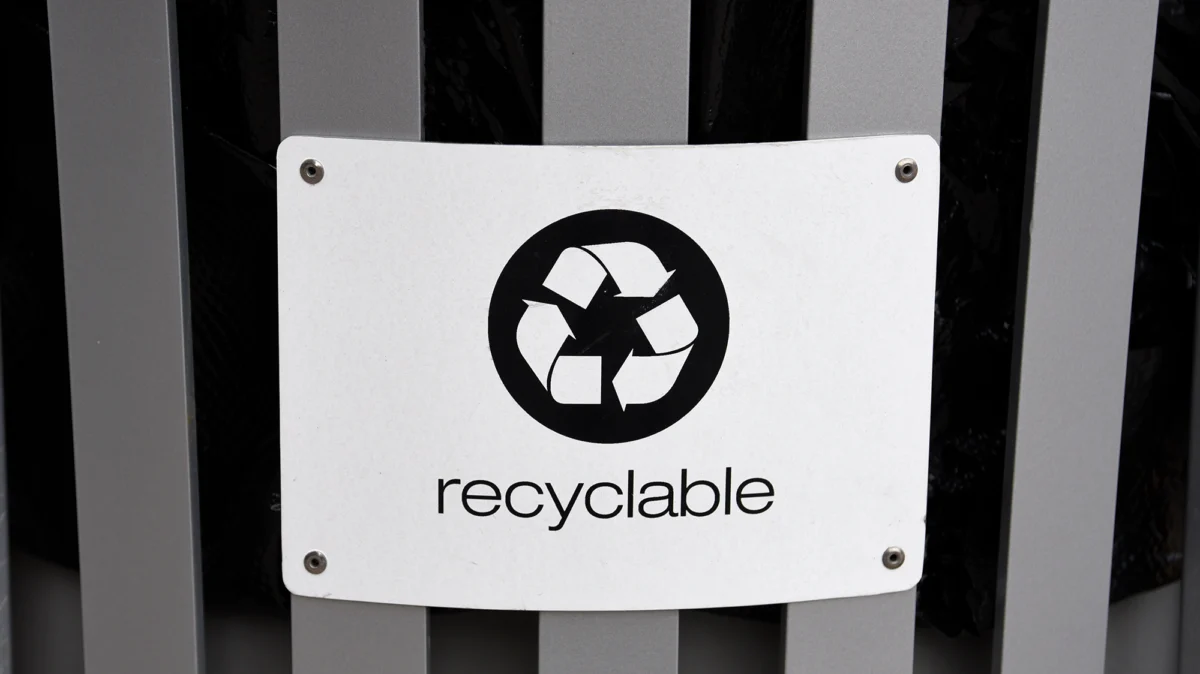
In an unexpected legal development that has sent shockwaves through the environmental policy community, a federal judge has effectively paralyzed one of California’s most ambitious legislative attempts to combat plastic pollution. The state’s "Truth in Labeling" law, known as SB 343, was designed to restrict the use of the ubiquitous "chasing arrows" recycling symbol on consumer packaging. However, a preliminary injunction issued by U.S. District Judge William Hayes has halted the enforcement of the law, citing potential violations of the First Amendment—a ruling that industry advocates are calling a victory for free speech, while environmentalists decry it as a corporate shield for deceptive marketing.
The Core Conflict: What is "Recyclable"?
For decades, the "chasing arrows" symbol has been a staple of American consumer life. To the average shopper, the presence of these arrows on a plastic container implies that the item can be tossed into a blue bin and successfully repurposed. However, the reality of the modern waste stream is far more grim.
A comprehensive statewide study conducted by the California Department of Resources Recycling and Recovery (CalRecycle) revealed a stark disconnect: the vast majority of plastic items labeled with the chasing arrows symbol are never actually recycled. Due to economic, logistical, and material limitations, most of these plastics end up in landfills or incinerators.
SB 343 was crafted to bridge this gap. The law mandated that the chasing arrows symbol could only be displayed on products and packaging that are truly and widely recycled. Specifically, it required that such items be accepted by recycling programs serving at least 60 percent of the California population and, crucially, that they be consistently sorted and processed into new materials by recycling facilities.
A Chronology of Contention
The legislative journey of SB 343 and its subsequent legal collapse highlights the growing friction between state-level climate initiatives and corporate interests.
- October 2021: California Governor Gavin Newsom signs SB 343 into law, aiming to tackle the burgeoning plastic crisis and protect consumers from misleading environmental claims.
- March 2026: A coalition of food, packaging, and retail trade associations files a lawsuit against the state of California, arguing that the law is "unconstitutionally vague" and infringes upon their rights to commercial speech.
- July 2026: U.S. District Judge William Hayes issues a preliminary injunction, blocking the law’s enforcement just months before it was set to take effect.
- Late July 2026: Environmental organizations, including the Earth Island Institute and Californians Against Waste, formally file motions to intervene in the case, pledging to support the state’s defense of the law.
The Constitutional Argument: Commercial Speech vs. Consumer Protection
The central tension of this legal battle lies in the interpretation of the First Amendment. In his ruling, Judge Hayes applied the "Central Hudson test," a four-part framework used by courts to determine whether government regulation of commercial speech is permissible.
While the judge acknowledged that the state has a "legitimate interest" in reducing consumer confusion and improving recycling infrastructure, he argued that SB 343 failed the latter portions of the test. Specifically, Hayes contended that the law would not necessarily advance the state’s goals. He suggested that instead of incentivizing companies to improve their packaging, the strict requirements of SB 343 might simply cause corporations to remove the recycling symbol entirely. In his view, the loss of the symbol would not necessarily lead to higher recycling rates and could potentially lead to more confusion for consumers who are accustomed to seeing the icon.
Furthermore, Judge Hayes suggested that the state overreached by not allowing for more nuanced, descriptive labels. He offered a hypothetical alternative: requiring labels that specify where an item is accepted, such as "accepted by recyclers in the greater Los Angeles area but nowhere else in California." By forbidding such nuance and mandating a binary "yes or no" on the use of the symbol, the judge argued the law was too restrictive.
The "Wish-Cycling" Crisis
Advocates for the law argue that the judge’s ruling reflects a fundamental misunderstanding of the systemic issues plaguing the waste management industry. Heidi Sanborn, executive director of the National Stewardship Action Council, emphasizes that the status quo is not merely "misleading"—it is operationally destructive.
"People are ‘wish-cycling,’ they are so desperate to recycle that they toss everything into their bins," Sanborn explained. "When non-recyclable materials like plastic films or certain food-contaminated containers end up in the sorting machines, they cause significant mechanical failures. This is highly labor-intensive to remove, and it drives up the cost of waste management for every taxpayer."
The industry’s defense—that the law amounts to government-mandated censorship—is viewed by critics as a classic "playbook" maneuver. By invoking the Constitution, corporations are effectively attempting to decouple their marketing claims from the material reality of their waste footprints.
Broader Implications for Environmental Regulation
The implications of this ruling extend far beyond the borders of California. Because California’s environmental standards often serve as a template for other states, the blocking of SB 343 could create a chilling effect on similar legislation nationwide.
1. The Precedent for Corporate Litigation
This case is part of a larger trend where "Big Polluters" utilize the First Amendment as a legal shield. Similar arguments have been used to fight regulations requiring the disclosure of greenhouse gas emissions and to challenge lawsuits regarding "greenwashing." If corporations can successfully argue that environmental marketing is protected political speech rather than regulated commercial information, the capacity for states to enforce truth-in-advertising standards will be severely diminished.
2. Jeopardizing Extended Producer Responsibility (EPR)
Perhaps most concerning for environmentalists is the potential ripple effect on California’s broader plastic policy, specifically the state’s landmark "Extended Producer Responsibility" (EPR) law, known as SB 54. This law shifts the financial burden of waste management from local municipalities to the producers of the plastic. Because SB 54 relies on the same scientific definitions of recyclability that are currently being challenged in the SB 343 case, a legal defeat could leave the foundation of the state’s entire plastic reduction strategy vulnerable to collapse.
3. A Call for Federal Action
Despite the legal setback, the discourse surrounding the case has shifted toward the potential for federal intervention. Many stakeholders, including some in the industry, acknowledge that a patchwork of state-level laws creates logistical nightmares for national retailers. Sanborn and other advocates suggest that while the court battle continues, there is a mounting need for national legislation that standardizes labeling and ends the era of "wish-cycling" on a federal level.
Looking Toward the Future
As the litigation moves toward a trial, the legal strategy for the state of California and its intervenors will likely focus on providing the court with empirical evidence of how the recycling system functions at a granular level. The goal is to demonstrate that the recycling symbol is not a neutral piece of information but a functional claim—a claim that, when false, results in tangible, measurable environmental and economic harm.
The industry, for its part, maintains that it is being unfairly targeted and that it is committed to sustainability, albeit through methods that do not involve the restrictive labeling mandates of the current law.
For now, the chasing arrows remain on millions of packages that will ultimately end up in landfills, serving as a silent testament to the ongoing struggle between a planet in crisis and the legal mechanisms that define how we talk about our waste. As Scott Hochberg of the Earth Island Institute put it, "What is concerning is when these arguments succeed and states are blocked from implementing common-sense initiatives to protect their residents."
The outcome of this case will likely define the boundaries of corporate environmental accountability for the next decade. Until a resolution is reached, the blue bin remains a place of confusion—a symbol of our collective desire to do better, often hampered by the very labels that claim to help us do it.
About the Author