In the high-stakes theater of artificial intelligence, where trillion-parameter models and multi-billion-dollar compute budgets have become the standard for "frontier" performance, a quiet, London-based startup is flipping the script. Inherent, an AI laboratory founded by alumni of Google DeepMind, has emerged from stealth with a bold proposition: you don’t need the world’s largest model to achieve the highest levels of scientific reasoning.
With a fresh $50 million seed round under its belt, the company has unveiled "Faraday," an AI agent capable of independently replicating complex scientific findings without prior guidance. Most strikingly, Faraday achieved these results using a model—Qwen 3.6—that is a mere fraction of the size of the industry-standard giants like OpenAI’s GPT-5.5 or Anthropic’s Claude Opus 4.8. By focusing on "research taste" rather than raw parameter brute force, Inherent is positioning itself as a pivotal player in the race to build the first truly autonomous AI scientist.
The Genesis: From DeepMind to King’s Cross
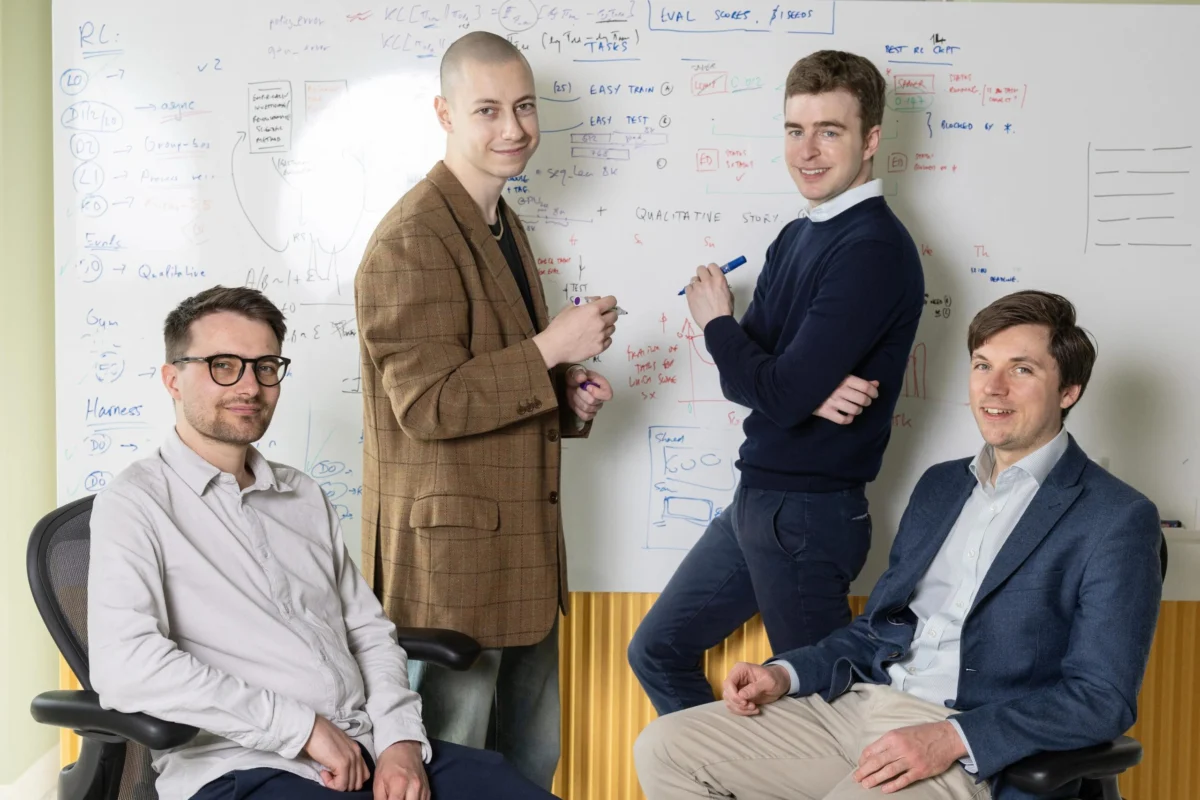
Inherent’s roots lie in the fertile soil of London’s King’s Cross, the epicenter of Europe’s AI boom and the home of Google DeepMind. The startup was founded by a quartet of veterans: Edward Hughes, Louis Kirsch, Kaloyan Aleksiev, and Tantum Collins. These founders, shaped by their tenure at one of the world’s most prestigious AI research organizations, identified a fundamental bottleneck in the current trajectory of AI development.
While the broader industry was obsessed with scaling models to improve general performance, the Inherent team was interested in utility—specifically, the utility of scientific discovery. The company operates out of a centralized office in London, maintaining a strict in-person culture that reflects the collaborative, high-intensity environment of their former employer. As the London AI ecosystem continues to mature, Inherent stands as a testament to the region’s ability to retain and cultivate top-tier talent, even as the global competition for researchers intensifies.
Chronology of a Breakthrough
The journey toward Faraday was not an overnight success but a calculated evolution in research methodology:
- Early 2025: The founders depart their respective roles, navigating the complexities of the U.K.’s restrictive "garden leave" policies to lay the groundwork for Inherent.
- May 2026: Inherent officially emerges from stealth, announcing a $50 million seed funding round to support its mission of building AI-driven scientific discovery tools.
- Late June 2026: The lab begins internal testing of Faraday, shifting the focus from standard language benchmarks to the rigorous task of reproducing published scientific literature.
- July 2026: Faraday successfully demonstrates the ability to verify scientific findings independently, marking a significant milestone for the team.
- August 2026: The startup begins to share its methodology with the public, contrasting its efficiency-first approach with the resource-heavy models of its Silicon Valley peers.
Supporting Data: Efficiency Over Scale
The central tension in the current AI landscape is the "parameter trap." Many believe that to build a more capable model, one must simply increase the parameter count. Inherent challenges this by demonstrating that specialized, reinforcement-learning-driven agents can outperform these monoliths.
The Faraday vs. The Titans
| Metric | Faraday (Inherent) | Industry Standard (e.g., GPT-5.5) |
|---|---|---|
| Model Base | Qwen 3.6 (27B parameters) | Frontier-scale (>1T parameters) |
| Primary Focus | Scientific "Taste" & Replication | General Knowledge & Reasoning |
| Methodology | Reinforcement Learning (RL) | Large-scale Pre-training |
| Efficiency | High (Low compute cost) | Low (High compute/energy cost) |
By utilizing a 27-billion-parameter model, Inherent has proven that "research taste"—the instinctual ability to design valid experiments and identify promising avenues of inquiry—is not solely a function of size. It is a function of training. Through reinforcement learning, Faraday is rewarded for successful outcomes and high-quality scientific design, rather than being forced to memorize vast datasets. This approach allows the agent to function more like an apprentice scientist than a search engine.
Official Perspectives: The "North Star" of Research Taste
In conversations with TechCrunch, Chief Scientist Edward Hughes emphasized that the goal was never just to beat OpenAI or Anthropic at a benchmark. The goal was to build a teammate.
"What was most interesting to us about this was not so much the result of beating those frontier agents—which of course we liked—but was actually the way we went about building this," Hughes noted. He draws a direct parallel between Faraday’s current capabilities and the training of a doctoral student. "Many PhD students actually start by doing this [replicating papers]. It is the foundation of learning the rigors of the scientific method."
Inherent is deliberately avoiding the "chatbot" trap. Instead of designing an agent that provides sycophantic answers, they are building a collaborator that can challenge assumptions. "The goal is modeled on my favorite kind of teammate—the kind who comes back and says, ‘I got curious about this, and I went off and I did these experiments. What do you think of these results?’"
This philosophy extends to their technical stack. Rather than building a redundant coding tool, Inherent allowed Faraday to utilize OpenAI’s GPT-5.5 Codex, treating it as a software library. This modular approach allows Inherent to focus its resources on its core objective: the "AI Scientist."
Implications for the Industry
The success of Inherent carries significant weight for the future of venture capital and AI research.
1. The Death of the "Bigger is Better" Paradigm
If a 27B parameter model can replicate scientific research as effectively as a multi-trillion parameter model, the justification for the massive, power-hungry compute clusters currently being built by hyperscalers may begin to erode. This suggests a pivot toward "model efficiency" and "specialized agents" as the next major trend in AI development.
2. The Talent Exodus and Regional Competition
Hughes has been a vocal critic of the U.K.’s "garden leave" policies, which require departing employees to wait months before starting a new venture. His success in bypassing these constraints and building a world-class lab in London provides a blueprint for others. As more DeepMind staff become "unsettled" by shifts in corporate strategy at Google, Inherent is positioning itself as a prime destination for researchers who want to work on foundational science rather than incremental product updates.
3. The Future of Scientific Discovery
The ultimate implication is the acceleration of the scientific method itself. If an AI agent can reliably replicate existing experiments, the next logical step is to have it design and execute novel experiments. This would theoretically compress the time required for drug discovery, material science, and climate research from years to weeks.
Conclusion: The Quiet Revolution
While Inherent has operated under the radar for much of its early life, its emergence signifies a maturation in the AI sector. The era of the "generalist chatbot" is slowly giving way to the era of the "specialized agent."
By focusing on the intangible quality of "research taste" and leveraging the efficiency of smaller models, Inherent is not just chasing the industry giants—they are building a different path entirely. As they look to scale their headcount to 25 employees by the end of the year, the team in King’s Cross is betting that the future of science will be written by algorithms that understand not just what has been discovered, but how to discover it themselves. In the quiet, rigorous hallways of their London office, the next scientific revolution may already be underway.
About the Author