In the industrial sector, the conclusion of an emergency drill is often marked by a sigh of relief, a completed sign-in sheet, and an evacuation time logged in a dusty binder. For many plant managers, the “completed” status serves as a box-ticking exercise to satisfy regulatory requirements. However, industry safety experts are increasingly warning that if a drill ends with nothing more than a timestamp, the facility has missed its most critical opportunity: the chance to expose operational vulnerabilities before a real crisis strikes.
The true value of an emergency drill lies not in the mere act of participation, but in the granular performance data it yields. A drill that fails to measure decision-making, communication clarity, and behavioral response is effectively a rehearsal for failure. To move beyond mere compliance, safety leaders must transition toward a metrics-driven culture that treats every drill as a diagnostic test for organizational survival.
The Chasm Between Compliance and Operational Readiness
Many facilities operate under the illusion of safety based on administrative indicators. These metrics—such as the date, time, total participant count, and the duration of the evacuation—are vital for OSHA compliance but provide almost no insight into the actual state of readiness.
Administrative data tells a leader that an evacuation occurred; readiness metrics tell a leader whether that evacuation would save lives during an actual fire, chemical leak, or structural failure. The latter requires measuring observable behavior: Did employees recognize the alarm instantly? Did they follow designated routes without supervisor prompting? Did they account for temporary contractors?
When a facility relies solely on compliance reporting, it risks masking underlying systemic issues. A drill that concludes with a perfect evacuation time but fails to note that half the workforce waited for a supervisor to lead them to the exit is a "successful" drill that obscures a critical training deficiency.
The Anatomy of an Effective Drill Metric
For a metric to be useful, it must move beyond descriptive statistics and become actionable. According to safety professionals, high-impact metrics should be anchored in a specific format: Expected Action + Observation Point + Acceptable Standard + Correction Owner.
Consider a scenario where packaging employees are expected to evacuate within 30 seconds of an alarm. If observation reveals that employees delayed movement due to alarm confusion or a reliance on peer confirmation, the "correction owner" is not a vague safety committee, but the specific packaging manager. The resolution must be verified not by a meeting, but by a subsequent test or spot check. This methodology transforms OSHA’s requirement for a site-specific Emergency Action Plan (EAP) from a static document into a living, validated process.
Eight Critical Metrics for Industrial Readiness
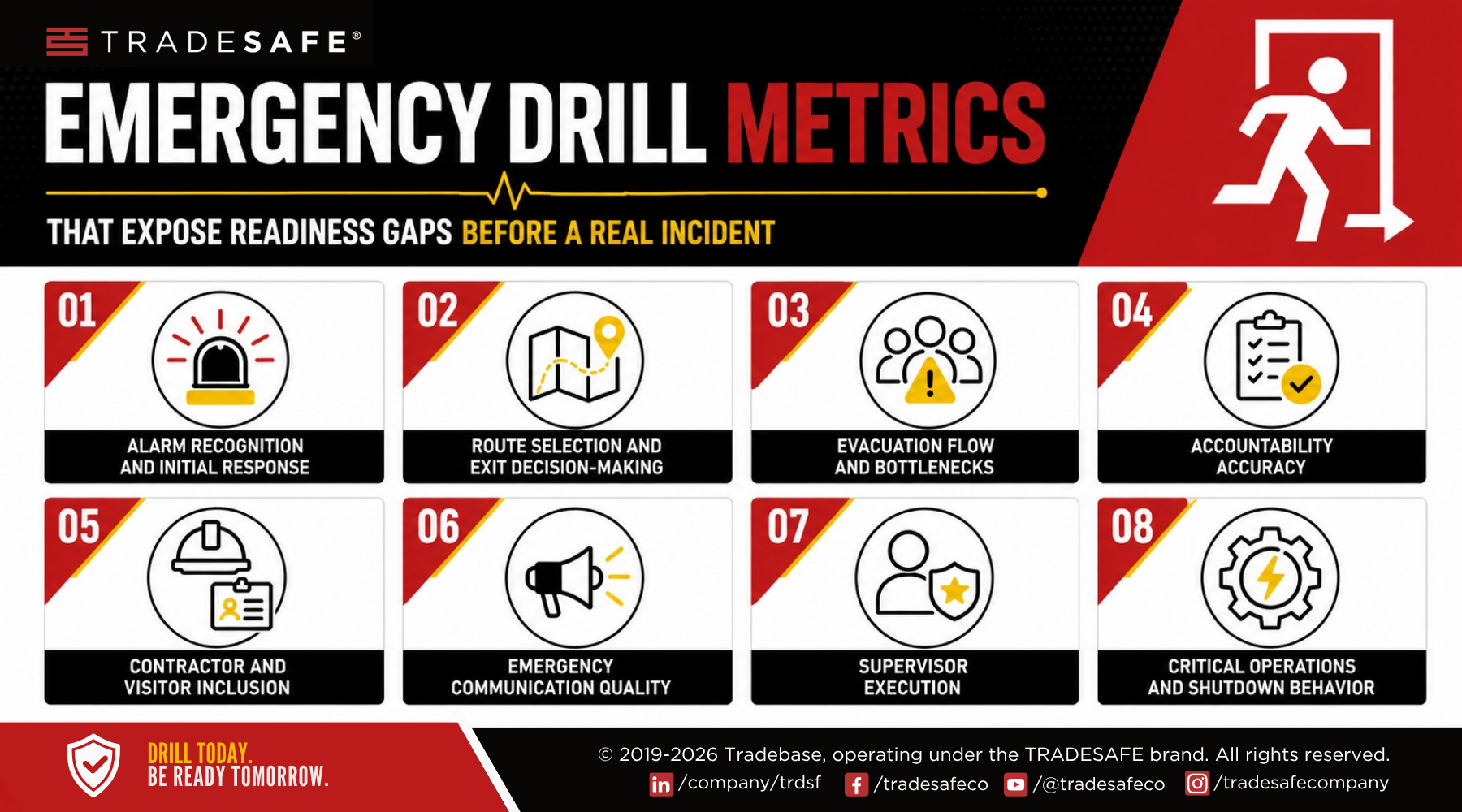
To build a robust safety profile, plant leaders must target the specific points where response is most likely to break down. By focusing on these eight key areas, organizations can identify gaps that are often invisible during standard drills.
1. Alarm Recognition and Initial Response
The first point of failure in any emergency is the failure to recognize the signal. OSHA standards dictate that alarms must be perceptible above ambient noise. In an industrial environment filled with heavy machinery, compressed air, and hearing protection, this is rarely straightforward. Metrics should measure the time elapsed from the initial alarm activation to the moment employees begin protective action. If employees in a maintenance shop don’t react until they see others moving, the alarm system has failed to meet the “perceivable” standard.
2. Route Selection and Decision-Making
Evacuation time is a deceptive metric. A facility might evacuate in under five minutes, but that number is meaningless if employees used unsafe routes or bypassed hazards. Observers must be positioned at key intersections and stairwells to verify that employees are not only moving toward the exit but choosing the correct exit based on the simulated emergency scenario.
3. Evacuation Flow and Bottlenecks
Congestion at turnstiles, badge readers, or narrow stairwells is a major cause of injury during real evacuations. Metrics should identify specific "choke points" where the flow of people is obstructed. By timing the arrival of the last person at the assembly point, leaders can analyze the entire evacuation chain to determine if a specific gate or doorway is creating a bottleneck that could turn a routine drill into a dangerous crush in a real-world scenario.
4. The Reality of Accountability
Accountability is not simply having everyone present; it is the process of verifying that every soul is accounted for. This includes visitors, temporary laborers, and employees working off-site. A strong metric requires the reconciliation of all personnel before an "all-clear" can be issued. The process must clearly define how missing-person information is escalated and how re-entry is controlled until the site is deemed safe.

5. Contractor and Visitor Inclusion
Contractors and third-party vendors are the most vulnerable populations in an industrial plant. Because they often operate outside of standard department rosters, they are frequently forgotten during headcounts. During a drill, management must measure whether contractors understand their specific muster points and whether the host supervisor has the information necessary to verify their safety.
6. Communication Quality
Communication is only successful when the message is received, understood, and acted upon. During a drill, leaders should test communication effectiveness against the realities of the facility: machinery noise, radio dead zones, and multilingual workgroups. The goal is to eliminate "message drift" and ensure that instructions—such as "Do not use the south corridor"—are consistent across all channels, including PA systems and mobile alerts.
7. Supervisor Execution
The supervisor is the linchpin of the emergency response. If a supervisor hesitates, the workforce will likely follow suit. Metrics should evaluate whether supervisors are effectively performing "sweeps" of restrooms and isolated areas, managing the pace of the evacuation, and preventing unauthorized re-entry. A score for supervisor performance should be a mandatory component of every post-drill review.
8. Critical Operations and Shutdown Behavior
Some roles require employees to perform a final shutdown procedure—such as closing valves or securing energy—before evacuating. These tasks are dangerous if performed incorrectly under duress. Metrics must verify that these employees know exactly when to abandon the task if the situation worsens. Any shutdown procedure that requires "improvisation" is a liability and must be refined.
Building the Scorecard: A Path to Improvement
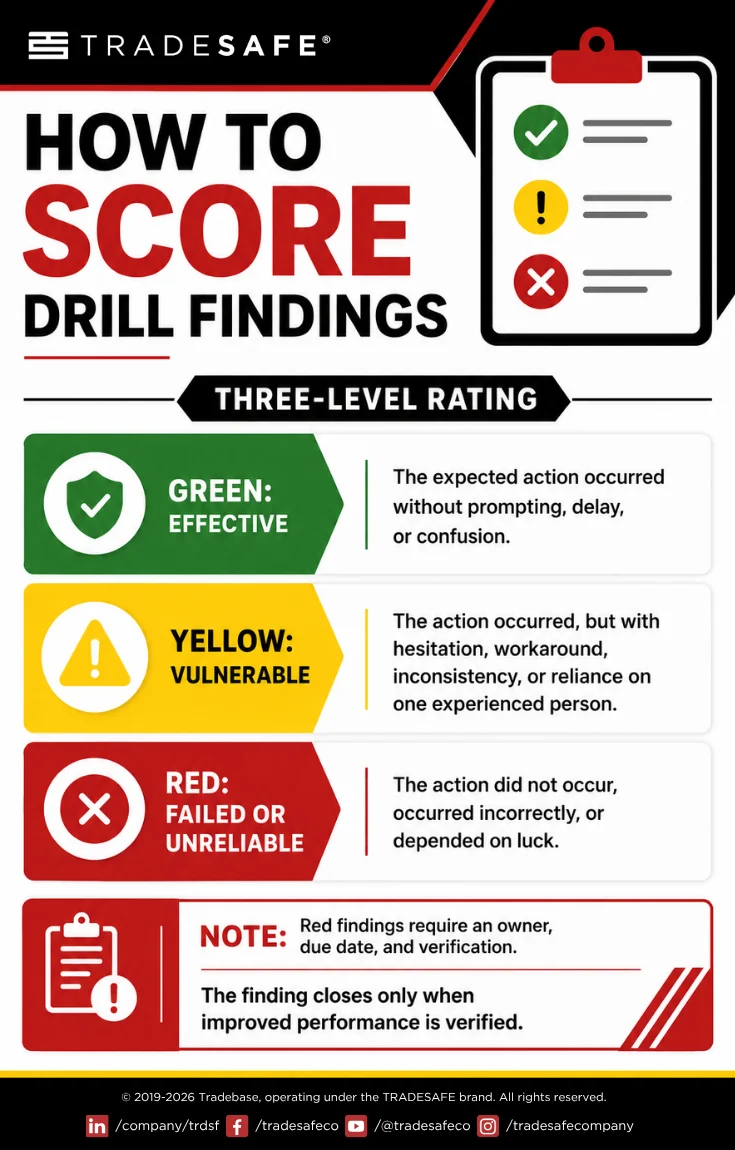
To operationalize these insights, plants should adopt a simple, three-level rating system: Effective, Vulnerable, or Failed.
- Effective: The action met the standard and required no intervention.
- Vulnerable: The action was completed but lacked speed, clarity, or consistency.
- Failed: The action was not completed or violated a fundamental safety protocol.
Every "Vulnerable" or "Failed" finding must be assigned a specific owner, a firm deadline, and a clear method for verification. A common pitfall is the "review with employees" trap, where a manager claims a finding is closed because they held a meeting. This is insufficient. A finding is only closed when a follow-up drill or spot check proves that the performance has fundamentally improved.
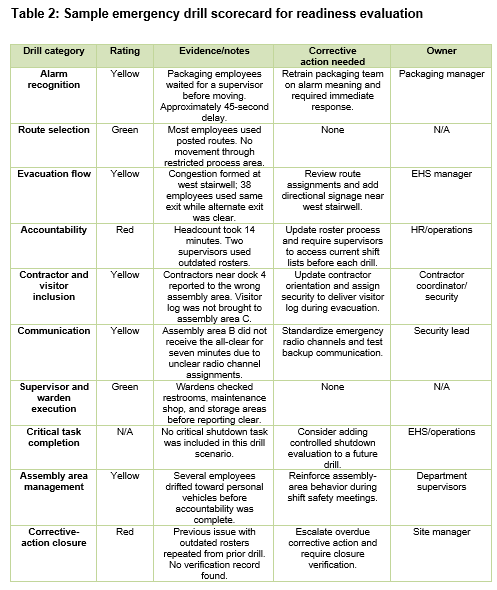
The Role of After-Action Reporting
Drawing from Federal Emergency Management Agency (FEMA) guidance, industrial facilities should adopt a formal "After-Action Report" (AAR). This report should document strengths, identify performance gaps, and list the specific corrective actions required.
By treating the AAR as a binding improvement plan, plant leadership moves away from the "compliance mindset" and toward a "readiness culture." The ultimate goal of an emergency drill is not to survive the drill itself, but to provide the organization with the evidence it needs to save lives when the alarm is not a drill.
As industrial processes grow more complex and workforces more transient, the gap between a written plan and a functional response will only widen unless bridged by rigorous, metrics-based testing. A drill should never end when the employees reach the assembly area; it ends when the facility has learned exactly where its defenses are thin and has committed to fixing them.
About the Author