Introduction
The rapid ascent of generative artificial intelligence has triggered a global infrastructure boom, but it has also brought a looming environmental crisis to the forefront of the tech industry. As data centers consume an ever-increasing share of the world’s electricity, the race for computational dominance is no longer just about raw speed—it is about "performance per watt."
In a significant strategic update, Advanced Micro Devices (AMD) has unveiled an ambitious roadmap to drastically reduce the energy footprint of its AI hardware. By 2030, the company predicts a paradigm shift in data center density: tasks that require 570 server racks today will eventually be handled by just two. This 20-fold increase in efficiency represents a cornerstone of AMD’s broader climate transition plan, positioning the company as a key architect in the sustainable scaling of the AI era.
Main Facts: Redefining Rack-Scale Efficiency
AMD’s latest disclosures outline a future where AI training and inference are decoupled from the exponential growth of carbon emissions. The company’s primary goal is to achieve a 20-fold increase in energy efficiency for its AI-configured server racks by 2030, using 2024 as the base year.
The "2 vs. 570" Metaphor
To illustrate the scale of this advancement, AMD executives point to the physical footprint of computing power. Currently, a massive deployment of 570 server racks is necessary to process specific large-scale AI workloads. Through advancements in silicon architecture and system design, AMD expects to condense that same workload into just two racks within six years. This represents more than just a reduction in space; it implies a 95% reduction in the electricity required to perform the same unit of work.
Carbon Intensity Reductions
Hand-in-hand with energy efficiency is a projected 28-fold decrease in carbon intensity. While efficiency measures how much work is done per kilowatt-hour, carbon intensity measures the greenhouse gas (GHG) emissions generated per unit of computational output. By optimizing how chips process data and how racks manage heat, AMD aims to satisfy the soaring demand for AI without a proportional spike in the corporate carbon footprint.
Technical Co-optimization
According to Sam Naffziger, AMD’s Senior Vice President and Corporate Fellow, the "low-hanging fruit" of chip-level improvements has already been harvested. The next frontier is "rack-scale" optimization. This involves a holistic approach where five key pillars are developed in unison:
- Compute Silicon: More efficient GPU and CPU architectures.
- Memory: Reducing the energy cost of moving data between storage and processors.
- Interconnects: High-speed pathways that allow multiple chips to work together with minimal energy loss.
- Software: Compilers and libraries optimized to run code with the fewest possible clock cycles.
- System Design: Advanced cooling and power delivery at the rack level.
Chronology: The Road to 2030
The path to these 2030 targets is not a sudden leap but a phased progression that AMD has been tracking for several years.
2021–2023: The Foundation
During the early stages of the AI surge, AMD began integrating energy-efficiency targets into its product development cycles. The company realized that as AI models grew from billions to trillions of parameters, the traditional roadmap would lead to unsustainable power demands.
2024–2026: The First Wave of Progress
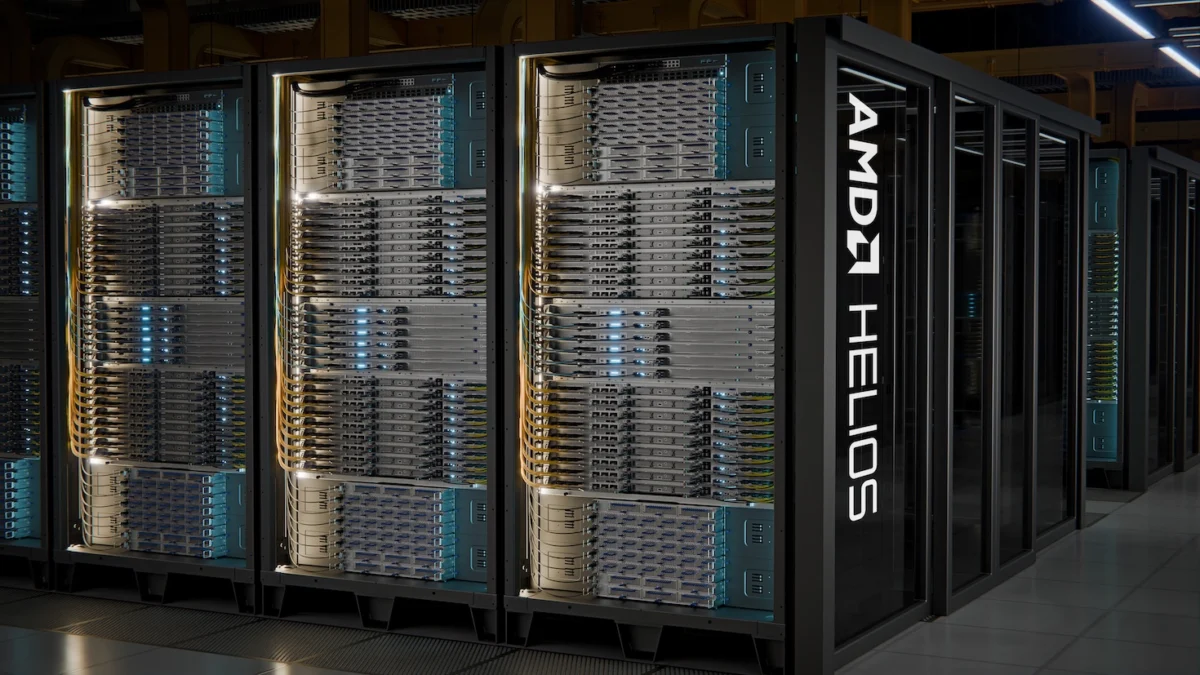
AMD reports that it has already delivered a fourfold increase in energy efficiency between 2024 and 2026. This was achieved largely through the deployment of the "Helios" system—an integrated rack architecture utilized by industry titans such as Meta, Microsoft, OpenAI, and Oracle. This period marked AMD’s transition from being a component supplier to a systems-level architect.
August 18, 2024: The Strategic Disclosure
In an August 18 blog post and its subsequent 2025-2026 Corporate Responsibility Report, AMD formalized its 20x efficiency pledge. This announcement was timed to address growing concerns from investors and environmental regulators regarding the "hidden" carbon cost of the AI boom.
2027–2030: The Push for 20x
The final phase of the roadmap focuses on reaching the 20x goal. AMD notes that its current trajectory is three times faster than historical industry averages for efficiency gains, suggesting that the company is currently ahead of schedule.
Supporting Data: The Carbon Math of Silicon
The environmental impact of a semiconductor company is divided into three "Scopes" of emissions. Understanding these is vital to evaluating AMD’s claims against those of its competitors.
Scope 1 and 2: Direct Operations
AMD has pledged to cut its Scope 1 (direct emissions) and Scope 2 (purchased electricity) emissions by 50% by 2030. To date, the company has achieved a 30% reduction. Because AMD is a "fabless" company—meaning it designs chips but does not operate the foundries that manufacture them—its direct operational footprint is relatively small compared to its overall impact.
Scope 3: The "Use of Sold Products" Challenge
The vast majority of AMD’s climate impact—approximately 85%—falls under Scope 3, specifically the electricity consumed by customers using AMD chips in data centers.
- AMD’s Scope 3 Inventory: Estimated at 24.1 million metric tons of CO2 equivalent (mt of CO2e) in 2024.
- Progress: AMD saw a 2% decrease in Scope 3 emissions between 2024 and 2025, despite a massive increase in sales. This suggests that efficiency gains are beginning to offset the volume of hardware being sold.
Comparative Landscape: AMD vs. NVIDIA
The battle for AI supremacy between AMD and NVIDIA is increasingly fought on the field of sustainability metrics.
- NVIDIA’s Targets: NVIDIA has pledged a 75% reduction in emissions intensity per PetaFLOP by fiscal year 2030.
- Transparency Gaps: Critics and investors have noted that NVIDIA’s latest sustainability report (published June 2024) does not disclose progress against its Scope 3 "use of sold products" goal. While NVIDIA touts a 10-fold efficiency improvement for its "Vera Rubin" architecture over the previous "Blackwell" generation, the lack of total Scope 3 transparency remains a point of contention for ESG-focused investors.
- Supply Chain: AMD has convinced 100% of its direct suppliers to set GHG reduction targets, resulting in an 8% reduction in supply chain carbon intensity so far.
Official Responses: Voices from the C-Suite and the Market
The push for efficiency is driven by a combination of internal corporate culture, external analyst validation, and pressure from shareholder advocates.
The Internal Mandate
Justin Murrill, AMD’s Chief Sustainability Officer, emphasized that efficiency is now baked into the company’s financial incentives. "Our biggest impact and opportunity is the energy efficiency of our products," Murrill stated. He revealed that every engineering team at AMD now has specific "efficiency-per-watt" targets, and progress toward these goals is tied directly to company-wide bonuses. This alignment of environmental goals with executive compensation is a tactic increasingly favored by institutional investors.
The Analyst Perspective
Jonathan Koomey, an independent analyst renowned for his research on data center energy use, praised AMD’s transparency. "AMD is being very transparent about what it will take, and it is known for being rigorous," Koomey said. He highlighted that AMD’s "systems-level view"—looking at the entire server rack rather than just the individual chip—is the only appropriate way to measure AI’s true environmental cost.
The Investor Critique
However, not all feedback is celebratory. Giovanna Eichner, a shareholder advocate at Green Century, warned that efficiency metrics can be misleading. "Energy efficiency doesn’t always translate to emissions reduction if you’re continuing to crank out products at a higher rate," she noted. Green Century was instrumental in pushing AMD to publish its first formal Climate Transition Plan in 2025. The firm has also filed resolutions against NVIDIA, requesting more comprehensive Scope 3 disclosures, which received 18% support from shareholders.
Implications: The Jevons Paradox and the Future of AI
The implications of AMD’s efficiency drive extend far beyond the company’s balance sheet. They touch on the global energy grid, the viability of corporate "Net Zero" pledges, and the fundamental economics of AI.
The Threat of Rebound Effects
In economics, the "Jevons Paradox" suggests that as a resource becomes more efficient to use, the total consumption of that resource may actually increase because it becomes cheaper and more accessible. If AMD makes AI 20 times more efficient, companies may simply run 20 times more AI models, resulting in zero net energy savings for the planet. This is why advocates like Eichner insist that efficiency must be paired with absolute emissions caps.
Easing the Burden on the Power Grid
Utility providers across the United States and Europe are currently struggling to accommodate the massive power demands of new data centers. In some regions, AI growth is forcing the delayed retirement of coal plants or the construction of new natural gas facilities. If AMD can successfully deliver "rack-scale" efficiency, it provides a crucial "safety valve" for the grid, allowing for more computational growth within existing power constraints.
The Competitive Moat of "Green AI"
For customers like Microsoft and Google, who have aggressive 2030 carbon-negative goals, the energy efficiency of their hardware suppliers is a "make-or-break" factor. AMD’s focus on this area creates a competitive moat. If an AMD-powered data center costs significantly less to cool and power than an NVIDIA-powered one, the Total Cost of Ownership (TCO) tilts in AMD’s favor, regardless of raw processing speed.
Conclusion: A High-Stakes Race
AMD’s commitment to a 20-fold efficiency increase by 2030 is a bold attempt to reconcile the insatiable demand for AI with the urgent need for global decarbonization. By shifting the focus from individual chips to integrated "rack-scale" systems, the company is challenging the industry to rethink how we build the brains of the digital age. Whether these technological leaps will be enough to offset the sheer volume of AI expansion remains the defining question for the next decade of the tech industry.
About the Author