In the rapidly evolving landscape of the 21st century, few technological advancements have stirred as much societal debate as Artificial Intelligence. While the promise of increased productivity and scientific breakthrough remains a central pillar of the tech industry’s narrative, the public’s perception is shifting in a decidedly more cautious direction. According to the latest data from the Pew Research Center, Americans are feeling the weight of this uncertainty more than ever, with a marked rise in anxiety regarding both the integration of AI into daily life and the long-term stability of the labor market.
For the first time since the onset of the mainstream AI boom, a majority of U.S. adults now report feeling more concerned than excited about the prevalence of these systems. This shift is not merely a transient reaction to headlines; it represents a deep-seated, multi-year trend that is fundamentally altering how the American public views the future of work and human connection.
The Broadening Scope of Public Concern
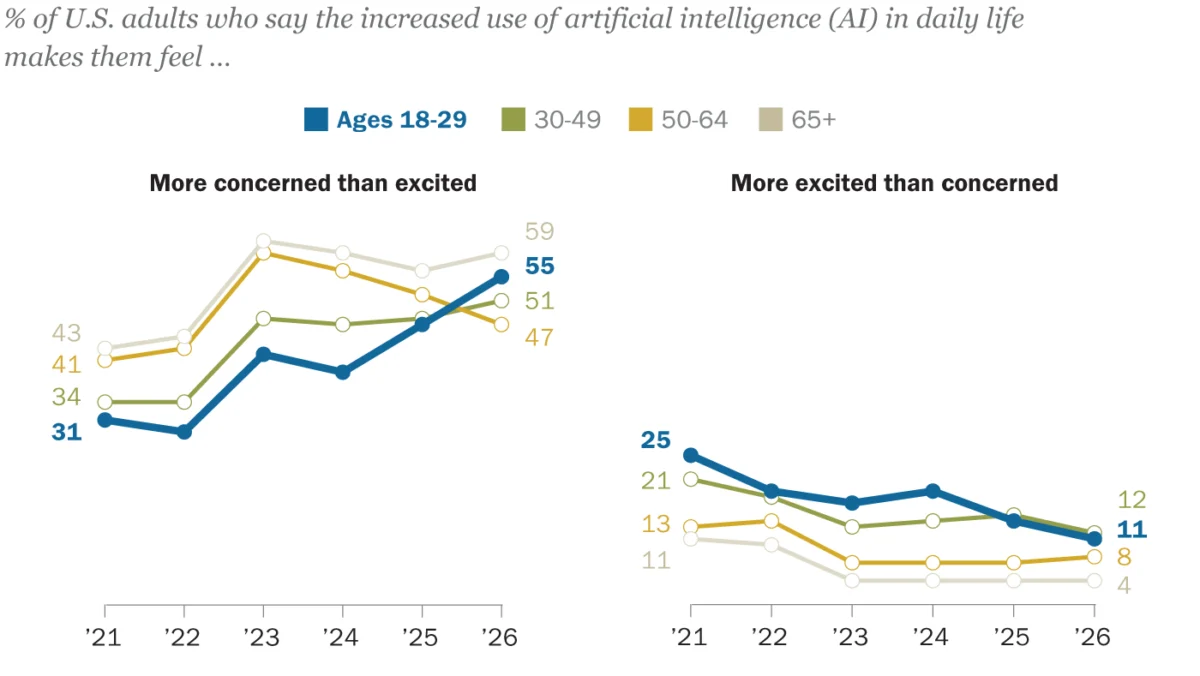
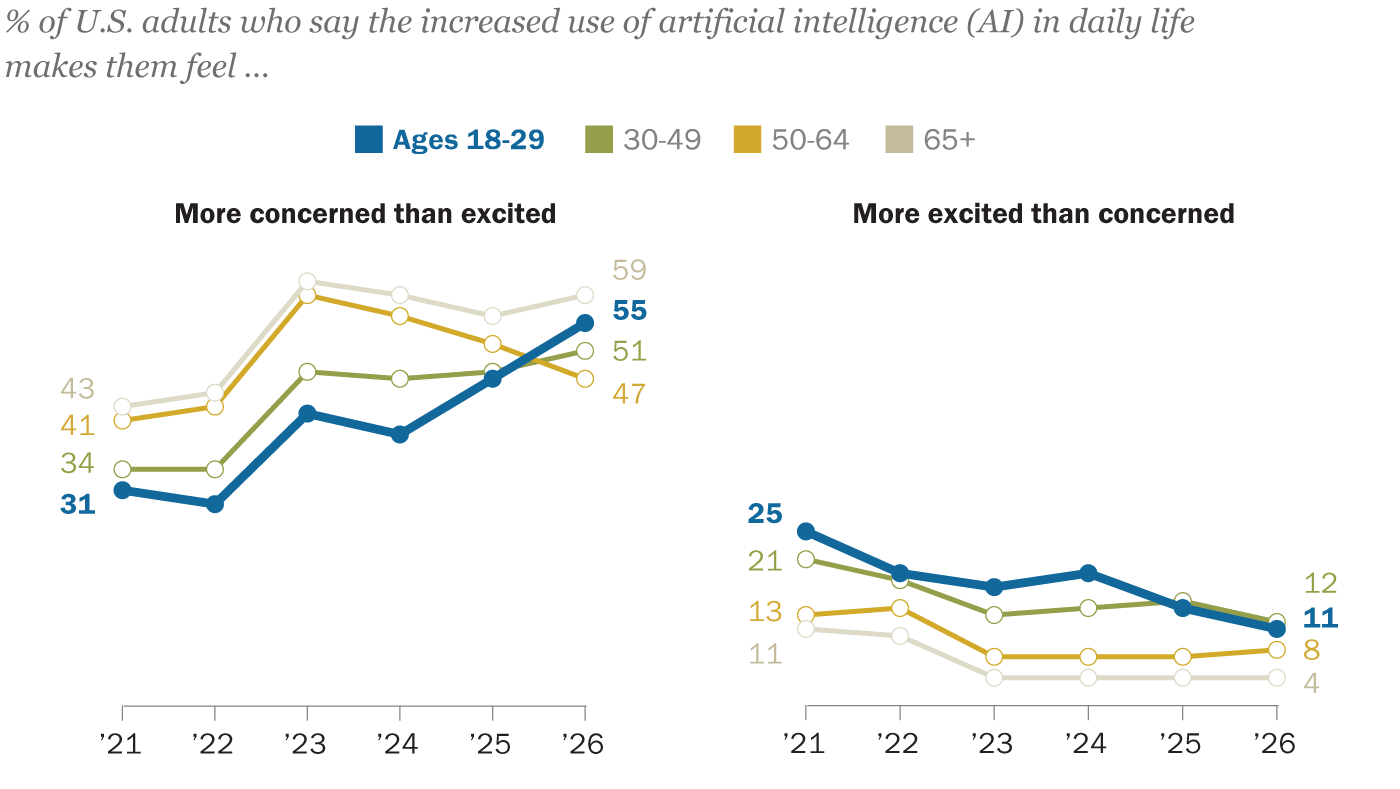
The latest survey, conducted by the Pew Research Center between June 22 and June 28, 2026, reveals that 52% of Americans are now more concerned than excited about the increased use of artificial intelligence in their day-to-day lives. This figure has seen a steady, consistent climb from 37% in 2021. In contrast, those who report feeling more excited than concerned have dwindled to a mere 9%, with 37% of respondents expressing a neutral position of being equally concerned and excited.
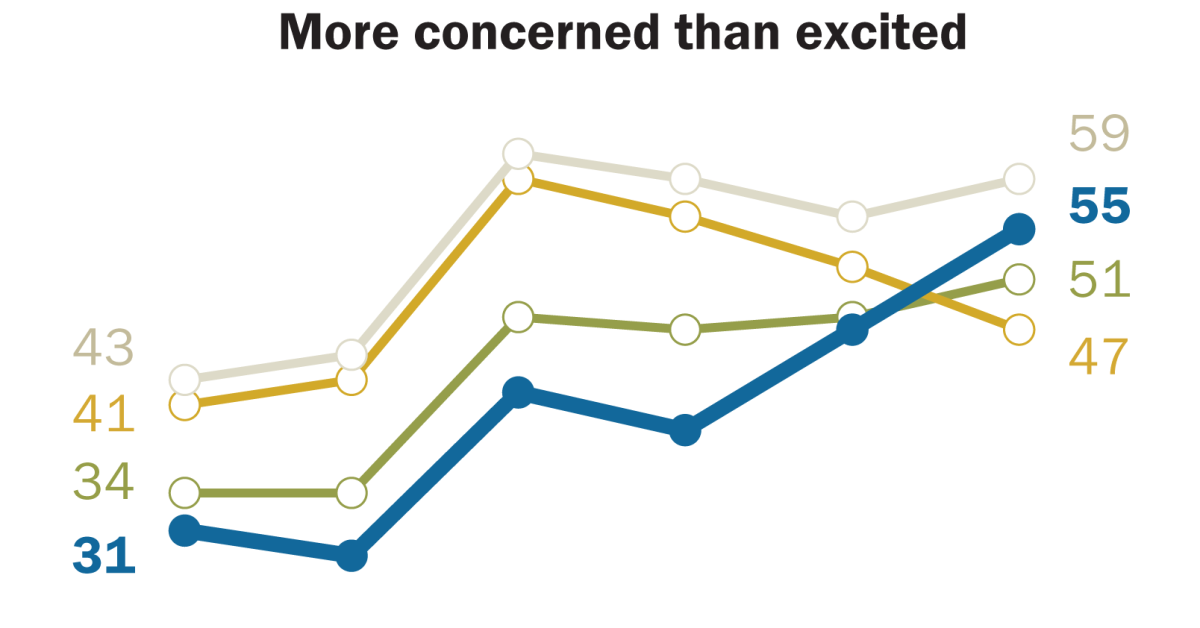
While anxiety regarding AI has historically been associated with older demographics, the most striking development in the 2026 data is the sharp rise in apprehension among the youth. For adults under the age of 30, the skepticism toward AI has reached a new threshold. In 2021, only 31% of this group felt more concerned than excited; today, that number has jumped to 55%. This demographic, often characterized by its digital fluency, now displays a level of wariness that is entirely on par with—and in some cases exceeding—that of older generations.
A Chronology of Declining Optimism
To understand the current state of public opinion, one must look at the trajectory of these sentiments over the last half-decade.
- 2021-2022: The Era of Curiosity: When the question was first introduced in 2021, the public was relatively split. The majority of Americans felt an equilibrium between excitement and concern, with only 37% leaning toward the "concerned" category.
- 2023: The Turning Point: The release of advanced generative AI models in late 2022 and early 2023 served as a catalyst for a massive shift in public perception. By 2023, the percentage of those more concerned than excited jumped to 52%, reflecting a sudden confrontation with the reality of AI’s capabilities.
- 2024-2025: Consolidation of Skepticism: The years 2024 and 2025 saw this high level of concern plateau, though it never receded. During this time, the "honeymoon phase" of AI adoption clearly ended, and the conversation shifted toward the tangible risks of automation, misinformation, and the erosion of creative autonomy.
- 2026: The New Normal: As of mid-2026, the data indicates that apprehension is not a passing phase. Instead, it has become a baseline sentiment across all age groups, with young adults leading the charge in articulating the perceived dangers of a technology-heavy future.
The Looming Threat of Job Displacement
Perhaps the most significant driver of this widespread anxiety is the fear of economic obsolescence. The 2026 survey highlights a massive surge in the belief that AI will fundamentally dismantle the traditional job market.

When asked about the impact of AI on the U.S. labor force over the next 20 years, a staggering 71% of adults now predict that the technology will lead to fewer jobs. This is a sharp increase from 64% just two years prior. The belief that AI will lead to the creation of more jobs remains a minority opinion, held by only 5% of respondents.
The demographic breakdown of this fear is equally telling. Younger workers, who are at the beginning of their careers, have experienced a dramatic spike in anxiety. In 2024, 61% of adults aged 18-29 believed AI would reduce the number of jobs; today, that figure has surged to 73%. This puts young adults in alignment with the 30-49 age bracket (74%) and the 50-64 bracket (72%). Even among those aged 65 and older, 63% believe that fewer jobs will be available due to AI, confirming that the fear of a "jobless future" has transcended generational lines.
Expert Perspectives and the Great Debate
The public’s fear of job loss is mirrored by a fierce and ongoing debate among economists and technology experts. On one side of the aisle, many analysts warn that the current speed of AI development is unprecedented and threatens to outpace the economy’s ability to create new roles. These experts point to the automation of routine cognitive tasks—from accounting and paralegal work to customer service and entry-level programming—as evidence of a looming structural unemployment crisis.

Conversely, some proponents argue that AI will act as an "augmentation" tool rather than a replacement. They suggest that the history of technological innovation, from the industrial revolution to the digital age, has consistently resulted in the creation of new categories of labor that were previously unimaginable. However, this optimistic view has struggled to gain traction with the public, who remain focused on the immediate, tangible risks to their current livelihoods.
Implications for Society and Culture
The implications of this widespread skepticism are profound. The data suggests that young adults, in particular, are becoming increasingly disillusioned with the narrative that more technology equates to more progress.
Beyond the economic sphere, the research indicates that adults under 30 are deeply concerned about the quality of human life in an AI-dominated world. They are the most likely to believe that AI will be detrimental to society, and they frequently cite concerns that the technology will make human connection, authentic creativity, and meaningful expression harder to achieve.
Even among those who actively use AI-driven tools, such as chatbots and creative assistants, there is a lingering sense of loss. Many young users report that while these tools are functional, they do not feel that they enhance their creative output—and in many cases, they feel that relying on them actively degrades their own ability to think and create independently.
Conclusion: A Call for Transparency and Trust
The findings from the Pew Research Center’s 2026 survey act as a clarion call for policymakers, tech developers, and industry leaders. The current climate of apprehension is not merely a communication failure; it is a direct result of the public witnessing the rapid, often disruptive, deployment of technologies that have significant consequences for their daily lives and future security.
As we move forward, the challenge for the architects of AI will be to address these deep-seated concerns. If the goal of the AI revolution is to benefit humanity, the industry must move beyond simply demonstrating technical capabilities. It must prove that it can offer security, sustainability, and—above all—a path forward that includes, rather than excludes, the human worker. Until then, the shadow of concern will likely continue to lengthen, casting a skeptical light on the next phase of the digital age.

About this Research
This analysis was conducted by the Pew Research Center, using data from the American Trends Panel, a nationally representative survey of 3,488 U.S. adults. The survey was fielded between June 22 and June 28, 2026, to provide a comprehensive look at how public opinion on AI has evolved since 2021. The research team, led by senior researcher Colleen McClain and research analyst Eugenie Park, focused on identifying the key drivers of public anxiety and the demographic variations in support and skepticism regarding AI’s long-term societal impact.
About the Author