The landscape of American manufacturing is undergoing a seismic shift. As labor volatility persists and the demand for supply chain agility intensifies, the integration of robotics into packaging and processing is no longer a futuristic aspiration—it is a competitive necessity. According to a landmark study produced by PMMI (The Association for Packaging and Processing Technologies) in collaboration with market intelligence firm Interact Analysis, the U.S. robotics market for this sector is poised for explosive growth.
Valued at over $440 million in 2025, the market is projected to nearly double within the next five years, reaching approximately $800 million by 2031. This trajectory represents a robust compound annual growth rate (CAGR) of 10.3%, signaling a fundamental transformation in how goods are handled, packaged, and processed across the United States.
Main Facts: A Market at an Inflection Point
The data paints a clear picture: robotics is transitioning from a niche solution to a cornerstone of modern industrial operations. The report highlights that the "automation of everything" is becoming a tangible reality, driven by a convergence of technological maturity and shifting operational priorities.
The market’s expansion is not merely quantitative; it is qualitative. While traditional industrial robots have long held the spotlight, the next six years will see a dramatic reordering of the robotics hierarchy. The shift favors flexibility and mobility over static, repetitive automation, as manufacturers seek to create "smart" facilities that can adapt to rapid changes in consumer demand and SKU complexity.
Chronology: The Evolution of Industrial Automation
To understand the current momentum, one must view the timeline of adoption.
- Pre-2020: Robotics in packaging was largely limited to large-scale, high-volume production lines where static industrial robots performed singular, high-speed tasks like palletizing or case packing.
- 2020–2025 (The Catalyst): The global supply chain disruptions and the acute labor shortage forced a rapid re-evaluation of human-machine interaction. This period saw the rise of collaborative robots (cobots) and the initial deployment of autonomous mobile robots (AMRs) in warehouses.
- 2025 (The Baseline): With a market valuation of $440 million, industrial robots dominated with a 63% share, while mobile robots captured 32% and cobots accounted for 5%.
- 2026–2030 (The Scaling Phase): Industry analysts expect a massive influx of capital into infrastructure as companies pivot toward end-to-end automation.
- 2031 (The Forecasted Maturity): The market reaches $800 million. Mobile robots emerge as the dominant force, and humanoid robotics moves from experimental pilot programs to becoming a recognized, 5% slice of the market.
Supporting Data: The Changing Anatomy of the Robot Fleet
The most compelling aspect of the PMMI/Interact Analysis study is the projected redistribution of market share among different robotic classes.
The Rise of Mobile Robotics
Currently, industrial robots represent the lion’s share of the market. However, by 2031, mobile robots are forecast to ascend to the top, capturing 45% of the total market share. This shift is reflective of a broader need for "intralogistics" efficiency—the ability to move goods between processing stations, storage, and shipping docks without human intervention.
The Humanoid Frontier
Perhaps the most intriguing data point is the growth of humanoid robots. Currently a nascent segment holding just 0.1% of the market, it is expected to grow to 5% by 2031. While this remains a small portion of the total, the percentage increase represents a massive acceleration in R&D and field testing, suggesting that the "general-purpose" worker bot is rapidly approaching commercial viability.
Adoption Statistics
The optimism is not just theoretical; it is reflected in the behavior of those on the front lines.
- End-User Adoption: 72% of surveyed end users currently employ robotics, a figure expected to climb to 95% by 2031.
- Investment Intentions: 61% of end users plan to increase their robotics investment over the next 12 months.
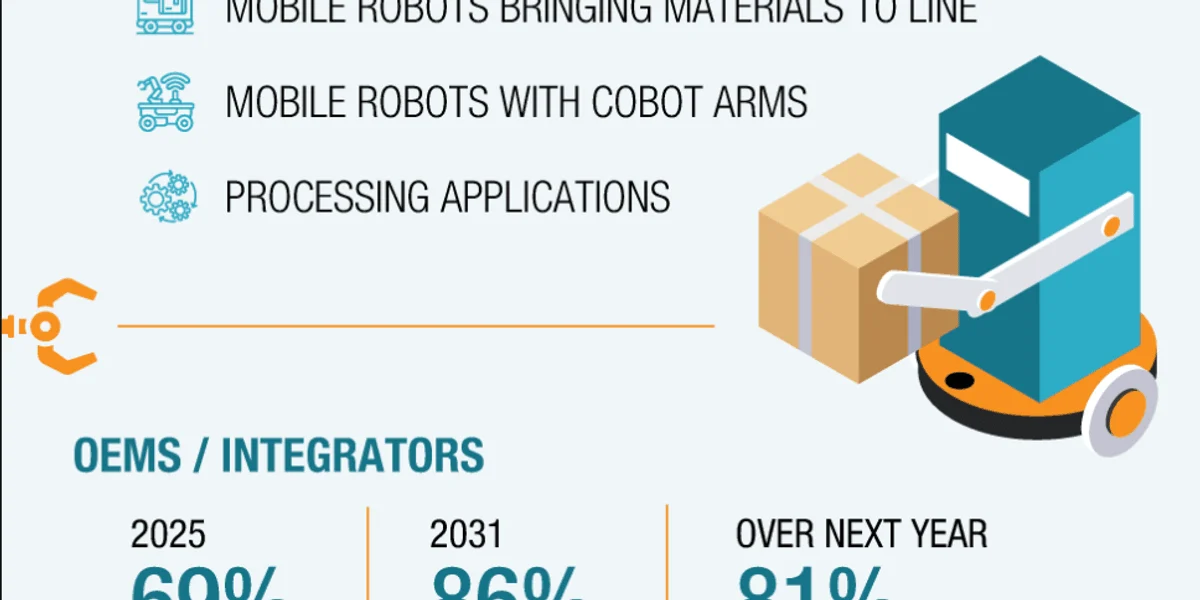
- OEM and Integrator Readiness: The supply side is keeping pace. 69% of OEMs and integrators currently include robotics in their portfolios, with 86% expected to do so by 2031.
Official Responses: Insights from Industry Leadership
Jorge Izquierdo, vice president of market development at PMMI, emphasizes that the industry is undergoing a "paradigm shift" in how it views the value proposition of automation.
"Robotics adoption is moving from targeted applications toward a broader role in packaging and processing operations," says Izquierdo. "The research shows that end users are looking beyond labor availability alone. They are prioritizing measurable gains in throughput, cost, quality, and consistency—and they expect reliable systems, strong service, and a clear path to ROI."
According to Izquierdo, the "labor crunch" was the spark, but the "efficiency mandate" is the fuel. Companies are no longer just trying to fill gaps in their workforce; they are trying to redesign their operations to be more resilient, data-driven, and scalable.
Implications: The Drivers and the Hurdles
While the growth projections are stellar, the industry is not without its challenges. The report identifies a distinct set of motivations and obstacles that will define the next decade of development.
The Three Pillars of Adoption
- Throughput and Productivity: In an era of instant gratification, the ability to pack and process goods faster is the ultimate competitive advantage.
- Cost Reduction: Automation helps mitigate the rising costs of labor, materials, and energy.
- Quality and Consistency: Robotics eliminates the "human error" factor, ensuring uniform packaging that meets the stringent requirements of modern retail and e-commerce.
The Persistent Hurdles
Despite the enthusiasm, the report highlights three critical barriers that OEMs and end users must overcome to reach the 2031 goals:
- High Upfront Costs: The capital expenditure required for high-end robotics remains a significant hurdle for small-to-medium-sized enterprises (SMEs). The industry will likely see a surge in "Robotics-as-a-Service" (RaaS) models to lower this entry barrier.
- Integration Complexity: Integrating new robotic systems into legacy environments is notoriously difficult. Facilities are often a patchwork of machines from different generations and manufacturers, making interoperability a primary pain point.
- Maintenance and Service Support: As systems become more complex, the need for specialized technicians grows. Companies are currently struggling to find or train the talent required to maintain these sophisticated, high-speed robotic fleets.
Conclusion: Preparing for the Future
The journey to an $800 million market by 2031 is not just about installing more hardware; it is about building a foundation for a more automated, efficient, and flexible future. The transition toward mobile and eventually humanoid robotics signals that the industry is ready to tackle the "last mile" of automation—tasks that were previously thought too complex or dynamic for machines to handle.
For manufacturers, the message is clear: the question is no longer if they should integrate robotics, but how to do it effectively. Those who successfully navigate the challenges of integration and maintenance, while focusing on the long-term ROI of higher throughput and quality, will find themselves at the forefront of the next industrial revolution. As the PMMI data demonstrates, the future of packaging and processing is robotic—and it is arriving faster than many anticipated.
About the Author