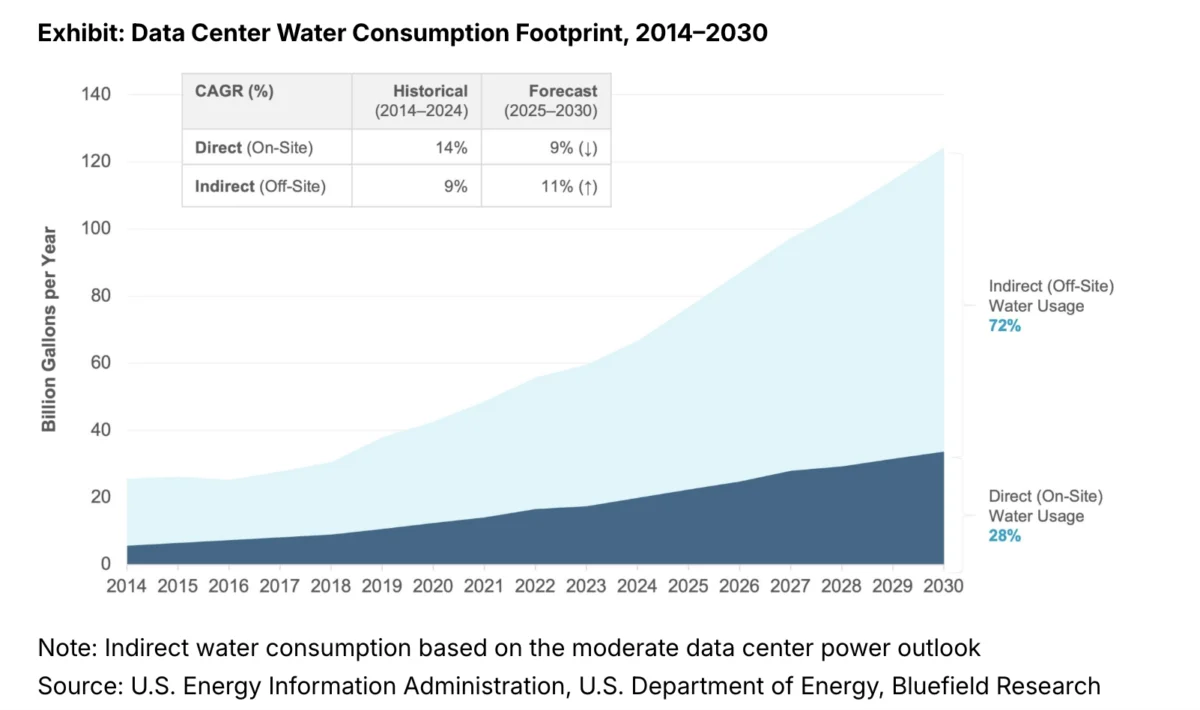
In the quiet, climate-controlled corridors of the world’s data centers, the hum of servers processing the world’s emails, social media feeds, and Artificial Intelligence (AI) queries suggests a sterile, dry environment. Yet, behind this digital curtain lies a staggering hydrological reality. While the industry has long focused on the water used for on-site cooling, a far more significant and "hidden" water footprint is emerging: the trillions of gallons required to generate the electricity that keeps these facilities running.
A landmark analysis published on August 25 by the sustainability nonprofit Ceres reveals that the thirst of data centers is far greater than previously understood. In just seven U.S. states that host over half of the nation’s data centers, thermal electricity generation—including fossil fuels and nuclear power—requires between 3 and 4 trillion gallons of water withdrawals annually. As the AI revolution accelerates, the "water-energy nexus" is becoming a flashpoint for environmentalists, regulators, and the tech giants themselves.
Main Facts: The Invisible Hydrological Footprint
The central finding of the Ceres report, "Water Behind the Watts," is that the indirect water consumption of data centers—the water used by power plants to generate electricity—dwarfs the direct water used on-site for cooling. This "indirect" usage is often excluded from corporate sustainability reports, creating a massive gap in public understanding of the industry’s environmental impact.
Key findings from the report and supplementary research include:
- The Virginia Benchmark: In 2024, the electricity required to power data centers in Virginia alone will necessitate water withdrawals estimated at 21 times the annual water usage of the entire city of Washington, D.C.
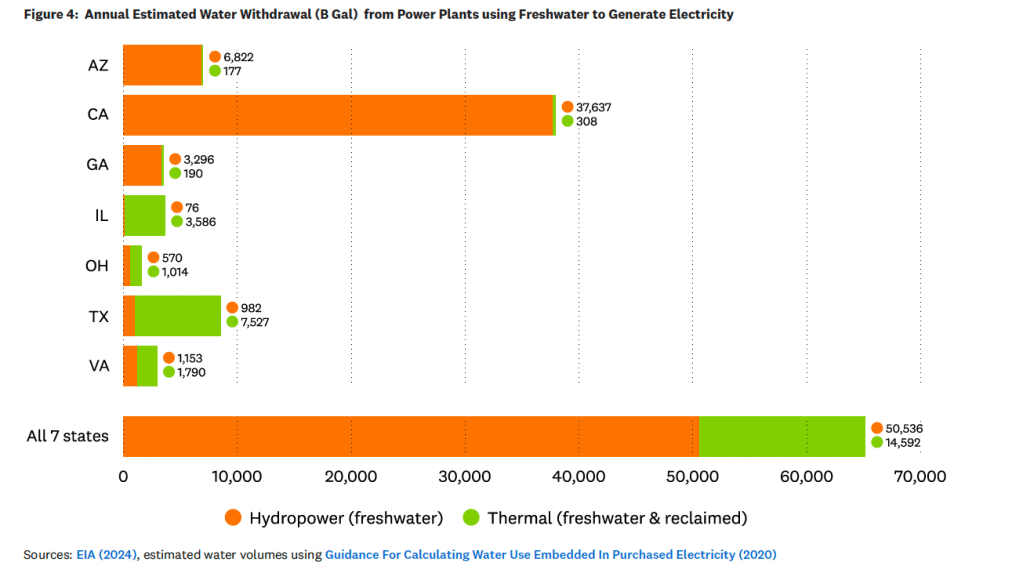
- The Scale of Withdrawal: Across seven key states—Virginia, California, Texas, Arizona, Illinois, Ohio, and Georgia—electricity generation for data centers accounts for 3 to 4 trillion gallons of water withdrawals.
- The Power Source Paradox: While renewable energy is often touted as the solution, different energy sources have vastly different water footprints. Hydroelectric power and traditional thermal plants (coal, gas, nuclear) are the most water-intensive, while wind and solar are the most "water-frugal."
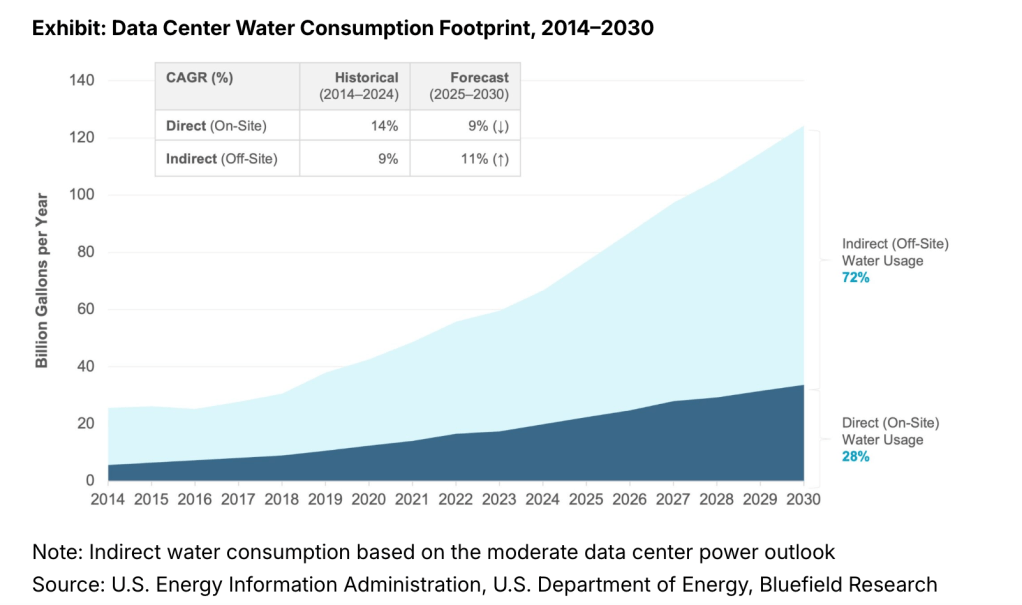
- Future Projections: Research from Bluefield Research suggests that the water needed for data center power generation is doubling annually. By 2030, this indirect usage is expected to account for more than 70% of the industry’s total water consumption.
Chronology: From Efficiency Gains to the AI Surge
To understand how the industry reached this point, one must look at the evolution of data center management over the last two decades.
2000–2010: The Era of PUE
During the early growth of the internet, the industry focused almost exclusively on Power Usage Effectiveness (PUE). The goal was to ensure that as much electricity as possible went to the servers rather than the cooling systems. During this time, water was seen as a "cheap" tool for cooling, leading to the widespread adoption of evaporative cooling towers.
2010–2020: The Rise of the Hyperscalers
As Amazon, Google, and Microsoft began building massive "hyperscale" facilities, they faced increasing scrutiny over their carbon footprints. This led to a massive push for Power Purchase Agreements (PPAs) for wind and solar energy. However, while these companies were matching their carbon output with renewables, the physical grid they relied upon remained heavily dependent on water-intensive thermal and hydro sources to maintain 24/7 reliability.
2021–Present: The AI Explosion
The arrival of Generative AI has fundamentally shifted the math. AI chips, such as those produced by Nvidia, require significantly more power per rack than traditional cloud servers. This surge in power demand has forced utility companies to delay the retirement of coal plants and fast-track the construction of new natural gas facilities. This shift back toward fossil-fuel-burning thermal plants has inadvertently sent the industry’s indirect water consumption skyrocketing.
Supporting Data: A State-by-State Crisis
The Ceres report highlights how geography and local energy mixes dictate the severity of the water crisis.
California: The Hydroelectric Burden
California used more water for data center power than any other state analyzed—nearly 1.4 trillion gallons. This is largely due to the state’s heavy reliance on hydroelectric power. While "green" in terms of carbon, large-scale hydro is incredibly water-intensive due to the massive amounts of water that evaporate from reservoir surfaces.
Virginia and Ohio: The Thermal Heavyweights
In states like Virginia, Georgia, and Ohio, more than 90% of indirect water use is linked to thermal generation. These states rely on a mix of natural gas, coal, and nuclear power. These plants operate on a steam cycle; they boil water to turn turbines and require even more water to cool the steam back into liquid. In "Data Center Alley" (Northern Virginia), the sheer density of facilities is putting unprecedented pressure on the regional watershed.
Texas: The Renewable Outlier
Texas emerged as a relatively positive model in the report. Despite having a massive data center footprint, its average water use per megawatt-hour was lower than its peers. This is attributed to the high penetration of wind and solar resources in the ERCOT grid, which require virtually no water to generate electricity.
Arizona and Illinois: The Risk of Water Stress
The report identifies Arizona and Illinois as the states most exposed to "water stress." In these regions, the high water withdrawals for power plants compete directly with agricultural needs and residential drinking water, especially during periods of prolonged drought.
Official Responses: Industry and Expert Perspectives
The lack of standardized reporting has become a primary target for critics. Shama Perveen, Director of Water Research at Ceres and co-author of the report, emphasizes that transparency is the first step toward mitigation.
"This is the foundation for better understanding water risk linked to procuring electricity," Perveen stated. She urged tech companies to work with power producers in a "precompetitive space" to establish best practices that minimize impacts on local water resources, particularly in regions already suffering from water scarcity.
However, the industry is struggling with a lack of clear metrics. Jonathan Koomey, a prominent researcher on data center energy and water use, points out that the current data landscape is chaotic. "It’s a real problem the industry needs to figure out," Koomey said. "They are being confronted with numbers that are all over the place. People don’t have a clear way to measure this, and there aren’t clear standards."
While companies like Microsoft, Google, and Meta have announced "Water Positive" goals—promising to return more water to the environment than they consume by 2030—these pledges often focus on direct on-site usage or local watershed restoration projects. Critics argue that these goals are incomplete if they do not account for the trillions of gallons withdrawn by the utilities providing their power.
Implications: The Future of the Digital-Water Nexus
The findings of the Ceres and Bluefield Research reports have profound implications for the future of the technology sector, the environment, and public policy.
1. Regulatory Pressure and ESG Reporting
As the "hidden" water cost becomes public, regulators are likely to demand more rigorous Environmental, Social, and Governance (ESG) disclosures. Future regulations may require data center operators to report not just their PUE, but their "Water Usage Effectiveness" (WUE) across the entire value chain, including the supply-side water used for power.
2. Strategic Site Selection
The era of building data centers wherever power is cheapest may be coming to an end. "Water stress" is becoming a critical factor in site selection. Companies may begin to favor regions with high wind and solar availability—not just for carbon credits, but to insulate themselves from the operational and reputational risks associated with high water withdrawals.
3. The Natural Gas Conflict
The recent trend of tech companies like Amazon and Meta supporting the addition of new natural gas capacity to meet AI demands is now under a double-lens of scrutiny. Not only does natural gas complicate net-zero carbon goals, but it also locks in decades of high water consumption. This creates a strategic tension between the need for rapid AI scaling and the commitment to environmental stewardship.
4. Technological Innovation in Cooling and Generation
The crisis is driving innovation in "waterless" cooling technologies, such as liquid-to-chip cooling and closed-loop systems. However, as the Ceres report proves, fixing the cooling at the data center is only half the battle. The real solution lies in decarbonizing—and "de-watering"—the power grid itself.
Conclusion
The digital world is not as ethereal as it seems. Every gigabyte processed and every AI prompt answered has a physical cost that flows through the nation’s rivers and lakes. As the thirst of the data center industry continues to grow, the "Water Behind the Watts" can no longer remain a hidden figure in a corporate ledger. The tech industry, which prides itself on solving the world’s most complex problems through data, now faces a challenge that requires a more ancient solution: the responsible stewardship of our most precious natural resource.
About the Author