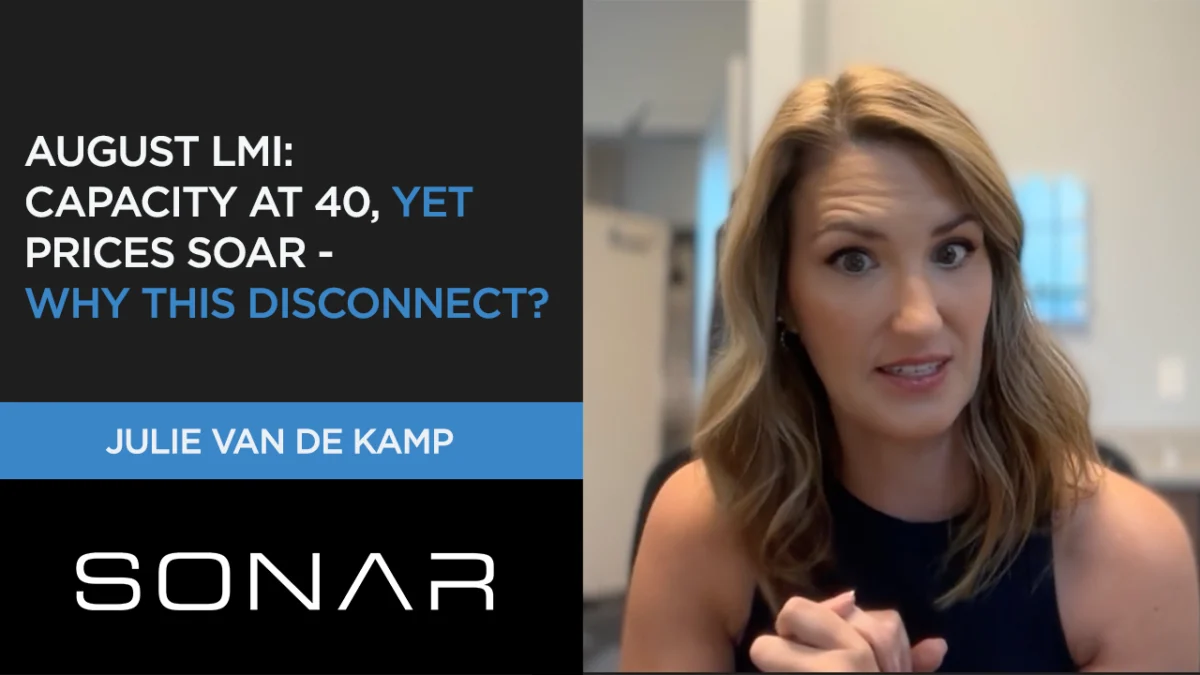
The logistics landscape is currently navigating a complex, paradoxical environment that challenges conventional economic wisdom. According to the August Logistics Managers’ Index (LMI), the industry is witnessing a decoupling of traditional market signals: transportation capacity continues to contract at an aggressive pace, yet transportation prices are skyrocketing. This friction has created a precarious operational environment for carriers, many of whom are desperate to restore profitability after enduring a multi-year cycle of depressed rates and inflationary cost pressures.
As the industry pivots toward the final quarter of the year, supply chain managers and logistics executives are finding that the traditional levers of demand and supply are failing to move in lockstep. With transportation prices hitting a reading of 90 on the LMI—a stark contrast to historical norms—the market is signaling that the era of "cheap freight" may be decisively over.
The State of the Market: Key Data Points
The August LMI report, which provides a comprehensive pulse of the nation’s supply chain, landed at an overall reading of 66.6. While this represents a modest 2.2-point decline from July, the internal metrics tell a more nuanced story of a sector under significant structural stress.
The primary drag on the overall index was a deceleration in inventory growth. However, the standout figure remains the Transportation Capacity Index, which registered at 40. While any reading below 50 indicates contraction, a 40 is particularly significant because it represents an 11-point improvement from July, marking the slowest rate of contraction seen in half a year.
Counterintuitively, as capacity contraction moderated slightly, Transportation Utilization surged 5.6 points to reach 70.6. This is a critical threshold; in the context of the LMI, a reading above 70 is categorized as "robust growth." This has occurred only twice in the past five years, underscoring that while capacity is still tight, the volume of goods moving through the network is placing an unprecedented strain on existing assets.
A Chronology of the Current Cycle
To understand the current state of the freight market, one must look at the historical trajectory of the last three years. The industry is currently emerging from a period defined by extreme volatility, beginning with the pandemic-era logistics boom and followed by a prolonged, punishing "freight recession."
- 2023: This period was characterized by a rapid normalization that quickly devolved into a buyer’s market. In August 2023, the LMI reported a capacity reading of 60, reflecting an oversupply of trucks. Transportation prices sat at a lowly 42, signaling a difficult environment for carriers who were unable to cover the surging costs of fuel, insurance, and labor.
- 2024: The market began to show signs of stabilizing, but the transition remained painful. Capacity levels shifted toward 55, and prices hovered around 61, indicating a slow, uneven crawl toward equilibrium.
- 2025-2026 (Present): The current climate is a departure from previous years. The August 2026 capacity reading of 40 is a dramatic reversal from the 57 recorded in the same month last year. Simultaneously, the price index of 90 represents an "incredible increase" in year-over-year pricing, marking a fundamental shift in market power back toward the carrier.
Manufacturing Pulse and Economic Sentiment
The logistics market does not exist in a vacuum; it is inextricably linked to the health of the manufacturing sector. The ISM Manufacturing PMI for August came in at 54.6, slightly below the economist consensus of 55.2. Despite this slight miss, the manufacturing sector remains in expansion territory.
Notably, the New Orders Index remained positive for the eighth consecutive month, sitting at 53.7. This indicates that despite broader macroeconomic concerns, the underlying demand for manufactured goods is holding steady. Furthermore, manufacturing employment turned positive for the second straight month in August, following a 33-month slump.
However, sentiment among respondents remains guarded. In the latest survey, 58% of respondents expressed negative sentiment, with pricing volatility consistently cited as the primary concern. As manufacturers grapple with the rising costs of transporting their goods, they are passing those costs along to consumers, which creates a ripple effect throughout the economy.
Expert Perspective: The Case for Profitability
Julie Van de Kamp, a prominent voice in logistics analysis, frames the current pricing surge as an existential necessity for the carrier community. In a recent analysis, she noted that the industry has survived a "multi-year, really, really tough environment where it was nearly impossible to be profitable."
"At some point," Van de Kamp remarked, "carriers have to get rates back up to a price point that’s profitable so they can continue to invest in capable and competent drivers, safety, and maintenance."
This perspective shifts the narrative from one of "greed" to one of "sustainability." For years, shippers enjoyed the benefits of an oversupplied market where rates were often driven below the cost of operation. The current surge in pricing is, according to this view, a market correction—a necessary adjustment to ensure that the infrastructure of the trucking industry, including the workforce and the equipment, remains viable for the long term.
Strategic Implications for Supply Chain Managers
The disconnect between capacity and price suggests that the next 12 months will be characterized by sustained tension. Logistics managers must prepare for a landscape where capacity is "absolutely in that contraction range and incredibly tight," according to Van de Kamp.
For supply chain professionals, this means that simple cost-reduction strategies are no longer sufficient. Instead, companies must pivot toward:
- Reliability over Price: In a tight capacity environment, securing a guaranteed spot on a truck is more valuable than negotiating the lowest possible rate.
- Regional Monitoring: As import-driven demand builds into the fourth quarter, companies must pay closer attention to regional variations in capacity, particularly in the Midwest and along the coastal ports.
- Data-Driven Decision Making: Relying on legacy pricing models is a recipe for failure. Utilizing real-time data, such as the Sonar Tender Rejection Index (STRI) and the National Truckload Index (NTI), is essential for anticipating shifts in spot rates and volume before they impact the bottom line.
Looking Ahead: The Peak Season Forecast
As the industry approaches the peak shipping season, the focus shifts to three critical Sonar metrics that will define the Q4 outlook:
- The Sonar Tender Rejection Index (STRI): This will be the primary barometer for capacity signals. A high tender rejection rate suggests that carriers are increasingly selective, choosing higher-paying loads over lower-margin freight.
- The Sonar Truckload Volume Index (STVI): Monitoring regional volume shifts will be vital for shippers looking to secure capacity ahead of competitors.
- The National Truckload Index (NTI): As the national benchmark for spot rates, the NTI will provide the most immediate signal of how quickly pricing pressures are being transmitted from the carrier to the shipper.
Conclusion: A New Normal?
The August LMI report confirms that the logistics industry is in the midst of a significant structural transition. The paradox of tightening capacity and surging prices is not a temporary anomaly; it is a clear indicator that the market is recalibrating to support a profitable and sustainable carrier base.
For shippers, the challenge of the coming year will not be finding a way to return to the depressed rates of 2023, but rather finding a way to integrate higher, more volatile transportation costs into their business models. By focusing on data-driven procurement and prioritizing long-term partnerships with carriers, businesses can navigate the current turbulence and ensure that their supply chains remain resilient in an increasingly complex global economy.
As we look toward the upcoming FreightWaves F3: Future of Freight Festival, these themes of compliance, innovation, and market sustainability will take center stage, providing a roadmap for the industry as it charts a course through the remainder of 2026 and beyond.
About the Author