The global sustainability movement is reaching a critical inflection point. For the better part of a decade, the corporate world has meticulously constructed a sophisticated ecosystem of climate accountability. We have seen the rise of the Science Based Targets initiative (SBTi), the Task Force on Climate-related Financial Disclosures (TCFD), and a litany of net-zero pledges that signal a high-level commitment to the planet. However, as the artificial intelligence (AI) revolution takes hold, a glaring contradiction has emerged: we have built a system that is far more effective at scrutinizing climate delivery than it is at enabling it.
As tech giants like Amazon, Google, and Microsoft grapple with the astronomical energy demands of generative AI, the limits of individual corporate action are being laid bare. The central challenge of the next decade will not be setting more ambitious targets, but rather building the shared execution capacity required to meet them.
Main Facts: The Accountability-Execution Gap
At the heart of the current climate crisis in the tech sector is a fundamental misalignment between corporate responsibility and systemic control. For years, the prevailing model of corporate sustainability has been "individualist." We ask individual companies to set their own targets, design their own transition plans, and account for their own progress as if they operate in a vacuum.
This model worked—or appeared to work—when the primary task was "low-hanging fruit" like efficiency gains or purchasing renewable energy credits. But as the AI boom accelerates, the hardest constraints on climate delivery now sit outside the organizations being held accountable. Internal corporate effort, no matter how well-funded, cannot solve a system-wide limitation like an aging power grid or a lack of carbon-neutral baseload power.
The Power Struggle
For AI, the most immediate and visceral constraint is electricity. AI models require exponentially more power than traditional computing. A single ChatGPT query is estimated to consume nearly ten times the electricity of a standard Google search. This surge in demand is growing faster than the energy system can expand.
Consequently, "hyperscalers"—the massive cloud providers—are forced into a zero-sum game. To keep their AI leads, they must secure generation and grid access individually. Often, because clean energy infrastructure cannot be built fast enough, these companies are forced to rely on fossil fuels to bridge the gap, leading to a spike in emissions that contradicts their long-term climate commitments.

Chronology: From Ambition to Reality Check
To understand how we arrived at this paradox, one must look at the evolution of the corporate climate movement over the last ten years.
2014–2020: The Era of Pledges
Following the Paris Agreement, the corporate world entered a "Gold Rush" of sustainability commitments. Companies across all sectors competed to announce the earliest net-zero dates. During this period, the focus was almost entirely on accountability. New standards were created to ensure companies weren’t "greenwashing," focusing on Scope 1, 2, and 3 emissions reporting.
2021–2022: The Integration Phase
Sustainability moved from the marketing department to the C-suite. ESG (Environmental, Social, and Governance) metrics became a standard part of investor relations. However, the focus remained internal. Companies looked at their own supply chains and their own direct operations, assuming that the external environment (the grid, the regulatory landscape, the technology market) would evolve in tandem with their needs.
2023–Present: The AI Disruption
The launch of sophisticated Large Language Models (LLMs) changed the trajectory. Suddenly, the energy "glide path" that tech companies had projected was obliterated. In 2024, Google reported that its greenhouse gas emissions had climbed nearly 50% compared to 2019, citing the energy-intensive nature of AI. Microsoft similarly reported a nearly 30% increase in total emissions since 2020. The "Accountability Era" hit the "Infrastructure Wall."
Supporting Data: The Cost of Fragmented Execution
The current "fragmented" approach—where every company tries to solve the same systemic problem independently—is not just environmentally damaging; it is economically inefficient.
Research involving more than 200 practitioners across the climate deployment landscape reveals a recurring pattern of "fragmentation costs":
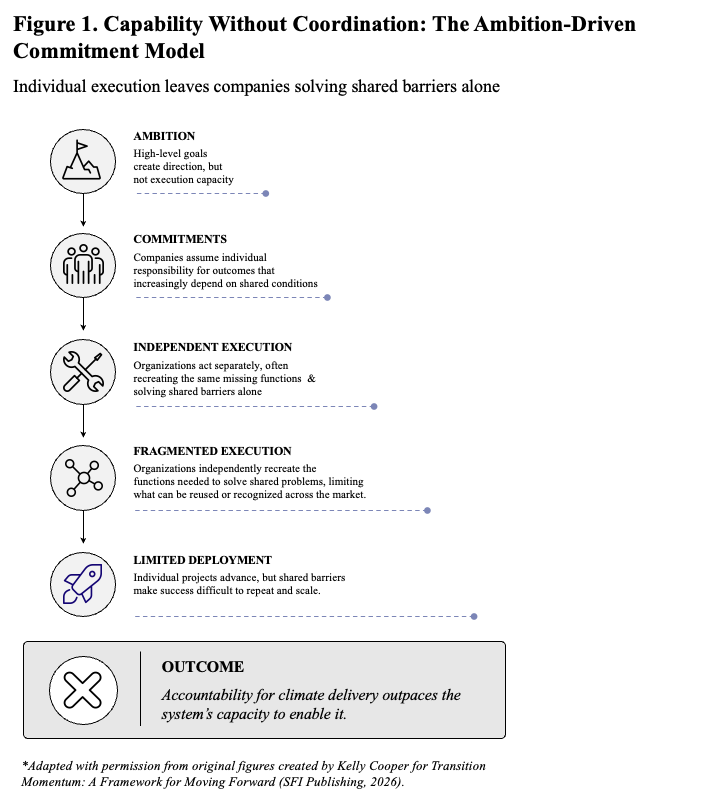
- Duplicated Effort: Hundreds of companies are independently performing due diligence on the same clean-tech startups or trying to navigate the same permitting hurdles for grid connection.
- Capital Misallocation: Capital remains disconnected from the projects that need it most because risk sits where individual actors cannot absorb it.
- Delayed Deployment: The "first-mover disadvantage" is real; the first company to try to upgrade a local substation often bears the full cost, leading many to wait for others to act first.
- Value Destruction: Persistent gaps between ambition and delivery weaken investor confidence, exposing companies to political attacks and "greenhushing" (where companies stop talking about their goals to avoid scrutiny).
In the AI sector, power is no longer just an input; it is a competitive moat. When critical infrastructure is scarce, firms compete for the very conditions the entire market depends on. This rational commercial behavior—securing power at any cost—makes collective climate action significantly harder.
Official Responses: Shifting Toward "Shared Capacity"
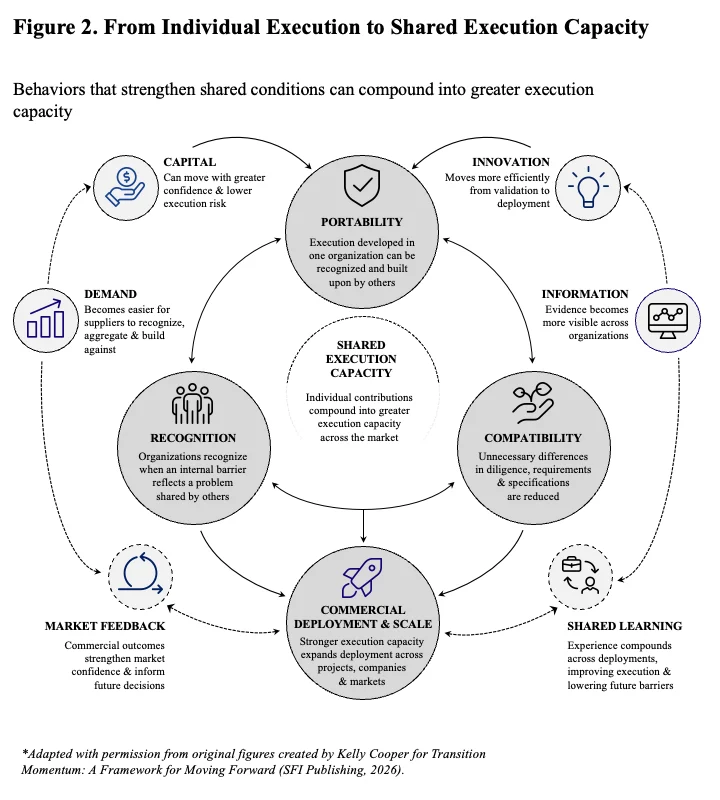
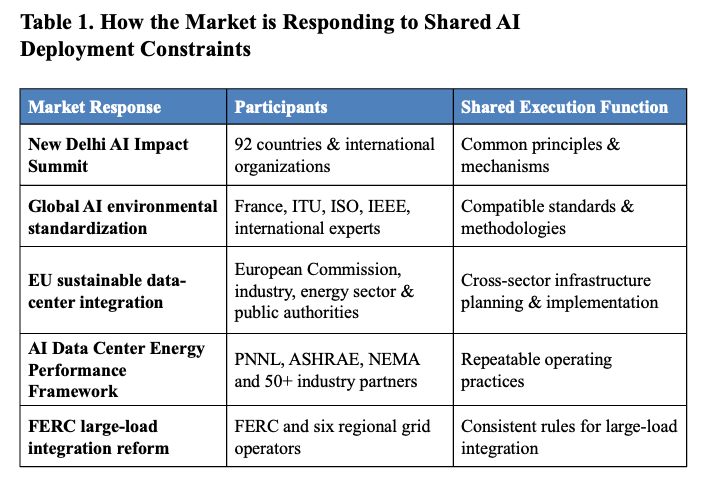
In response to these challenges, we are seeing the first signs of a shift from fragmented execution to shared capacity. Governments and industry leaders are beginning to realize that competing over a shared constraint does not remove the constraint.
Big Tech’s Nuclear Pivot
Perhaps the most high-profile response has been the move toward nuclear energy. In September 2024, Microsoft announced a landmark deal with Constellation Energy to restart a reactor at Three Mile Island. Similarly, Amazon recently purchased a 960-megawatt data center campus powered directly by a nuclear plant in Pennsylvania. These aren’t just energy deals; they are attempts to bypass a congested public grid by building or securing private "execution capacity."
The Rise of Coalitions
We are seeing the emergence of AI and climate coalitions that aim to build common rules and repeatable practices. The goal is to move toward a model where governments, regulators, and companies coordinate on infrastructure rather than leaving each company to navigate the constraints alone. These groups are looking at "demand pooling"—where multiple companies guarantee they will buy clean energy if a provider builds the plant—thereby de-risking the investment for everyone.
Regulatory Evolution
Regulators are also beginning to look at "System-Wide" reporting. There is a growing realization among standards bodies that evaluating a company solely on its internal metrics is insufficient if the external "enabling infrastructure" is the primary bottleneck.
Implications: Building the "Other Half" of the System
The AI boom has made shared constraints commercially urgent. When a lack of clean power threatens a company’s ability to lead in the most important technological race of the century, the economic incentive to fix the system becomes undeniable. This raises a vital question for the broader world: if commercial urgency can mobilize markets to build shared capacity for AI, what would it take to create the same incentives for the rest of the climate transition?
Moving from Navigation to Reduction
For sustainability practitioners, the mandate is shifting. It is no longer enough to "navigate" around fragmentation; they must work to "reduce" it. This requires a four-pronged strategic shift:
- Defining Shared Problems: Companies must stop treating every hurdle as a unique internal challenge. If a supplier cannot decarbonize because they lack access to green financing, that is a market failure, not just a procurement issue.
- Eliminating Bespoke Requirements: Fragmentation is often self-inflicted. When every company demands a slightly different carbon accounting standard or a bespoke technology specification from a vendor, they slow down the entire market. Standardizing requirements reduces friction.
- Strengthening the System: Solutions should be judged by whether they make the next deployment easier. A company that builds a private microgrid helps itself; a company that lobbies for and co-funds a public grid upgrade helps the system.
- Cross-Boundary Execution: Execution must carry across organizational boundaries. One company’s due diligence on a new hydrogen technology should be credible and usable by another, reducing the time-to-market for everyone.
The Economic Rationality of Collaboration
The sustainability ecosystem spent the last decade building the architecture for commitments and disclosure. We have the "scorecard," but we are still missing the "playing field."
The next phase of the climate journey is about building the "other half" of the system—the execution infrastructure. This isn’t about reducing competition; it’s about ensuring that competition happens in a way that doesn’t destroy the environment or the economy.
When shared execution capacity is missing, everyone loses. When it is built, it creates immediate economic value by unlocking stalled projects and realizing the commercial potential of new technologies. AI has provided the wake-up call; now, the market must decide if it is willing to build the shared foundations required to survive the very boom it created. The challenge is no longer just to "be better"—it is to "build better," together.
About the Author