The American logistics and transportation sectors are facing a precarious economic reality as retail diesel prices shattered all-time records this week. According to the latest data from the American Automobile Association (AAA), the national average for a gallon of diesel reached $5.85 on Friday, marking a significant escalation in energy costs that threaten to ripple through the entire supply chain and the broader U.S. economy.
This figure eclipsed the previous all-time high of $5.82 per gallon, a peak established in June 2022 during the volatile market conditions that followed the initial months of Russia’s invasion of Ukraine. The rapid ascent in prices over the last four days—a surge of nearly 25 cents per gallon—underscores the fragility of global energy markets and the outsized impact that international conflict exerts on domestic fuel availability.
The Chronology of a Price Spike
To understand the severity of the current situation, one must look at the trajectory of the market since the onset of the latest round of Middle Eastern tensions. Before the recent escalations involving Iran, diesel prices hovered at approximately $3.758 per gallon. In the relatively short time since those hostilities commenced, the national average has climbed by roughly $2.10 per gallon, a staggering increase that has left fleet operators and independent owner-operators scrambling to adjust their operational budgets.
The trajectory of the Ultra Low Sulfur Diesel (ULSD) contract on the Chicago Mercantile Exchange (CME)—the primary benchmark for wholesale fuel costs—provides a clear window into this volatility. On August 21, ULSD settled just under $4.50 per gallon. In the following four days, the market experienced a brief period of optimism, with prices dipping to $4.25 per gallon. This temporary relief was driven by speculation regarding potential improvements in shipping flows through the Strait of Hormuz. However, this optimism failed to account for the deeper, structural issues plaguing the global refining sector, particularly the ongoing, successful drone strikes by Ukrainian forces targeting Russian oil infrastructure.
As these fundamental supply constraints reasserted themselves, the market entered a fierce bull run. By Wednesday of this week, the ULSD contract had climbed to $4.6822 per gallon, marking a new all-time high settlement for the contract, excluding a brief 2022 outlier. For context, just one month ago on August 4, the contract sat at $3.7705 per gallon. While there has been a marginal softening of prices on the CME as of Friday morning—with ULSD dropping roughly 12 cents to $4.4739—the damage to the retail market remains pronounced.
Supporting Data and Market Fundamentals
The discrepancy between the CME wholesale price and the retail pump price is a classic indicator of the "crack spread"—the difference between the price of crude oil and the refined petroleum products extracted from it. Currently, U.S. refineries are operating at maximum capacity, or "flat out," as described by industry experts. Despite this high utilization, the supply of middle distillates remains critically tight.
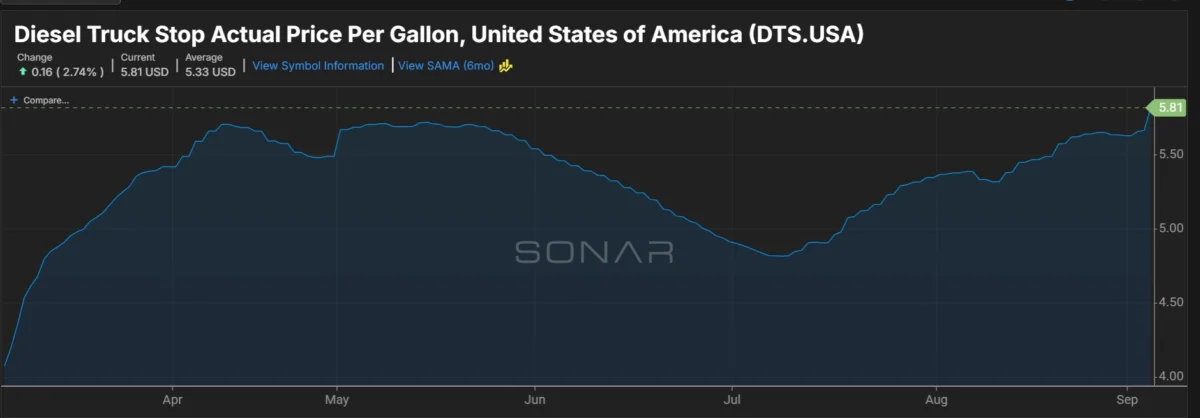
The SONAR data stream provided by DTS.USA offers an alternative perspective on these figures, recording a slightly lower, though still record-level, average of $5.81 per gallon on Friday. These figures are not merely abstract numbers; they are the direct results of a multi-step pricing process that begins at the commodity exchange and ends at the fuel island of a truck stop.
Key Factors Driving the Crisis:
- Refinery Outages: Beyond the geopolitical theater, the domestic refining sector is facing maintenance cycles and operational pressures that limit the ability to increase the supply of diesel.
- The Russian Factor: Russia remains a key global producer of middle distillates. Persistent drone strikes on its refineries have effectively curtailed global output, tightening the supply available to the international market.
- The Strait of Hormuz: As a critical chokepoint for global energy transit, the closure or restricted flow through the Strait of Hormuz has created a logistical bottleneck that prevents oil from reaching processing facilities in a timely manner.
Expert Analysis: The View from ClearView Energy
Kevin Book, managing director of ClearView Energy Partners, offered a sobering assessment of the situation in a recent appearance on CNBC. Book identified middle distillates—specifically diesel—as the single most critical item in the current energy policy discussion.
"U.S. refineries are running at absolute maximum capacity," Book stated. "This is hardly surprising when you look at the crack spreads for diesel, which are currently at historic highs. However, we are seeing a compounding effect where Middle East supplies are blocked by the situation in the Strait of Hormuz, and this is being exacerbated by the ongoing outages in the Russian refining sector."
When asked whether a reopening of the Strait of Hormuz would lead to an immediate price correction, Book expressed significant skepticism. "There are real questions about the infrastructure on the other side of that bottleneck," he explained. "Even if the shipping lanes return to normal, we have to ask if the refineries and the distribution networks are capable of flowing product as they did previously. It doesn’t seem likely right now."
Book’s testimony highlights a critical concern: that the current price levels may not be a temporary spike, but rather a reflection of a new, constrained reality for the global energy infrastructure.
Implications for the Freight and Logistics Industry
The implications of $5.85/gallon diesel are profound for the trucking industry. Diesel is the lifeblood of the American economy, powering the vast majority of heavy-duty vehicles responsible for moving goods from ports to warehouses and from warehouses to retail shelves.
Economic Ripples
For the logistics sector, high fuel costs are an immediate margin killer. Small carriers and owner-operators, who often operate on razor-thin margins, are the most vulnerable. As fuel costs increase, the "fuel surcharge" mechanisms used by many carriers are often insufficient to cover the speed at which prices are rising, leading to significant cash flow pressure.
The Regulatory Landscape
The industry is simultaneously grappling with a shifting regulatory environment. As highlighted by ongoing debates regarding the EPA’s Diesel Exhaust Fluid (DEF) rules and increasing scrutiny on driver violations, trucking companies are facing higher costs on multiple fronts. These expenses are inevitably passed on to the consumer, contributing to inflationary pressure on everything from groceries to electronics.
Future Outlook
The trucking industry is currently in a "wait and see" mode. The upcoming events, such as the FreightWaves F3: Future of Freight Festival in Chattanooga, will serve as a critical forum for industry leaders to discuss how to navigate this high-cost environment. From brokerage compliance to technological innovations aimed at fuel efficiency, the industry is searching for ways to insulate itself from the volatility of the global energy market.
However, as long as the fundamental supply-demand imbalance persists—compounded by geopolitical uncertainty in Eastern Europe and the Middle East—the outlook for diesel prices remains bearish. The transition to alternative fuels and the modernization of the U.S. power grid remain long-term solutions, but for the millions of trucks currently on the road, the current, record-breaking prices are a present-day crisis that demands immediate attention.
As we look toward the final quarter of 2026, the question for shippers, carriers, and consumers alike is not just when the prices will stabilize, but whether the infrastructure of the global energy market can ever return to the stability of the pre-conflict era. For now, the "all-time high" is not just a headline—it is the new, expensive reality of American freight.
About the Author