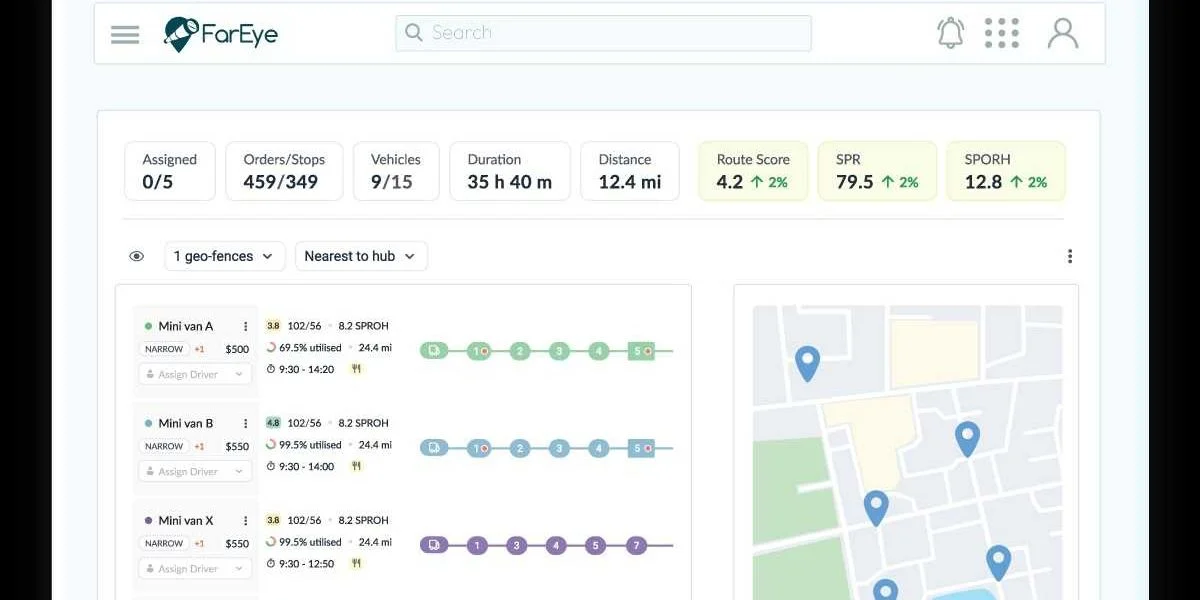
In the contemporary retail landscape, the "last mile" has transitioned from a logistical footnote to the primary battleground for customer loyalty and brand survival. However, a new comprehensive study from Chicago-based delivery software provider FarEye, titled “Eye on the Last Mile America 2026,” suggests that many U.S. enterprises are approaching this challenge with a flawed strategy. By prioritizing raw speed at the expense of infrastructure control, companies are inadvertently eroding their margins and weakening their brand promises.
The research, which synthesized over 3,000 data points from more than 500 U.S. delivery operators, paints a sobering picture of an industry grappling with persistent cost inflation, fragmented networks, and a fundamental misalignment between corporate objectives and consumer needs.
The Core Findings: Control as the New Competitive Advantage
The central thesis of the FarEye report is that the ability to exert granular control over network infrastructure and delivery data is the single greatest predictor of operational success. The data reveals a stark bifurcation in the market: organizations that have invested in centralized orchestration and visibility tools are significantly outperforming their counterparts on every key performance indicator (KPI).
The Performance Gap
The contrast between high-control and low-control operators is not merely marginal; it is transformative.
- Reliability: High-control operators report a 95% on-time delivery rate, dwarfing the 65.5% rate managed by those with fragmented or outsourced control.
- Customer Experience: One of the most expensive metrics in logistics—the WISMO (Where Is My Order?) inquiry—highlights this disparity. Companies with high control experience a median WISMO rate of just 6.2%, whereas low-control organizations face a staggering 20.8%. This gap suggests that when companies lack internal data control, they are forced to spend disproportionate resources managing customer anxiety rather than shipping product.
- Economic Resilience: Perhaps most critical in a high-inflation environment, high-control operators reported a median year-over-year cost inflation of only 8.3%, compared to a bruising 14.5% for those lacking that level of oversight.
Chronology of the Last-Mile Crisis
To understand why these findings are so critical, one must look at the recent evolution of U.S. supply chains:
- 2023–2024 (The Post-Pandemic Adjustment): Following the massive supply chain shocks of the early 2020s, businesses scrambled to diversify their fulfillment networks. The prevailing strategy was "capacity at any cost," leading to the rapid adoption of multi-carrier models and regional partnerships.
- 2025 (The Inflationary Plateau): As supply chains stabilized, companies realized that the costs they assumed were temporary spikes had become a "new normal." In 2025, the industry recorded a 12% median increase in cost per delivery, signaling that inflation was structural rather than transitory.
- 2026 (The Orchestration Era): The Eye on the Last Mile report documents the current year as a pivot point. With 88% of operators noting that delivery costs are rising at or above the rate of revenue growth, the focus has shifted from mere volume expansion to "logistics orchestration." The current environment is no longer about finding capacity, but about managing the complexity of diverse, multi-modal fleets under tight margin constraints.
Supporting Data: The "Speed Penalty" Myth
Perhaps the most disruptive finding in the study is the "Speed Penalty." For years, the industry operated under the assumption that Amazon-style rapid fulfillment was the gold standard. FarEye’s data suggests that, for the average enterprise, this is a path to financial ruin.
Performance by Strategic Priority
The researchers categorized operators based on their primary strategic driver, yielding results that challenge industry conventional wisdom:
- The Speed-First Cohort: Operators prioritizing maximum speed reported the worst outcomes: only 76% on-time performance coupled with a 24% median cost inflation. This suggests that the cost of "rushing" the last mile is exponential, not linear.
- The Predictability-First Cohort: These operators—who focus on meeting promised delivery windows rather than beating them—achieved an 88.4% on-time rate with a much more manageable 10% median cost inflation.
- The Visibility-First Cohort: This group, which prioritizes real-time data and tracking transparency, emerged as the clear winners. They achieved a 90.3% on-time performance rate with a median cost inflation of just 4.9%.
This data suggests that customers do not necessarily want their packages in four hours; they want to know exactly when they will arrive. Organizations that prioritize visibility can manage customer expectations proactively, reducing the need for expensive, high-speed shipping interventions.
The Structural Threat: Revenue vs. Costs
The financial implications of the current delivery environment are severe. The report highlights that 60% of respondents saw delivery cost increases exceeding 10% in the last year, with 20% reporting increases of over 20%.
When 88% of operators admit that their delivery costs are growing at the same pace as, or faster than, their revenue, the mathematical conclusion is clear: the current model is unsustainable. If a company cannot decouple its revenue growth from its delivery cost growth, its margins will eventually be cannibalized by its own logistics operations. This creates a "structural pressure" that necessitates a move away from manual, spreadsheet-based management toward intelligent, automated orchestration platforms.
Official Perspective: The CEO’s View
Kushal Nahata, CEO and Co-Founder of FarEye, argues that the industry is at an inflection point. In his view, the "emerging" phase of last-mile delivery is over.
“In the U.S., last-mile delivery is no longer an emerging capability; it is a highly mature, highly competitive operating environment where the differentiator is increasingly the quality of orchestration,” Nahata stated.
He emphasized that many retailers are currently misallocating capital. They believe that buying more capacity or adding more carriers will solve their problems. Instead, Nahata argues that the winners are those who can successfully integrate visibility, governance, and orchestration.
“What this research makes clear is that investment alone does not create control,” Nahata noted. “The leaders are the organizations that can translate visibility, governance and orchestration into consistent execution across the network.”
Implications: The Path Forward for Logistics Leaders
The implications of these findings for logistics leaders and C-suite executives are profound. The mandate for the coming fiscal years is clear:
1. Shift from Capacity-Centric to Data-Centric Models
Leaders must stop viewing logistics as a collection of carriers and start viewing it as a data ecosystem. The ability to pull granular data from every leg of the journey is the only way to identify inefficiencies before they manifest as cost overruns.
2. Prioritize Predictability over Velocity
Marketing departments may want to tout "two-hour delivery," but the data suggests that for most firms, "predictable, two-day delivery" is more profitable and more reliable. Aligning brand promises with operational capabilities—rather than chasing the fastest competitor—is a necessary step toward margin protection.
3. Institutionalize "Orchestration"
Orchestration is the bridge between visibility and execution. It involves using software to automatically route, re-route, and manage exceptions in real-time across a diverse fleet. Companies that rely on manual dispatching or siloed carrier portals will continue to see their WISMO rates and cost inflation climb.
4. Address the Structural Cost Gap
If delivery costs are consistently outpacing revenue, the business model must change. This might mean adjusting delivery fees for end-users, incentivizing in-store pickup, or shifting from a "speed-at-any-cost" mindset to one that rewards consolidation and route optimization.
Conclusion
The "Eye on the Last Mile" report serves as a wake-up call for the U.S. logistics sector. The industry is currently trapped in a cycle of reacting to external pressures rather than proactively managing them. By shifting the focus from the pursuit of unearned speed to the mastery of orchestration, enterprises can reclaim their margins, improve their customer experience, and build a more resilient delivery architecture for the remainder of the decade. The message is unequivocal: in the future of retail, control is not just a benefit—it is the only way to survive.
About the Author