In the modern industrial landscape, Automated Storage and Retrieval Systems (AS/RS) have long been championed as the ultimate solution for warehouse optimization. For decades, the narrative surrounding these systems focused on tactical gains: maximizing vertical storage, mitigating labor shortages, accelerating fulfillment cycles, and sharpening overall productivity. While these operational benefits remain foundational, a significant paradigm shift is underway. Today, high-tech automation is no longer merely a warehouse tool; it has become a cornerstone of corporate strategy, enabling firms to penetrate new international markets and diversify product portfolios with unprecedented agility.
As global supply chains face mounting pressure from shifting consumer behaviors, AS/RS is proving to be the primary engine for industrial resilience. This evolution is perhaps most visible in the food and beverage sector, where the race to capture the burgeoning prepared-meals market is forcing manufacturers to rethink the very architecture of their distribution networks.
The Prepared-Foods Revolution: A Market in Flux
The surge in demand for ready-to-eat meals, frozen snacks, and sophisticated meal kits is not merely a transient trend; it is a structural transformation of the food industry. According to a recent report by Core Market Research, the prepared-foods segment is projected to sustain an average annual growth rate of 10% between 2025 and 2035.
This expansion is fueled by a confluence of socio-economic factors. Busy working professionals are increasingly prioritizing convenience; the "on-the-go" lifestyle is moving from urban centers to suburban markets; and the rapid penetration of e-commerce platforms has dismantled traditional geographic barriers to food distribution.
"As competition becomes more intense, manufacturers must continuously innovate and adapt to maintain their position in the prepared-food market," analysts from Core Market Research noted. For the industry leaders, this means that the bottleneck is no longer just the kitchen—it is the supply chain. Companies that cannot move goods with the speed and accuracy required by modern e-commerce standards are finding themselves quickly eclipsed by more agile, automated competitors.
Chronology of an Operational Overhaul: The Herba Ricemills Case
To understand the strategic application of this technology, one must look at the recent transformation of Spanish rice producer Herba Ricemills. A division of the global food giant Ebro Foods, the company’s San José de la Rinconada facility in Seville serves as a bellwether for the industry.
The Pre-Automation Era
Before the intervention of advanced robotics, Herba Ricemills relied on a traditional model. While the company utilized an Enterprise Resource Planning (ERP) system to track inventory, the physical movement of goods was a manual, labor-intensive process. Operators were tasked with placing pallets on shelves or directly on the warehouse floor. As the facility expanded its reach to supply international brands—such as Minute for North America, Lassie for the Netherlands, and Cigala for Portugal—the limitations of the manual system became painfully apparent.
The Strategic Pivot
Recognizing that their legacy methods could not support their ambitious expansion plans into Africa and the Middle East, leadership at Ebro Foods decided to commission a bespoke AS/RS project from warehouse storage specialists Mecalux. The objective was clear: to transform the warehouse from a storage site into a strategic distribution hub.
Implementation and Integration
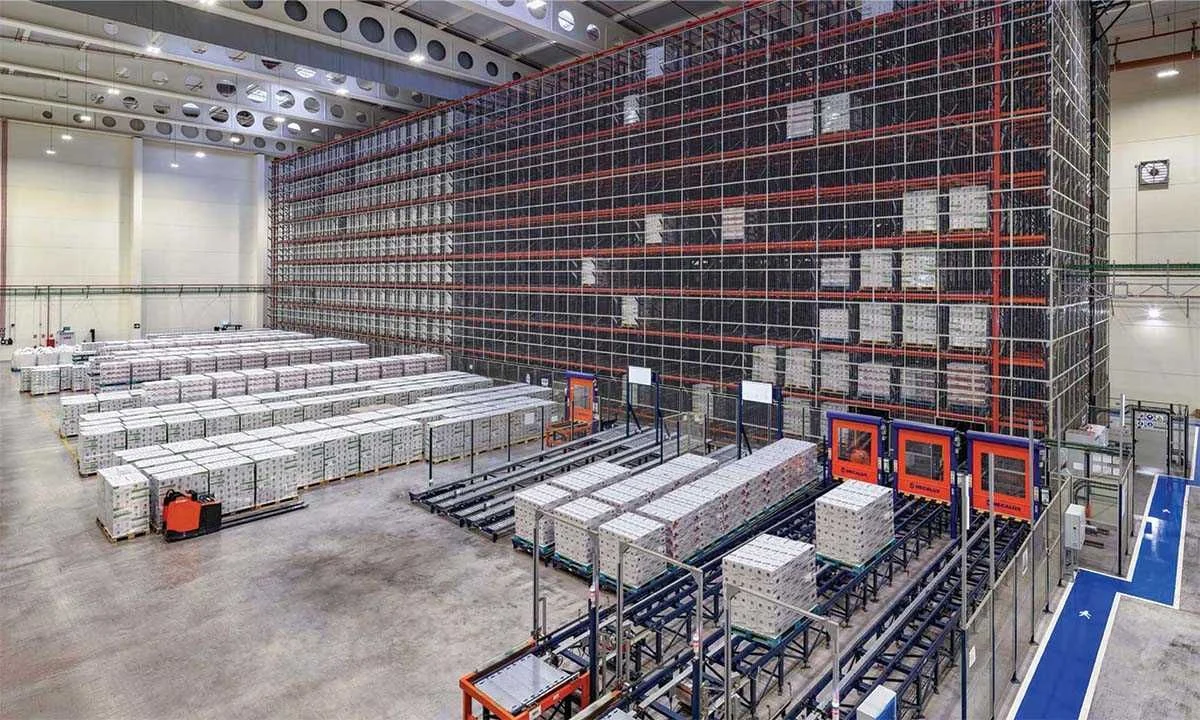
The project, which spanned several months of design and installation, resulted in a high-density racking system standing over 60 feet tall. The system was designed to house up to 5,400 pallets, utilizing a sophisticated interplay of stacker cranes and electric shuttles.
The integration process was deliberate. The facility implemented a multi-tiered flow:
- Inbound: Raw ingredients arrive at the loading docks and undergo automated inspection.
- Internal Transport: Autonomous Guided Vehicles (AGVs) ferry bulk materials from the racking to production lines.
- Production: Following cooking and packaging, finished goods are retrieved by AGVs and moved to the AS/RS infeed stations.
- Storage: A stacker crane navigates a central aisle to deliver pallets to their designated lanes, where electric shuttles finalize the storage process.
Supporting Data: Quantifying the Impact of Automation
The transition at Herba Ricemills provides a clear dataset on the return on investment (ROI) associated with high-tech logistics. According to the company’s internal review, the implementation of the Mecalux system resulted in a 25% increase in overall facility productivity. Perhaps more tellingly, the reduction in human error—a primary cause of supply chain friction—reached an impressive 95%.
Beyond these metrics, the qualitative benefits have been equally transformative. By eliminating manual intervention in the storage cycle, the facility has successfully minimized travel distances and reduced the time spent on forklift maneuvering. This "frictionless" flow ensures that the warehouse is not just storing products, but actively participating in the rapid fulfillment of international orders.
Official Perspectives: The Imperative of Innovation
The leadership at Ebro Foods views this project as a milestone in the company’s long-term sustainability. Juan Pedro Álvarez, the director of Ebro Foods’ ready-to-serve division in Andalusia, has been vocal about the necessity of this shift.
"That [manual] setup required greater flow coordination, used space less efficiently, and increased the likelihood of picking mistakes," Álvarez noted in a formal project review. "We needed a system that would maximize capacity, shorten handling times, and ensure complete traceability."
His colleague, Manuel Matías Martínez, head of warehousing and logistics management, emphasized the role of the Warehouse Management System (WMS) in providing the "brain" for the facility. "The WMS provides us with end-to-end, real-time control over our facility," Martínez explained. "We now track locations, inventory status, and product flows accurately. Training was straightforward, and the team gained full autonomy quickly."
These testimonials underscore a growing consensus in the industrial sector: automation is no longer a luxury for the ultra-wealthy, but a basic requirement for survival. As Álvarez poignantly stated, "To remain competitive, implementing the latest technologies is essential. It’s no longer a luxury—it’s an imperative. The time for innovation is now."
Implications for the Global Supply Chain
The implications of the Herba Ricemills project extend far beyond the borders of Spain. As companies worldwide grapple with the dual pressures of labor volatility and rising consumer expectations, the model of "Automating for Expansion" is likely to become the industry standard.
1. The Death of Geographic Distance
By achieving high-density storage and rapid retrieval, companies can maintain massive inventory levels closer to global transport hubs. This reduces lead times for international exports, allowing a company in Seville to compete effectively in markets as diverse as North America and the Middle East.
2. The Rise of "Intelligent" Inventory
The shift toward WMS-controlled automation allows for unprecedented data visibility. With end-to-end traceability, companies can perform dynamic quality control—using quarantine channels for inspection without slowing down the primary production line. This level of granular control is essential for food safety and regulatory compliance in global markets.
3. Sustainability and Resource Efficiency
Automation is inherently more energy-efficient than traditional manual warehousing. By optimizing the paths of AGVs and stacker cranes, companies reduce their carbon footprint per pallet moved. Furthermore, the ability to store more goods in a smaller physical footprint allows companies to grow without the environmental impact of expanding their physical facility boundaries.
Conclusion: The New Strategic Horizon
The era of the "dumb" warehouse—a passive structure used solely for storage—is coming to a definitive close. In its place, we are seeing the rise of the intelligent, integrated distribution center that acts as a strategic lever for business growth.
The story of Herba Ricemills and their partnership with Mecalux serves as a blueprint for any organization looking to scale in an uncertain economic climate. By leveraging AS/RS technology, companies are not just solving the problem of storage; they are solving the problem of growth. As consumer demand for convenience continues to accelerate, the companies that thrive will be those that have successfully transformed their supply chains into high-speed, automated, and hyper-accurate engines of value creation. The technology is available, the data is compelling, and, as industry leaders have noted, the time to innovate is not in the next decade—it is now.
About the Author