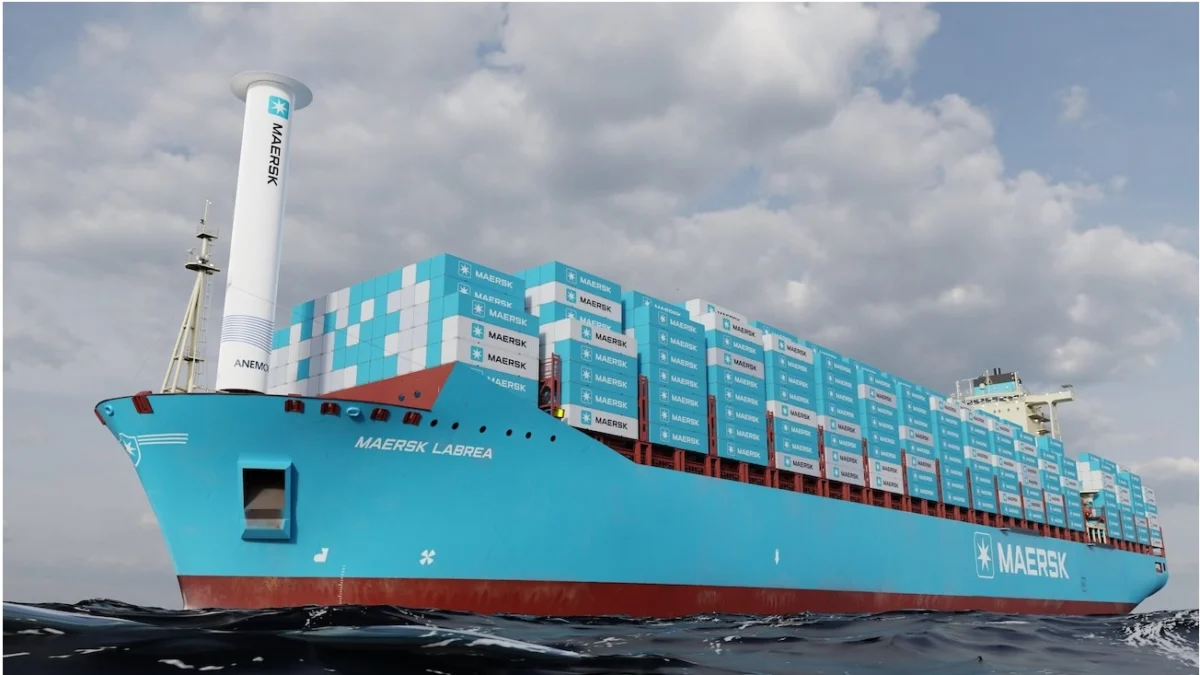
In a landmark move that signals a significant shift in maritime technology, global shipping giant A.P. Moller-Maersk has officially entered the world of wind-assisted propulsion. The company recently signed a formal agreement to retrofit a massive 8,700-TEU Lima-class container vessel with a cutting-edge "rotor sail" system, marking a pivotal moment in the industry’s transition toward decarbonization.
This strategic initiative, slated for implementation in mid-2027, represents more than just an engineering experiment; it is a calculated step in Maersk’s aggressive roadmap to achieve net-zero greenhouse gas emissions by 2040. As international regulations tighten and the environmental impact of global supply chains faces unprecedented scrutiny, wind power—the oldest form of maritime propulsion—is being reimagined through the lens of modern digital and mechanical innovation.
The Engineering Behind the Rotor Sail
The technology, developed by the London-based engineering firm Anemoi Marine Technologies, is as striking as it is functional. Standing at an imposing 115 feet in height, the rotor sail is designed to be mounted onto the deck of a 984-foot vessel. Unlike traditional fabric sails, which rely on wind resistance, the Anemoi system operates on the Magnus effect—a physical phenomenon where a spinning object creates a pressure differential in the surrounding fluid (or air).
When the cylindrical sail rotates, it interacts with the prevailing winds to generate a powerful aerodynamic thrust that propels the vessel forward. This supplementary propulsion reduces the load on the ship’s primary engines, directly translating into significant fuel savings and reduced carbon output. According to technical specifications provided by Anemoi, a typical installation involves three to five such units per ship. Each individual rotor sail is estimated to save approximately one ton of fuel per day and eliminate roughly three tons of CO2 emissions, providing a quantifiable boost to the vessel’s overall environmental performance.
A Chronology of Maritime Decarbonization
The integration of wind power into the Maersk fleet is the latest chapter in a multi-year, multi-billion-dollar effort to overhaul the company’s environmental footprint.
- 2020-2023: Maersk solidified its commitment to carbon neutrality, focusing heavily on internal operational efficiencies, including route optimization and hull cleaning, which significantly lowered the company’s Energy Efficiency Operational Indicator (EEOI).
- 2024: The company accelerated its fleet renewal program, placing massive orders for dual-fuel methanol-capable vessels to replace aging, high-emission ships.
- 2025: A banner year for Maersk, which saw the successful introduction of 10 new dual-fuel methanol vessels into its active fleet. Simultaneously, the company completed fuel-saving retrofits—such as propeller upgrades and engine adjustments—on 230 owned vessels and 150 time-chartered ships. These efforts pushed the fleet’s EEOI to a record low of 10.8 gCO2e per ton-nautical mile.
- 2026: Industry competitors began testing similar technologies. Notably, CMA CGM commenced service with the Neoliner Origin, a specialized roll-on/roll-off (ro-ro) vessel that leverages sail-assisted technology for trans-Atlantic routes, proving the commercial viability of wind power for modern shipping.
- Mid-2027: The scheduled installation of the Anemoi rotor sail on the Maersk Lima-class vessel will mark the company’s first large-scale pilot of wind-assisted propulsion in commercial container service.
Supporting Data and Technical Efficacy
The move toward wind-assisted propulsion is backed by a robust dataset that suggests the shipping industry is reaching a point where "marginal gains" are no longer optional. With the EEOI sitting at 10.8 gCO2e per ton-nautical mile, Maersk is entering a phase of diminishing returns on traditional engine-based efficiency. Consequently, the company is turning to "fuel-agnostic" solutions.
The 8,700-TEU Lima-class ship selected for the pilot is intended for deployment on North and South Atlantic voyages. This specific route is chosen for its consistent wind patterns, which will allow the rotor sail to operate at maximum efficiency. By integrating this technology, Maersk is testing whether wind can act as a reliable "base-load" power source that complements the primary methanol-fuel engines. If the pilot proves successful, the scalability of this technology could theoretically be applied to a large portion of the Maersk fleet, provided the vessel design allows for the necessary deck space.
Official Responses and Strategic Vision
Maersk’s leadership has been transparent regarding their strategy: there is no "silver bullet" for shipping decarbonization. Instead, the company is pursuing a diversified portfolio of solutions.
"Our approach is fuel-agnostic," a Maersk spokesperson noted during the announcement. "While the transition to bio- and e-methanol remains our primary vehicle for lowering emissions, we must leverage every available technology to improve vessel efficiency. The rotor sail is not a replacement for our green-fuel strategy; it is a force multiplier for it."
The company’s target of net-zero emissions by 2040 is widely considered one of the most ambitious in the industry. To hit this goal, Maersk estimates that by 2027, 25 dual-fuel ships will be in active service. The ultimate ambition is to have 25% of the total fleet capable of running on lower-emission fuels, a target that necessitates both massive capital expenditure on new vessels and clever retrofitting of existing ones.
Implications for the Global Supply Chain
The implications of Maersk’s move extend far beyond the technical performance of a single ship.
1. The Normalization of Wind-Assisted Shipping
By adopting rotor sail technology, Maersk is signaling to the rest of the global shipping industry that wind power is ready for the mainstream. Smaller players or specialized carriers like CMA CGM have already begun this transition, but Maersk’s entry provides the institutional validation needed for widespread investment. As more companies adopt these systems, the economies of scale will likely drive down the cost of manufacturing and installing rotor sails, making them a standard feature for new-build container ships by the 2030s.
2. Regulatory Pressure and Market Competitiveness
International maritime regulations, particularly those set by the International Maritime Organization (IMO), are increasingly punitive toward high-emission vessels. Ships that fail to improve their efficiency ratings face higher operating costs, potential port restrictions, and reduced charter rates. Maersk’s proactive investment ensures that its fleet remains "future-proofed" against upcoming regulatory hurdles, effectively shielding the company from carbon-tax-related volatility.
3. Supply Chain Resilience
The current volatility in the maritime industry—marked by fluctuating freight rates, port congestion, and geopolitical disruptions—has forced shipping lines to prioritize reliability. A vessel that is less dependent on bunker fuel is, by definition, more resilient to oil price shocks. While wind power cannot replace the primary engine, it provides a buffer against fuel cost volatility, offering a stable, predictable cost base for long-term logistics planning.
4. The Future of Green Logistics
The move is also a response to the demands of Maersk’s client base. Major cargo owners, including global retailers and industrial manufacturers, are under pressure to reduce their Scope 3 emissions (the emissions associated with their supply chains). By utilizing wind-assisted, methanol-fueled ships, Maersk provides its customers with a verified path to lower their own environmental footprint, turning sustainability into a competitive service advantage.
Conclusion: A Wind-Powered Horizon
As the mid-2027 installation date approaches, the eyes of the maritime world will be fixed on the Maersk Lima-class vessel. The success of this pilot will likely determine the pace at which the world’s largest container lines integrate renewable energy sources into their operations.
While the industry continues to debate the merits of ammonia, hydrogen, and methanol as the "fuel of the future," the rotor sail serves as a reminder that the solution to modern problems can sometimes be found in the elements we have relied on for millennia. For Maersk, the journey to 2040 is not just about the fuel they put in the tanks, but how they utilize the forces of nature to carry the world’s trade. The winds of change, it seems, are blowing in favor of a cleaner, more efficient maritime future.
About the Author