In the high-stakes theater of the commercial space industry, the ultimate currency is not just liquid oxygen or high-grade aerospace alloys—it is capital. Stoke Space Technologies, a burgeoning startup based in the Pacific Northwest, has just signaled its intent to aggressively disrupt the launch market, announcing an initial closing of a $1 billion Series E funding round. This massive infusion of capital is designed to propel the company past the prototype phase and into a future defined by fully reusable, high-frequency orbital access.
Led by Point72 Ventures—the venture arm of billionaire Steve Cohen—and Spark Capital, the round represents a massive vote of confidence in a company that is betting its future on a technical “holy grail”: a launch vehicle where both the primary booster and the payload-carrying second stage return to Earth for rapid, low-cost refurbishment.
The Financial Fuel: Scaling for the Long Haul
The $1 billion Series E is more than just a balance sheet booster; it is an infrastructure investment. According to CEO Andy Lapsa, the funds are earmarked for three critical pillars of the company’s evolution: laying the groundwork for high-volume production, establishing the operational cadence necessary for frequent flight, and funding the development of its second-generation vehicle.
This latest round brings Stoke Space’s total funding to approximately $2.3 billion. While this remains a fraction of the estimated $10 billion-plus that SpaceX has poured into its Starship program over the last decade, it positions Stoke as one of the most well-capitalized contenders in the private space race. By securing this capital, Stoke is transitioning from a research-and-development boutique into a serious industrial manufacturer capable of challenging the entrenched incumbents.
The Technical Edge: Solving the Reentry Riddle
The central problem of rocket science is not getting to orbit; it is surviving the return trip. SpaceX has faced significant hurdles in identifying the optimal materials and thermal shielding configurations to protect the second stage of its Starship vehicle from the blistering heat of atmospheric reentry.
Stoke Space is taking a radically different approach to this thermal challenge. Rather than relying solely on passive heat tiles or ablative materials that erode over time, the company has developed an active cooling system. By circulating super-cooled liquid hydrogen through the rocket’s thermal shielding during reentry, Stoke can dissipate extreme heat through the cooling fluid itself.
“We can flow excess coolant—more than we think we need in order to overcool the surface of the vehicle—and take a conservative stance from that perspective in early flights,” Lapsa explained. This method, which has been exhaustively tested at the company’s ground facilities, provides a significant margin of safety that Lapsa believes will prove decisive when the vehicle faces its first true atmospheric descent.
Chronology of Development: From Concept to Orbit
Stoke Space’s trajectory has been marked by a series of deliberate, milestone-driven steps:
- Foundation and Early Testing: The company spent its initial years refining its engine architecture and cooling mechanisms, moving away from traditional, expendable rocket designs.
- The Moses Lake Milestone: Operations at the company’s Moses Lake facility have been central to testing the structural integrity of the first-stage hardware. These tests have validated the company’s approach to vertical takeoff and landing systems.
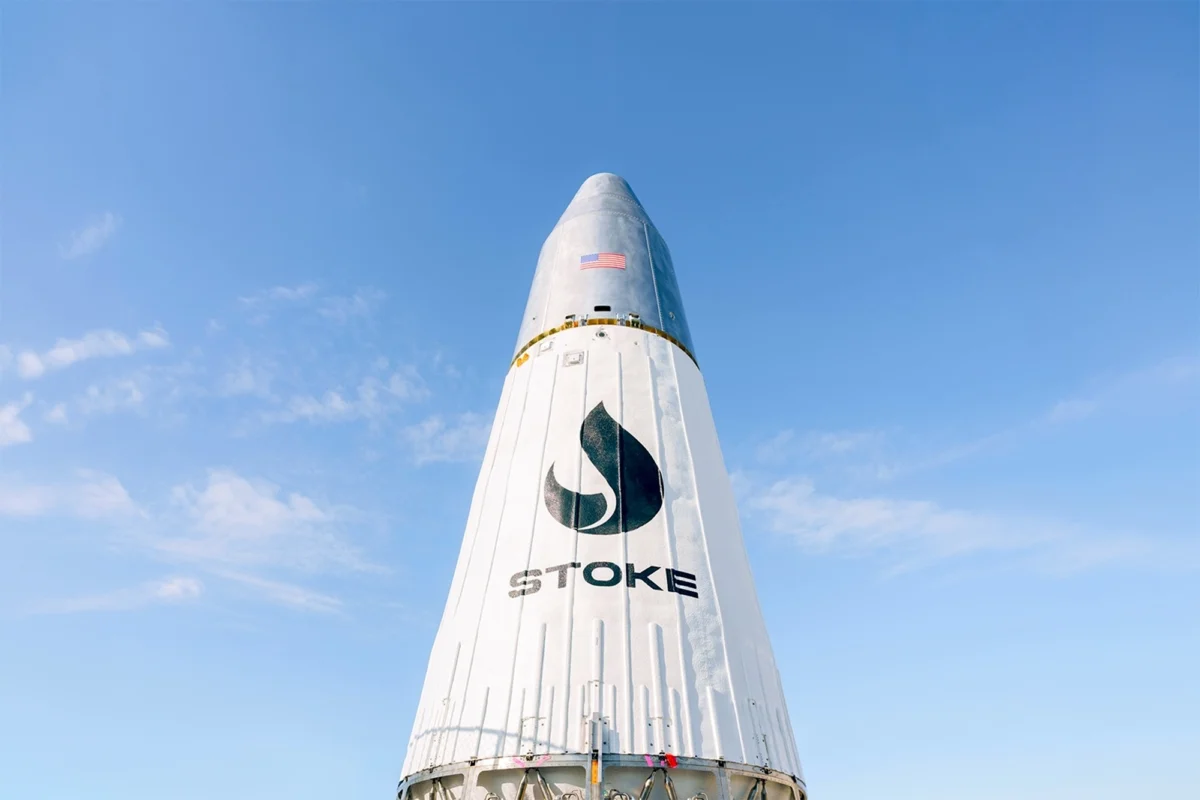
- Pathfinder Integration: The "Nova Pathfinder" vehicle currently serves as the testbed for the company’s full-stack integration. Lapsa confirms that multiple Pathfinder units are already in production, mitigating the risks associated with a single-prototype approach.
- The 2027 Horizon: With ground systems and rocket stages undergoing individual checkouts, the company is preparing for integrated system testing. The current roadmap targets an orbital flight for the Nova Pathfinder in early 2027.
- The 2029 Expansion: Looking further ahead, the company is already developing the "Nova Block 2," a larger iteration of the Pathfinder technology designed to carry 15 metric tons to low-Earth orbit (LEO). This timeline aligns strategically with the projected retirement of the workhorse Falcon 9.
Competitive Landscape: Navigating the SpaceX Shadow
Stoke Space occupies a unique niche. While companies like Rocket Lab and Relativity Space have made significant strides in satellite delivery and 3D-printed rocket technology, respectively, Stoke is aiming directly at the full-reusability paradigm that SpaceX has spent years trying to perfect.
The market environment is shifting. As SpaceX pivots its focus toward the massive Starship platform, the industry is bracing for a potential supply-demand mismatch. Satellite operators, government agencies, and research institutions have become increasingly reliant on the Falcon 9. However, as Musk prioritizes his own massive constellation—Starlink—and the development of Starship, third-party customers may find themselves paying a premium or facing scheduling conflicts.
Lapsa is acutely aware of this shift. “It amplifies the mismatch between launch supply and demand for launch, there’s no question about that,” he noted. “Regardless of Falcon 9 retiring or not retiring, the space industry and the space economy scales exactly as fast as rockets get off the ground.”
This is a subtle but potent strategic differentiation: Stoke is positioning itself as a "pure-play" launch provider. Unlike SpaceX, which operates as both a launch provider and a space-asset operator (Starlink), Stoke currently has no plans to deploy its own space-based infrastructure. For potential customers who fear competing for launch slots with their own service provider, Stoke offers a clean, neutral partnership.
Implications for the Space Economy
The implications of Stoke Space’s success would be transformative. If the company achieves full, rapid reusability with the Nova Pathfinder, it will effectively lower the barrier to entry for the entire space economy.
1. Market Democratization
Current launch costs, while significantly lower than in the pre-Falcon era, remain a hurdle for smaller startups and research entities. A fully reusable, three-metric-ton-capacity vehicle could turn orbital access into a commodity service, similar to freight shipping.
2. The Infrastructure Bottleneck
The "space economy" is often described as being in a state of arrested development. We have the technology for sophisticated satellite constellations and in-space manufacturing, but we lack the affordable, frequent launch cadence to deploy them. By focusing on the 15-metric-ton "sweet spot" with the Nova Block 2, Stoke aims to provide the workhorse capacity that the industry currently lacks.
3. Engineering Sustainability
The shift from "expendable" to "reusable" is also an environmental and resource-management imperative. Building a rocket from scratch for every mission is an inefficient use of high-value raw materials and labor. Stoke’s reliance on active cooling and a modular design philosophy aims to maximize the "flight-per-unit" lifecycle of every vehicle.
Conclusion: The Road Ahead
As Stoke Space moves toward its 2027 flight window, the company faces the same harsh reality that has claimed dozens of other aerospace startups: the transition from ground-based testing to orbital flight is where the most ambitious visions often stall. The history of the private space sector is littered with missed deadlines and technical setbacks.
However, the $1 billion influx provides a vital buffer. It buys the company the time to iterate, the resources to fail safely, and the production capacity to keep multiple vehicles in the assembly line. CEO Andy Lapsa remains characteristically measured, noting that the goal is not just to reach orbit once, but to create a sustainable, high-frequency bridge to space.
“Now is the time to get moving,” Lapsa said, “so that we can finally start deploying a lot of the constellations and applications that we aspire to as an industry but have been stuck on the ground.”
Whether Stoke Space can deliver on the promise of the Nova system remains to be seen. But in a sector where the cost of entry is astronomical and the stakes are even higher, the company has officially moved from a player to a primary contender. The next few years will determine if the "active cooling" bet pays off, or if the vacuum of space proves once again that it is the ultimate arbiter of success.
About the Author