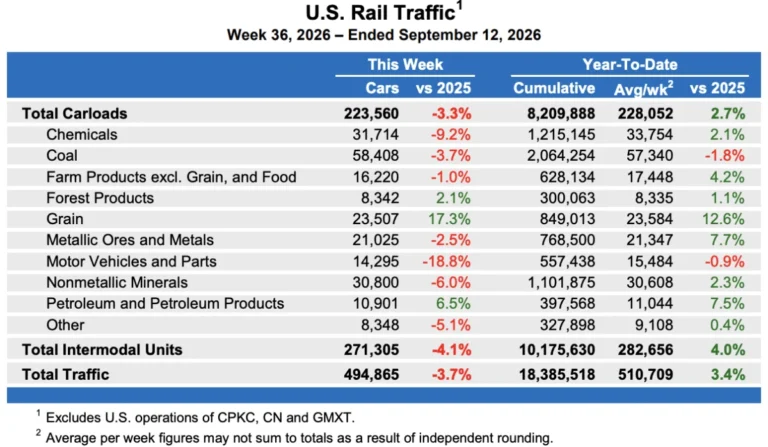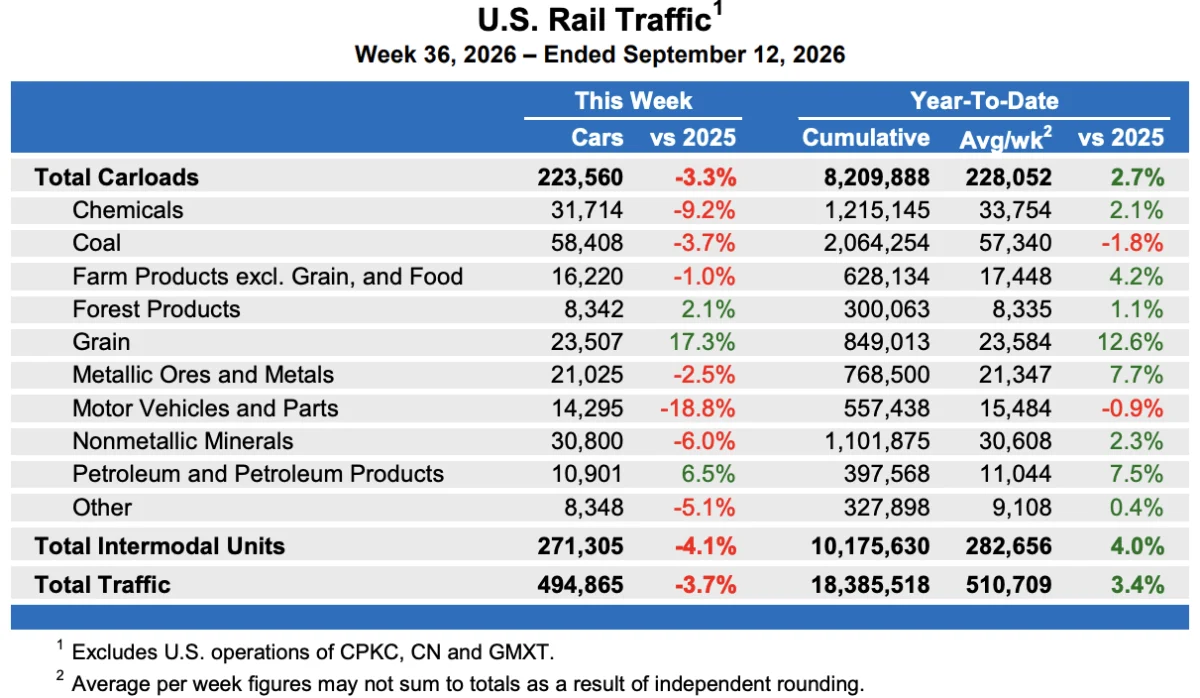
The latest data from the Association of American Railroads (AAR) reveals a period of deceleration for U.S. rail freight as the industry navigates the seasonal shifts of the third quarter. For the week ending Sept. 12, 2026, total rail traffic across the United States—encompassing both carloads and intermodal units—dipped by 3.7% compared to the same period last year, totaling 494,865 units. While this weekly contraction reflects broader volatility in industrial production and consumer demand, the year-to-date trajectory suggests that the rail sector remains a critical, albeit fluctuating, engine of the North American supply chain.
The Weekly Snapshot: Commodity and Intermodal Performance
The AAR’s report highlights a double-pronged decline in the week ending Sept. 12. Commodity freight, which tracks the movement of raw materials and bulk goods in carloads, fell to 223,560 units, marking a 3.3% year-over-year decrease. Simultaneously, intermodal volume—the backbone of retail and manufacturing supply chains consisting of containers and trailers—saw a steeper drop of 4.1%, settling at 271,305 units.
The disparity in performance across specific commodity sectors underscores the uneven nature of the current economic environment. Of the 10 distinct commodity groups tracked by the AAR, only three managed to register growth during this reporting period:
- Grain: Leading the pack with a robust 17.3% increase, signaling a strong harvest cycle and consistent export demand.
- Petroleum and Petroleum Products: Up 6.5%, likely buoyed by energy market fluctuations and refinery output adjustments.
- Forest Products: Posting a modest 2.1% gain, reflecting steady demand in the lumber and construction materials sector.
Conversely, the decliners painted a picture of cooling manufacturing and industrial activity. Motor vehicles and parts, a sector highly sensitive to consumer sentiment and supply chain precision, led the slump with a sharp 18.8% decline. Chemicals followed with a 9.2% drop, and nonmetallic minerals fell by 6%. These metrics suggest that manufacturers are recalibrating inventories, perhaps anticipating a cautious end to the fiscal year.
A Broader Context: 36 Weeks of Resilience
While the weekly numbers appear contractionary, a zoomed-out perspective provided by the AAR’s 36-week cumulative data reveals a more resilient narrative. For the first 36 weeks of 2026, U.S. railroads have maintained a positive momentum, reporting 8,209,888 carloads—a 2.7% improvement over 2025. Intermodal units have fared even better, reaching 10,175,630, a 4% increase year-over-year.
Combined, the total traffic for the year stands at 18,385,518 units, representing a 3.4% gain compared to the same period in 2025. This cumulative growth indicates that while the week of Sept. 12 was a soft spot, the broader industrial and consumer demand cycles remain healthier than they were at this time last year. The rail industry’s ability to sustain this 3.4% growth margin despite the recent weekly dip suggests that the core infrastructure of the U.S. freight network remains robust, even as it faces intermittent headwinds.
North American Integration: A Regional Perspective
The rail network is inherently a transcontinental enterprise, and the performance of U.S. railroads is intrinsically tied to their Canadian and Mexican counterparts. When observing the aggregate North American volume for the week ending Sept. 12, the trend mirrors the U.S. experience.
Nine major railroads operating across the U.S., Canada, and Mexico reported a combined 326,500 carloads (down 3.3%) and 353,081 intermodal units (down 3.8%). Total combined traffic for the region hit 679,581 units, a decrease of 3.6% compared to the 2025 figures.
However, looking at the long-term trend, the North American market continues to show growth. For the first 36 weeks of 2026, the cumulative volume for the continent reached 25,216,803 carloads and intermodal units, representing a 3% year-to-date gain. This synchronization across borders highlights the deep integration of the North American supply chain, where manufacturing and raw material extraction are spread across a wide geographic footprint, making cross-border rail efficiency a critical success factor for global trade.

Implications for the Freight Ecosystem
The recent decline in weekly volume, particularly in the motor vehicle and chemical sectors, carries significant implications for the wider freight ecosystem. Rail serves as a bellwether for the economy; when carloads drop, it often precedes shifts in manufacturing production or retail inventory management.
Industry experts have pointed to several factors contributing to these fluctuations. Container delays at major U.S. ports, for instance, have been a recurring theme, affecting the flow of intermodal units. Norfolk Southern and other major carriers have recently prioritized "removing rail friction" to combat these bottlenecks, aiming to improve throughput speeds and reliability. However, as noted in recent analyses, the increase in U.S. container imports—up 3.8% to 2.6 million TEUs—creates a "tug-of-war" scenario. While the ports are seeing high volumes, the rail network’s ability to process and move this cargo efficiently remains the primary constraint.
Furthermore, global geopolitical risks continue to cast a shadow over maritime shipping, which eventually impacts the intermodal rail network. As carriers attempt to restore Red Sea services and manage Houthi-related risks, the predictability of container arrival times at U.S. gateways remains uncertain. This unpredictability ripples through the rail network, complicating the planning and scheduling of intermodal services.
Strategic Responses and Future Outlook
The industry is not standing still in the face of these challenges. Throughout the final quarter of 2026, the focus for major railroads will shift toward maximizing operational efficiency and leveraging technology to mitigate volatility.
For stakeholders, the upcoming FreightWaves F3: Future of Freight Festival in Chattanooga, TN, serves as a focal point for these discussions. Scheduled for late October, the festival will bring together industry leaders, policymakers, and technology innovators to address the very issues highlighted by the latest AAR report—including regulatory compliance, carrier liability, and the integration of advanced freight technologies.
The event’s Brokerage Compliance Symposium and the F3 Awards underscore a shift toward a more sophisticated, technology-driven approach to freight management. As the industry grapples with the decline in weekly volume, the emphasis is moving away from purely volume-based growth to "value-based" logistics. This includes investing in infrastructure that reduces the "friction" Norfolk Southern and others have identified, as well as finding creative ways to manage the volatility of global container imports.
Conclusion
The data for the week ending Sept. 12 serves as a reminder that the rail industry is subject to the ebbs and flows of the broader economy. While the 3.7% dip in weekly volume is noteworthy, it must be viewed in the context of a 3.4% year-to-date growth that has largely outperformed the previous year.
As we move into the final months of 2026, the focus will remain on whether the underlying strength of the North American consumer and the ongoing recovery in industrial production can overcome the short-term pressures of automotive slowdowns and logistics bottlenecks. With a strong cumulative performance year-to-date, the rail sector remains well-positioned, provided it can continue to navigate the complexities of an increasingly volatile global trade environment.
For those looking to stay ahead of these trends, the industry’s ongoing commitment to transparency—as evidenced by the AAR’s detailed reporting and the collaborative efforts showcased at events like F3—remains the best indicator of long-term stability and success in the American rail freight landscape.
About the Author