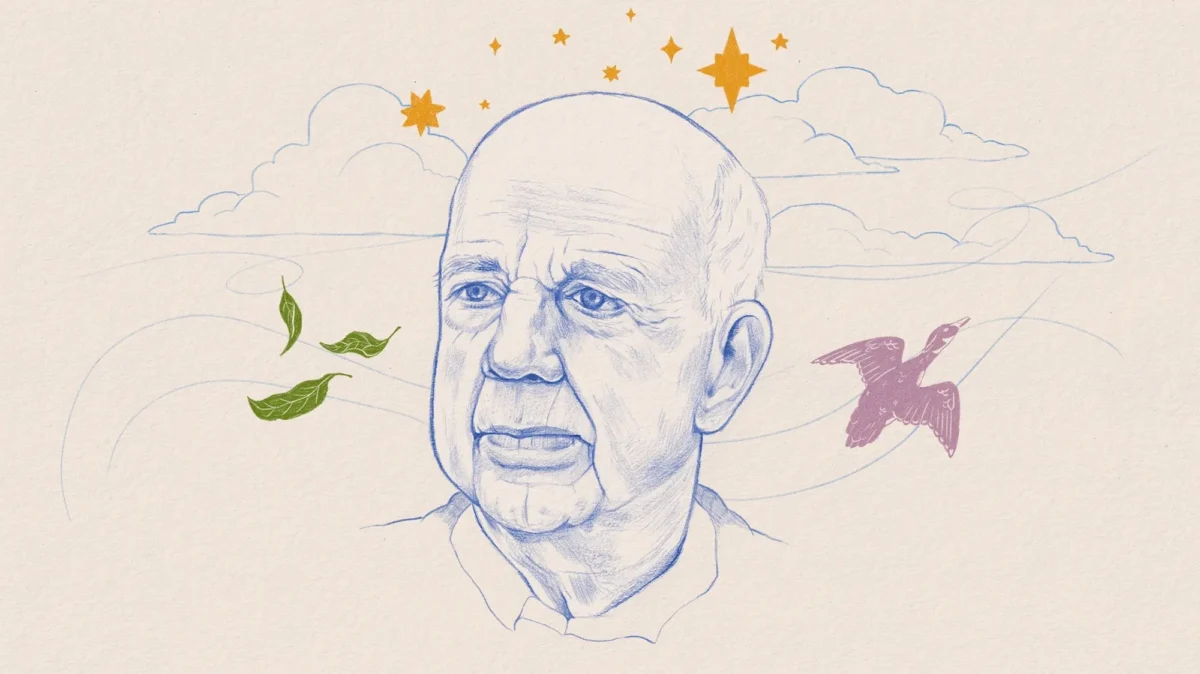
Wendell Berry, the venerable Kentucky farmer, essayist, poet, and philosopher whose work served as a moral compass for the American environmental movement for over half a century, passed away on August 31 at the age of 92. From his quiet farmhouse in Henry County, Kentucky, Berry cultivated a body of work that challenged the industrialization of the American landscape and advocated for a return to community, land stewardship, and local autonomy.
His death marks the end of an era for a specific strain of American agrarianism—one that rejected the siren call of technological "progress" in favor of the slow, deliberate rhythm of the seasons. A prolific author of more than 50 books, Berry was a man who famously rejected the digital age, opting for pencil and paper, and who viewed the modern obsession with efficiency as a fundamental divorce from the reality of being human.
A Life Rooted in Henry County
Born in 1934 in Henry County, Kentucky, Berry’s life was defined by a profound devotion to his home. While his intellectual career took him to various corners of the world—including a stint as a professor and time spent as a Guggenheim fellow—he always returned to the rolling hills of his native soil.
His daily existence was a deliberate act of resistance. By eschewing the computer and the smartphone, he maintained a physical connection to the act of writing, treating his prose and poetry as physical products of labor rather than mere information. This practice was not merely a stylistic choice; it was a philosophical statement. As he argued in his seminal 1987 Harper’s Magazine essay, "Why I am not Going to Buy a Computer," technology often acts as a wedge, separating individuals from the dignity of their own work and the intimacy of their communities.
Chronology of a Quiet Rebellion
- 1934: Wendell Berry is born in Henry County, Kentucky, the landscape that would anchor his life’s work.
- 1960s-1970s: Berry emerges as a prominent voice in the budding environmental movement, publishing essays that bridge the gap between agrarian ethics and modern ecology.
- 1972: Publication of Think Little, a seminal essay arguing that the "public crisis" of the environment is rooted in "private" failures of lifestyle and community.
- 1979: Berry is arrested for his first act of high-profile civil disobedience, protesting a nuclear power plant in Indiana.
- 1987: The publication of Why I am not Going to Buy a Computer cements his reputation as a critic of industrial technological dependence.
- 2011: Berry participates in a sit-in at the Kentucky state capitol to protest the destructive practice of mountaintop removal coal mining.
- 2010s: He continues to serve as a vocal opponent of the coal industry, notably pulling his personal papers from the University of Kentucky in protest of the institution’s financial ties to the fossil fuel sector.
- August 31, 2026: Wendell Berry passes away at the age of 92, leaving behind a legacy that continues to challenge the trajectory of modern society.
Challenging the Dualisms of Modernity
Perhaps the most enduring element of Berry’s philosophy was his refusal to accept the "dualisms" that categorize modern thought. He rejected the separation between humanity and nature, between the body and the soul, and between the political ideologies that divide neighbor from neighbor.
In his poem "Manifesto: Mad Farmer Liberation Front," Berry captured the essence of his contrarian spirit:
"Invest in the millennium. Plant sequoias. / Say that your main crop is the forest / that you did not plant."
To Berry, the activist language of "apocalypse" and "salvation" was often misleading. He viewed the world as a cyclical process of birth, death, and renewal—a perspective that demanded patience rather than panic. This put him at odds with some mainstream environmentalists who focused heavily on political lobbying in Washington. Berry argued that unless people were willing to make "fundamental changes in the way we are living," legislative victories would be hollow.
The "Luddite" Label and the Reality of Resistance
Throughout his later years, critics frequently labeled Berry a "Luddite" or a "curmudgeon" because of his stance against industrial technology. However, scholars like Jeffrey Bilbro of Grove City College suggest that this misunderstanding ignores the historical context of the term.
The original Luddites were not anti-technology; they were anti-exploitation. They destroyed machines that were used to strip workers of their dignity and economic autonomy. Similarly, Berry’s refusal to modernize was an attempt to protect the integrity of his work and his relationship with the land. He was not against tools; he was against tools that alienated the human spirit from the natural world.
Official Responses and Cultural Impact
The passing of Wendell Berry has prompted an outpouring of tributes from across the political spectrum—a testament to his rare ability to appeal to both conservative traditionalists who value community and religious life, and progressives who prioritize ecological sustainability.
In a recent assessment of his life, academic observers noted that Berry’s influence is "impossible to quantify." By creating a bridge between faith and stewardship, he offered a path for those who felt that the cold, mechanical nature of modern capitalism had left them spiritually and physically adrift. His willingness to walk out of his own state university in protest of corporate donations demonstrated that for Berry, integrity was not a theoretical concept—it was a currency to be spent.
Implications for the Future of Environmentalism
As the world faces the escalating consequences of climate change, the relevance of Berry’s work may be greater than ever. His core belief—that we must "think little"—suggests that large-scale global problems cannot be solved by grand political posturing alone. Instead, he argued that the health of the planet is the aggregate of the health of our local neighborhoods, our farms, and our individual daily choices.
Berry acknowledged that we live in a "fallen world" where, as Bilbro notes, "our hands are all dirty." He did not demand a impossible, pristine purity. He simply asked that we be honest about our compromises and work to leave the land better than we found it.
A Legacy of Cycles
The environmental crisis, as Berry viewed it, is a form of social and cultural decay. Yet, his final message was one of cautious hope. In his poem "A Discipline," he addresses the looming threat of the end of the world, writing:
"It is the time’s discipline to think / of the death of all living, and yet live."
This paradox defines the Berry legacy: to recognize the fragility and the impending death of our current systems, and yet to continue planting trees, tending soil, and building community.
For those who follow in his wake, the task is clear. We are not expected to solve the world in a single stroke. We are expected to come into a relationship with the "smallest handful of earth," to understand the rhythms of the world, and to recognize that in the act of nurturing a single seedling, we are participating in the grand, necessary work of life itself. Wendell Berry has left the stage, but the sequoias he encouraged his readers to plant are still growing.
About the Author