By FreightWaves Staff
In the complex ecosystem of global maritime logistics, the correlation between major trade lanes is usually a reliable constant. When global demand shifts, the ripples are typically felt across the primary arteries of trade. However, the last seven weeks have defied these traditional market mechanics, revealing a stark and widening chasm between the trans-Pacific trade to the North American West Coast and the route from China to the Mediterranean.
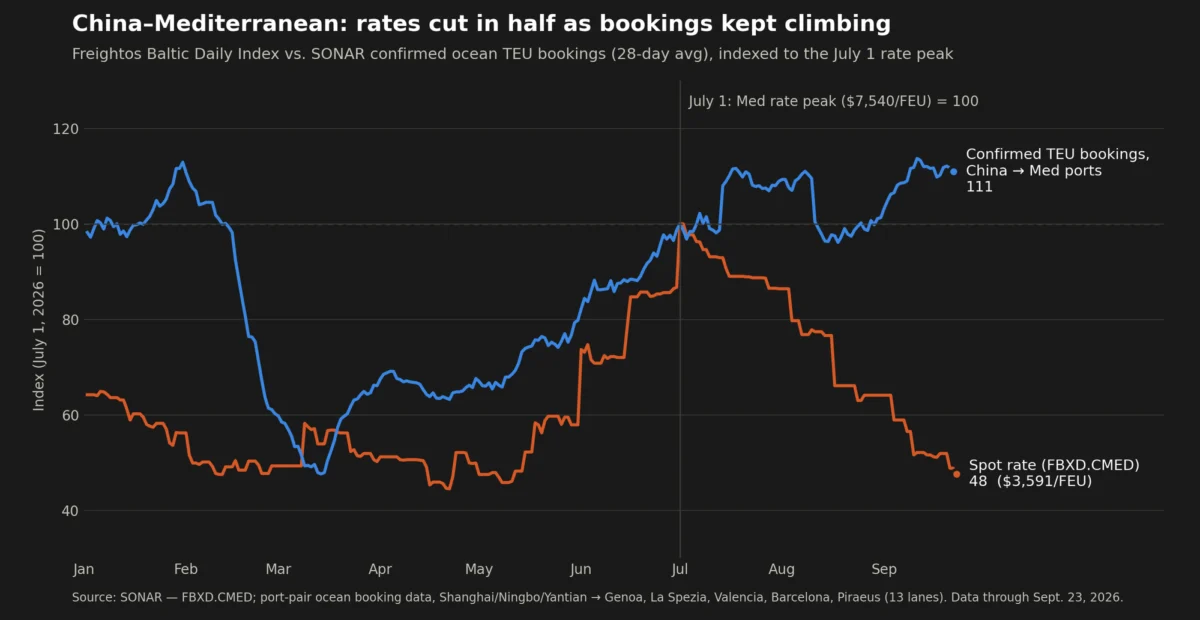
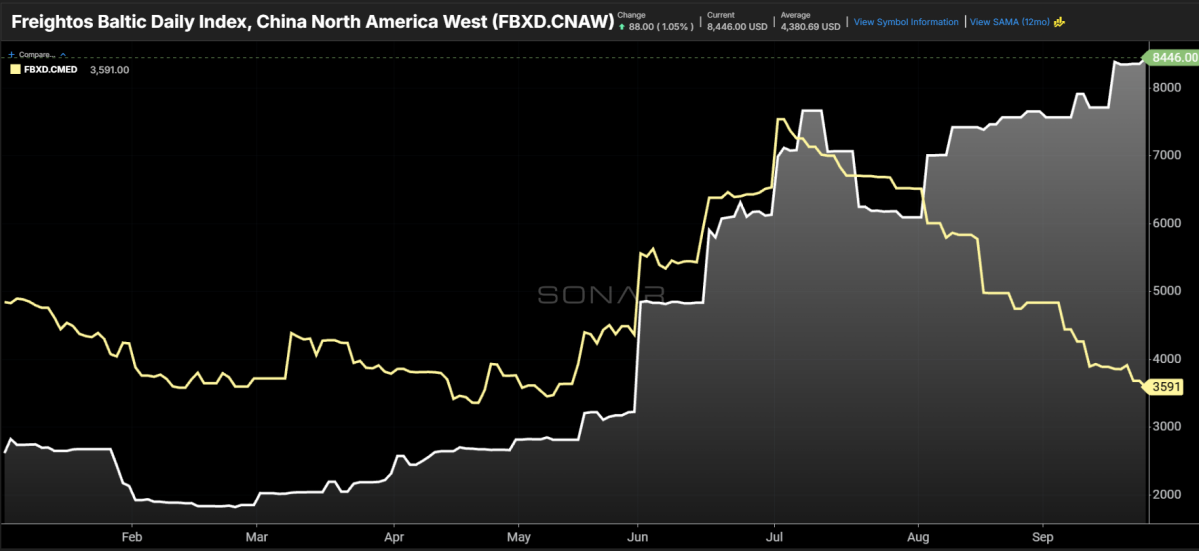
As of September 23, 2026, the Freightos Baltic Daily Index (FBXD) for China to North America West (FBXD.CNAW) surged to $8,446 per forty-foot equivalent unit (FEU). This figure represents a dramatic climb, nearly doubling the 12-month average of $4,381 and standing at a staggering four times the cost recorded in September 2025. Conversely, the China-to-Mediterranean index (FBXD.CMED) has plummeted to $3,591 per FEU, marking a decline of more than 50% from its July peak of $7,540. The market has effectively flipped: while a West Coast-bound container was once the cheaper option, it now commands a premium 2.35 times higher than its Mediterranean counterpart.
A Chronology of Market Divergence
To understand the current volatility, one must look back to the start of the year. In January 2026, the cost of moving a box from China to Mediterranean hubs like Genoa or Valencia was approximately 1.7 times more expensive than shipping to Los Angeles. This pricing structure reflected the geopolitical realities and logistical premiums associated with navigating the waters surrounding the Middle East.
Throughout the spring and early summer, both lanes saw synchronized price appreciation, buoyed by global demand and seasonal restocking. However, as the industry transitioned into the latter half of the year, the synchronization dissolved.
- June to July: Rates for both the trans-Pacific and Asia-Mediterranean routes climbed in tandem.
- Early August: The first signs of separation emerged as Mediterranean capacity began to normalize, while trans-Pacific routes faced mounting logistical hurdles.
- Late August to September: The "Great Decoupling" became entrenched. While North American rates continued to escalate, Mediterranean rates entered a sustained freefall, dropping below their January starting points.
The Data Paradox: Demand vs. Capacity
The most common explanation for rising freight rates is a surge in consumer demand—a theory that suggests American importers are aggressively fighting for space while European consumption wanes. Yet, data from SONAR, the industry’s leading freight intelligence platform, suggests this narrative is fundamentally flawed.
Contrary to the pricing signals, confirmed TEU (twenty-foot equivalent unit) bookings from major Chinese export hubs—including Shanghai, Ningbo, and Yantian—to five primary Mediterranean ports are up 38% year-over-year. In fact, 11 of the 13 tracked trade lanes indicate year-over-year growth. On a 28-day rolling average, bookings into the Mediterranean have climbed 11% since the July 1 rate peak.
"European demand is not collapsing," market analysts note. "It is holding steady, or even growing, even as the spot rates for those very containers have been cut in half."
The picture on the North American West Coast is far more fractured. While total confirmed TEUs from China to the U.S. and Canadian West Coast are up approximately 50% from the previous year, the growth is heavily concentrated. Nearly all the upward momentum is attributed to the Port of Long Beach, where bookings have more than doubled. In contrast, the median West Coast lane is up a marginal 1%. Los Angeles, the nation’s busiest gateway, has seen bookings from Ningbo plummet by 33%, with similar cooling trends in Oakland and Seattle.
Supply-Side Dynamics: The Suez and Typhoon Factors
If demand does not account for the widening gap, the answer must lie in the supply of effective vessel capacity.
In the Asia-Mediterranean sector, carriers have been systematically recalibrating their networks. A growing number of services have shifted away from the arduous Cape of Good Hope routing, opting instead to return to the Suez Canal. Maersk and Hapag-Lloyd, for instance, transitioned four additional Asia-Europe services back to the Suez route this month alone. Year-to-date, Suez container tonnage has increased by 54%. This shift has a multiplicative effect on supply: by shortening the transit time, carriers effectively increase the frequency of vessel rotations, flooding the market with capacity that was previously trapped in longer voyages. Consequently, carrier rejection rates for Mediterranean bookings have dropped from 8.3% to 7.1%, signaling increased fluidity.
Conversely, the trans-Pacific trade has been hamstrung by a confluence of supply-side constraints. Since mid-July, severe typhoon activity near key Chinese maritime hubs has disrupted schedules, forcing vessels out of rotation. Carriers have responded by leaning heavily into "blank sailings"—canceling scheduled stops to manage capacity—with nine such cancellations announced in a single week in September. Furthermore, rising tensions in the Strait of Hormuz have driven up bunker fuel costs, setting a higher "floor" for the price of the long, trans-Pacific haul. According to Xeneta, global schedule reliability hit a grim milestone in August, with only 29% of vessels arriving on time—the third consecutive monthly decline.
The Pricing Power of the Oligopoly
While supply chain disruptions provide context, they do not fully explain the extreme magnitude of the price swings. SONAR data reveals that carriers are rejecting fewer West Coast bookings than they were a year ago (8.3% versus 10.1%), yet rates have quadrupled.
This suggests that space is not being rationed by physical shortages, but rather by aggressive pricing strategies. The spot market acts as a sensitive barometer for the "uncovered" portion of global freight—cargo not protected by long-term annual contracts. With 10 major carriers now controlling roughly 90% of global capacity, the market has become highly susceptible to price manipulation. Minor fluctuations in available slot space are being amplified by the concentrated power of these carriers, turning incremental changes in supply into volatile price swings.
Implications for Shippers and the Future Outlook
As the industry approaches the early October window, all eyes are on the traditional "Golden Week" factory shutdowns in China. Historically, this period triggers a frantic scramble by exporters to move cargo before operations cease. Analysts expect one final, intense push on trans-Pacific rates as shippers bid for limited pre-holiday space.
However, the outlook post-October remains cautious. Once the Golden Week rush dissipates and typhoon-related congestion begins to clear, the capacity that carriers have been withholding is likely to return to the Pacific lanes. The Mediterranean experience serves as a cautionary tale for the industry: rates can crater with remarkable speed, even when booking volumes remain robust.
For shippers, this environment underscores the dangers of relying heavily on the spot market. As the gap between the Pacific and Mediterranean lanes demonstrates, freight costs have become decoupled from traditional indicators of trade health. In a market where 10 players hold the keys to 90% of the capacity, the "invisible hand" of the market is increasingly being replaced by the visible hand of carrier strategy.
As we look toward the final quarter of 2026, participants in the global supply chain must prepare for continued volatility. Whether the Pacific rates mirror the Mediterranean’s correction or hold their elevated ground will depend not on the health of the consumer, but on the disciplined capacity management of a few dominant global shipping lines.
Join the Discussion at F3
The complexities of global logistics and the future of freight technology will be at the forefront of the industry conversation at the Future of Freight Festival (F3), held October 27–28, 2026, in Chattanooga, Tennessee. From the Brokerage Compliance Symposium to the unveiling of the FreightTech 25, join 300+ industry leaders as they navigate the challenges of a rapidly changing global landscape.
About the Author