Bad Hersfeld, Germany – In a significant move set to reshape the landscape of the global graphic industry, INKISH, a Danish media and content platform, is launching FLOW – an unprecedented exhibition exclusively dedicated to software and robotics. Touted by its founder, Morten Reitoft, as the world’s first event of its kind, FLOW addresses a critical juncture for printing companies grappling with evolving market dynamics, technological advancements, and the imperative for increased efficiency and sustainability. Scheduled to run from November 3rd to 5th in Bad Hersfeld, Germany, FLOW promises to be a "game-changer," offering a focused deep dive into the ‘infrastructure’ solutions that can extend the life and boost the productivity of existing print hardware.
The timing of FLOW could not be more pertinent. As the graphic industry navigates a period of digital transformation, many printing houses are reconsidering substantial investments in new, high-capital printing machinery. Instead, a growing consensus points towards optimizing current assets through strategic integration of advanced software and robotic solutions. This approach offers a pathway to enhanced operational efficiency, reduced waste, and improved profitability with a comparatively modest financial outlay. FLOW stands as a testament to this paradigm shift, bringing together 28 leading software exhibitors and seven pioneering robotics companies, including Denmark’s own RobotFactory, to showcase the cutting-edge tools that will define the next generation of print production.
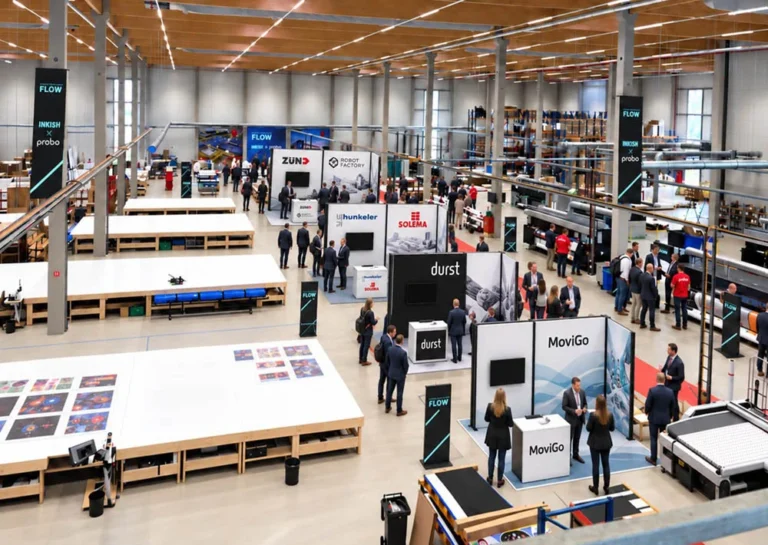
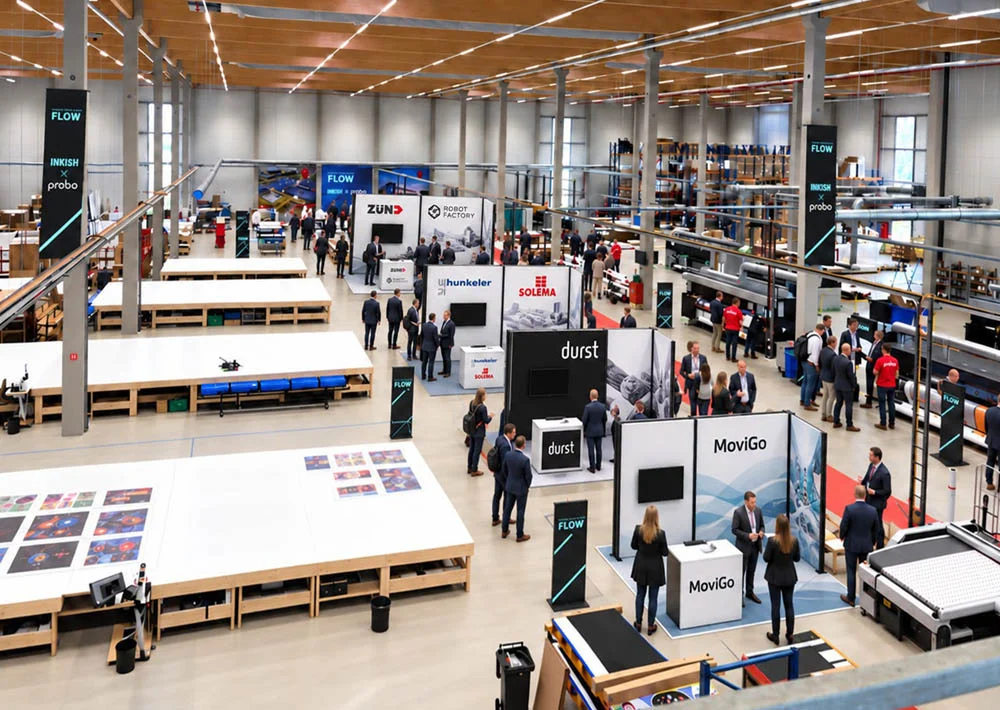
Crucially, FLOW distinguishes itself not only by its niche focus but also by its unique setting. Held in collaboration with PROBO, one of Europe’s largest large-format print subcontractors, the exhibition takes place directly within an active production environment. This innovative approach allows attendees to witness real-world applications of these transformative technologies, moving beyond theoretical demonstrations to practical, tangible insights into how software and robots integrate seamlessly into a live manufacturing workflow. The event also embraces digital accessibility, with all demonstrations live-streamed, ensuring that knowledge and innovation reach a broader global audience, regardless of their ability to attend in person.
Main Facts: A New Era for Graphic Industry Investment
FLOW is poised to inaugurate a new chapter in how the graphic industry perceives and prioritizes technological investment. Traditionally, exhibitions in this sector have been dominated by colossal printing presses and finishing equipment, with software and automation often playing a supporting, albeit crucial, role. INKISH, under the visionary leadership of Morten Reitoft, has identified a critical gap in this traditional model, recognizing that the true levers for future growth and resilience lie within the digital and automated backbone of print operations.
The core premise of FLOW is elegantly simple yet profoundly impactful: rather than continuously chasing the latest hardware iterations, printing companies can achieve significant competitive advantages by investing in the intelligent systems that orchestrate, automate, and optimize their entire production ecosystem. This includes everything from initial order intake and job management to prepress automation, material handling, and post-press finishing. The exhibition’s focus on software encompassing MIS/ERP systems, workflow and automation solutions, and the emerging field of orchestration, alongside advanced robotics, reflects a holistic understanding of the modern print factory.
The event’s collaboration with PROBO in Bad Hersfeld, near Kassel, Germany, further elevates its significance. By embedding the exhibition within an operational large-format print facility, FLOW offers an unparalleled opportunity for visitors to observe live integrations and understand the practical benefits and implementation challenges of these technologies in a real-world context. This experiential dimension is designed to foster a deeper understanding and accelerate the adoption of these transformative tools across the graphic industry, not just in Denmark but throughout Europe and beyond. The daily program, featuring expert insights from industry leaders like DURST and Heidelberg, underscores the strategic importance of this new direction, positioning FLOW as a pivotal forum for discussing the future trajectory of print.
Chronology: From Concept to a Game-Changing Event
The journey of FLOW from a nascent idea to a tangible, industry-defining event is rooted in a deep understanding of the graphic industry’s evolving needs and the strategic foresight of its organizers.
The Genesis and INKISH’s Vision
INKISH, founded by Morten Reitoft, has established itself as a dynamic voice in the graphic arts community, known for its insightful interviews, industry analysis, and commitment to fostering innovation. Reitoft, a long-time observer and commentator on the industry, recognized a growing dissonance: while printing technology continued to advance, the rate of investment in new presses was decelerating. Economic uncertainties, capital expenditure constraints, and an increasing focus on return on investment (ROI) meant that printers were seeking alternative avenues for growth and efficiency.
Reitoft’s vision for FLOW emerged from this observation. He hypothesized that the next frontier for competitive advantage wasn’t necessarily in faster presses, but in smarter operations. "We believe that FLOW will be a game-changer," Reitoft stated, articulating his conviction that a dedicated platform for software and robotics was not just timely, but essential. The idea was to create an environment where decision-makers could explore solutions that directly addressed prevalent challenges such as labor shortages, increasing demand for customization, shorter run lengths, and the need for greater operational agility. This shift in focus from "horsepower" to "brainpower" is the foundational philosophy behind FLOW.
Strategic Location and Collaboration with PROBO
The choice of Bad Hersfeld, near Kassel, Germany, as the host city for FLOW was a strategic one. Its central location within Europe makes it accessible to a broad international audience, particularly from key industrial regions. However, the most innovative aspect of the location is its integration with PROBO. PROBO, a prominent player in the large-format print sector, agreed to host the exhibition within its active production facility. This collaboration is more than just a venue partnership; it’s a testament to the belief that showcasing technology in a live environment provides unparalleled value.
Leon van der Meer, CEO of PROBO, likely shared Reitoft’s enthusiasm for demonstrating practical innovation. For attendees, this means moving beyond static booths and theoretical presentations. Imagine witnessing a robotic arm seamlessly transferring large-format prints from one station to another, or seeing how a new MIS system integrates real-time production data from actual print jobs. This immersive experience is designed to break down barriers to adoption, allowing visitors to visualize how these solutions could be directly applied to their own operations. The dynamic backdrop of a bustling production floor is set to offer a unique, hands-on perspective that traditional exhibition centers often cannot replicate.
Event Timeline and Daily Highlights
FLOW is scheduled for three intensive days, from November 3rd to 5th. Each day is meticulously planned to provide a blend of exhibition viewing, live demonstrations, and expert insights. A key feature of the daily program is the series of lunch presentations, designed to offer high-level strategic discussions from industry thought leaders.
- Tuesday, November 3rd: The inaugural day will feature Christian Schowalter and Philip Moedinger, who will present DURST’s vision for the future of printing. DURST, a leader in digital printing technologies, is well-positioned to discuss the convergence of hardware, software, and automation in shaping the industry’s trajectory. Their insights are expected to set the stage for the discussions over the subsequent days.
- Wednesday, November 4th: Heidelberg, a name synonymous with print machinery, will take the stage. This presentation is particularly significant as it signals how even traditional hardware giants are adapting to and championing the shift towards software and automation. Their perspective on integrating digital workflows and intelligent solutions into their ecosystem will be eagerly anticipated.
- Thursday, November 5th: The exhibition will conclude with a pivotal discussion between Leon van der Meer, CEO of PROBO, and Morten B. Reitoft, editor of INKISH. This closing dialogue is designed to synthesize the week’s learnings, discuss the immediate and long-term implications of the showcased technologies, and explore the opportunities that FLOW has unveiled for the graphic industry. This session promises to offer a forward-looking perspective, cementing the exhibition’s role as a catalyst for future innovation.
The strategic planning, innovative venue, and curated content underscore INKISH’s commitment to delivering an event that is not merely an exhibition but a vital forum for industry transformation.
Supporting Data: The Imperative for Smart Investment
The premise of FLOW is deeply rooted in contemporary industry trends and compelling data that highlight the growing importance of software and robotics. The graphic industry, like many manufacturing sectors, is undergoing a profound transformation driven by digitalization, automation, and the principles of Industry 4.0.
The Shift from Hardware to "Infrastructure" Investment
Global market research consistently indicates a sustained, albeit modest, growth in the graphic communications market. However, within this growth, there’s a distinct shift in investment patterns. While new printing presses represent significant capital expenditures, their incremental gains in speed or quality may no longer offer the same compelling ROI as they once did, especially for mid-sized and smaller print shops. Instead, the focus has moved to optimizing the entire production chain.
Investing in "infrastructure" – referring to the software, automation, and robotics that underpin operations – offers several critical advantages:
- Enhanced Productivity: Streamlined workflows, automated tasks, and robotic assistance can significantly increase throughput without requiring additional human labor.
- Extended Equipment Lifespan: Intelligent maintenance schedules, optimized job queuing, and precision handling can reduce wear and tear on existing machinery.
- Reduced Operational Costs: Automation minimizes manual errors, reduces material waste, and lowers labor costs over time.
- Increased Flexibility and Customization: Software-driven workflows enable quicker changeovers, support variable data printing, and facilitate personalized jobs, catering to market demands for bespoke products.
- Data-Driven Decision Making: MIS and ERP systems provide real-time data on production, costs, and efficiency, empowering management with actionable insights.
This strategic pivot is not just about cost-cutting; it’s about building more resilient, adaptable, and intelligent print factories capable of thriving in a rapidly evolving market.
Deep Dive into Software Solutions at FLOW
FLOW will feature 28 software exhibitors, showcasing the breadth and depth of digital solutions available to the graphic industry. These can broadly be categorized into:
-
MIS (Management Information Systems) / ERP (Enterprise Resource Planning) Systems: These are the central nervous systems of a printing business. They integrate various functions, from quoting, order entry, and job costing to production planning, inventory management, and financial accounting.
- Examples at FLOW: Dataline, Obility, Rogler.
- Benefits: Improved cost control, streamlined administration, better resource allocation, enhanced customer relationship management, and comprehensive business intelligence. They provide a unified view of the entire operation, critical for efficiency and profitability.
-
Workflow and Automation Solutions: These systems automate repetitive tasks, ensure consistency, and accelerate job processing from prepress to post-press.
- Examples at FLOW: Callas, Ultimate Tech, Enfocus.
- Benefits: Reduce manual touchpoints and human error, speed up prepress (e.g., preflighting, imposition, color management), optimize print queues, and ensure consistent quality. They are crucial for handling increasing job volumes and shorter deadlines efficiently.
-
Orchestration Solutions: This is an emerging and highly sophisticated category, representing the next level of automation. Orchestration solutions go beyond individual workflow steps; they coordinate multiple software and hardware components across the entire production chain, creating a truly ‘smart’ factory.
- Examples at FLOW: Atomyx, CoCoCo, CTRL-S.
- Benefits: Provide end-to-end process visibility and control, automate complex multi-stage jobs, optimize resource utilization across different machines and departments, and enable predictive maintenance through interconnected systems. These are vital for achieving lights-out manufacturing and highly automated, flexible production lines.
The Rise of Robotics in Graphics
The seven robot exhibitors at FLOW, including RobotFactory, underscore the growing practical application of robotics in the graphic industry. Once considered too expensive or complex for print shops, collaborative robots (cobots) and advanced robotic systems are now becoming accessible and indispensable.
- Applications: Robotics can automate a multitude of tasks in print production, including:
- Material Handling: Loading and unloading substrates, moving printed sheets or rolls between machines.
- Finishing: Pick-and-place operations for intricate finishing tasks, stacking, sorting, and packaging.
- Post-Press: Palletizing finished products, kitting, and order fulfillment.
- Benefits: Address labor shortages by performing repetitive or physically demanding tasks, improve precision and consistency, enable 24/7 operations, reduce workplace injuries, and free up human workers for more complex, value-added roles. The integration of robots alongside human operators in a collaborative environment is a key trend.
The Power of Live Streaming
Morten Reitoft’s assertion that "All demonstrations will also be transmitted live, so both those who cannot attend and visitors who wish to revisit a presentation can follow online during or after the event" is a strategic move that significantly expands FLOW’s reach and impact. In an increasingly globalized and digitally connected world, live streaming ensures:
- Global Accessibility: Printers worldwide, regardless of geographical location or travel constraints, can participate and learn.
- Knowledge Retention: The ability to re-watch presentations serves as an invaluable educational resource, allowing attendees to absorb complex information at their own pace and share it with their teams.
- Enhanced Engagement: Remote participants can still engage with Q&A sessions, fostering a broader community of learning and discussion.
This blended approach of physical presence and digital reach positions FLOW as a truly modern and inclusive industry event.
Official Responses: Voices Shaping the Future
The success and impact of an event like FLOW are heavily influenced by the vision of its organizers and the commitment of its partners and speakers. The official responses and planned discussions reflect a collective belief in the transformative power of software and robotics.
Morten Reitoft’s Unwavering Vision
As the architect of FLOW, Morten Reitoft’s perspective is central to understanding the event’s ethos. His "game-changer" declaration is not merely marketing rhetoric but stems from a deep conviction about the industry’s trajectory. Reitoft often emphasizes the need for printers to think beyond incremental improvements and embrace fundamental operational shifts.
"The graphic industry has always been about innovation, but for too long, that innovation has been narrowly defined by the press itself," Reitoft explained in a recent interview, expanding on his vision for FLOW. "We’re seeing an unprecedented opportunity to unlock efficiency and profitability through intelligent software and agile robotics. FLOW is about showcasing how these ‘invisible’ technologies are, in fact, the most powerful engines for growth today. We want printers to leave not just with ideas, but with concrete, implementable solutions that can start delivering ROI immediately."
His commitment to live-streaming underscores INKISH’s broader mission of knowledge dissemination and democratizing access to industry insights. It reflects a modern understanding of how information should be shared in a fast-paced global market.
PROBO’s Partnership: Real-World Application
Leon van der Meer, CEO of PROBO, plays a crucial role as the host partner. His willingness to open an active production facility for an exhibition speaks volumes about PROBO’s belief in the showcased technologies and its commitment to industry progress.
"For us at PROBO, hosting FLOW is a natural extension of our own philosophy of continuous improvement and embracing the latest technologies," stated van der Meer. "We constantly strive for efficiency and quality in our large-format production. By having the exhibition here, our visitors can see these advanced software and robotic solutions not in a sterile demo room, but within the vibrant, sometimes challenging, context of a real-world print operation. This offers an authentic perspective on their benefits and how they can truly integrate into a demanding workflow. It’s about practical learning, not just theoretical concepts."
The collaboration highlights a shared understanding that innovation thrives when theoretical knowledge meets practical application.
Expert Perspectives: Guiding the Dialogue
The daily lunch presentations are curated to provide strategic guidance and different industry perspectives on the future.
- DURST’s Vision: Christian Schowalter and Philip Moedinger from DURST presenting their "vision for the future" signifies the importance of digital transformation from a leading equipment manufacturer’s standpoint. Their insights are expected to cover how digital printing, automation, and data analytics converge to create more efficient, sustainable, and versatile production environments. This often includes discussions on cloud-based solutions, AI integration, and predictive analytics.
- Heidelberg’s Evolving Role: Heidelberg’s participation is particularly telling. A company historically synonymous with offset printing, their focus in such an event demonstrates their ongoing evolution into a holistic solution provider, embracing digital workflows, software services, and automation alongside their hardware offerings. Their presentation will likely delve into how traditional print shops can leverage new technologies to enhance their existing operations and expand into new markets.
- The Concluding Discussion: The dialogue between Leon van der Meer and Morten B. Reitoft on the final day is designed to be a synthesis of the exhibition’s key takeaways. It will likely address the immediate impact of FLOW, the critical challenges and opportunities identified, and a forward-looking perspective on how printing companies can best leverage the showcased innovations. This session will serve as a roadmap for attendees, offering actionable insights and a vision for the future.
These official responses and planned discussions collectively paint a picture of an industry poised for significant transformation, with FLOW serving as a vital catalyst.
Implications: Charting the Course for Future Print
The introduction of FLOW carries significant implications for the global graphic industry, signaling a decisive shift in investment priorities and operational strategies. This pioneering exhibition is not just an event; it’s a statement about the future direction of print.
Accelerating Industry 4.0 Adoption
FLOW is a powerful accelerator for the adoption of Industry 4.0 principles within the graphic arts. Industry 4.0, characterized by the integration of cyber-physical systems, the Internet of Things (IoT), cloud computing, and artificial intelligence, aims to create "smart factories" where machines and systems can communicate and cooperate. By focusing exclusively on software and robotics, FLOW directly addresses the core components of this transformation.
For printing companies, this means moving towards:
- Automated Data Exchange: Seamless flow of information from customer order to final product, eliminating manual data entry and errors.
- Real-time Monitoring and Control: The ability to track every aspect of production, identify bottlenecks, and make immediate adjustments.
- Predictive Maintenance: Using data analytics to anticipate equipment failures before they occur, minimizing downtime.
- Adaptive Production: Systems that can automatically adjust to changing demands, job specifications, and material availability.
FLOW will demonstrate how these concepts translate into tangible benefits, enabling print businesses to become more agile, responsive, and resilient.
Enhancing Competitive Advantage
In an increasingly competitive market, the adoption of advanced software and robotics is no longer a luxury but a necessity for maintaining a competitive edge. Printers who invest in these "invisible" technologies will gain significant advantages:
- Cost Reduction: Through optimized workflows, reduced waste, and labor efficiency.
- Increased Speed to Market: Automated processes and streamlined operations enable faster turnaround times for jobs.
- Superior Quality and Consistency: Automated systems perform tasks with higher precision and repeatability than manual methods.
- Expanded Service Offerings: The flexibility and efficiency gained can enable printers to offer new, value-added services, such as highly personalized products or on-demand printing.
- Attracting Talent: Modern, technologically advanced workplaces are more attractive to a new generation of skilled workers.
FLOW provides a platform for printers to identify the specific tools and strategies that will differentiate them in the marketplace.
Paving the Way for Sustainable Print
While not explicitly stated as a primary focus, the implications of FLOW extend to sustainability. Optimized workflows, reduced waste, and efficient resource utilization are direct outcomes of implementing advanced software and robotics.
- Material Efficiency: Precise planning and automated cutting/imposition reduce material offcuts and spoilage.
- Energy Consumption: Optimized machine utilization and smarter scheduling can lead to lower energy consumption.
- Waste Reduction: Minimizing errors and rework directly translates to less material and energy waste.
- Circular Economy: Data-driven insights can support better resource management and participation in circular economy initiatives.
By promoting efficiency, FLOW indirectly contributes to the graphic industry’s broader sustainability goals, offering a path towards greener print production.
The Call to Action for Danish and European Printers
The exhibition’s location near Kassel makes it particularly interesting for Danish printers, as noted in the original brief, but its significance extends across Europe and beyond. The challenges and opportunities addressed by FLOW are universal to the modern graphic industry.
For a modest entry fee of 25 Euros per day, which includes food and beverages, attendees gain access to a wealth of knowledge, direct interaction with leading innovators, and an unparalleled opportunity to see these technologies in action. This accessible pricing strategy underscores INKISH’s commitment to making cutting-edge information available to a wide audience.
FLOW is more than just a trade show; it is an educational imperative for any printing company serious about future-proofing its operations. By providing a dedicated platform for the crucial areas of software and robotics, INKISH has created a vital forum for learning, networking, and strategic planning. The insights gained and connections made at FLOW will undoubtedly help chart the course for a more efficient, productive, and resilient graphic industry for years to come.
Printers looking to unlock new levels of productivity, extend the life of their existing equipment, and embrace the future of manufacturing are strongly encouraged to register and experience this pioneering event.
Registration: https://flow.inkish.news/en
About the Author