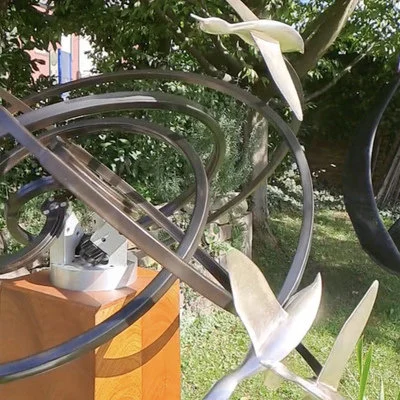
In the quiet intersection of precision engineering and whimsical artistry, German creator Felix Scharstein has carved out a niche that challenges the boundaries of modern sculpture. His latest creation, a mesmerizing kinetic installation titled "Flock of Ducks," has become the centerpiece of his ongoing exhibition at the Deutsches Museum in Munich. Through a complex interplay of aluminum and gold-plated brass, Scharstein has managed to capture the ephemeral, fluid grace of nature within the rigid confines of motorized mechanics.
Main Facts: The Anatomy of a Kinetic Masterpiece
At its core, "Flock of Ducks" is a study in synchronous movement. The sculpture utilizes a sophisticated system of three interlocked spirals that rotate in perfect harmony. As the mechanism engages, the miniature duck figures—each meticulously crafted—traverse these spirals, creating a visual narrative of flight that appears both organic and choreographed.
The choice of materials reflects Scharstein’s commitment to longevity and aesthetic brilliance. By utilizing lightweight aluminum for the structural framework, the artist ensures that the motor experiences minimal strain during continuous operation. The gold-plated brass elements, meanwhile, provide a reflective, high-end finish that catches the gallery lights, adding a sense of luxury to the industrial design.
The sculpture is not merely a static object; it is a "machine that plays." Unlike traditional kinetic art that often leans toward the abstract or the chaotic, Scharstein’s work is characterized by its intentional, rhythmic clarity. The ducks do not simply move; they navigate a spatial geometry that mimics the swirling, collaborative patterns of a real flock in flight.
Chronology: From Conceptual Sketch to Museum Pedestal
The evolution of "Flock of Ducks" is a testament to the iterative process inherent in kinetic engineering.
- 2022: The Genesis. Felix Scharstein conceptualized and fabricated the first iteration of the "Flock of Ducks." This initial version served as a proof-of-concept, testing the feasibility of the triple-spiral interlocking mechanism and the balance required to maintain fluid movement without mechanical stuttering.
- 2023: The Scaling Phase. Following the success of the original, Scharstein began the process of re-engineering the sculpture for a larger, public-facing environment. This required a complete recalculation of the torque and material stress factors, as scaling kinetic pieces is rarely a linear task.
- 2024: The Deutsches Museum Residency. The culmination of this research resulted in the current, larger version of the sculpture. Commissioned for the museum’s "Free Machines" exhibition, the piece was installed in mid-2024, serving as a flagship demonstration of Scharstein’s mechanical philosophy.
- November 2024: The current exhibition at the Deutsches Museum is scheduled to conclude on November 29th, marking the end of this specific iteration’s residency in one of the world’s most prestigious science and technology museums.
Supporting Data: The Physics of Synchronization
To understand the impact of Scharstein’s work, one must look at the mathematical rigor required to make such a machine functional. Kinetic art—or "automata"—relies on the marriage of gear ratios and kinetic energy.
In "Flock of Ducks," the synchronization is the primary technical challenge. Each of the three spirals operates on a gear train that must account for rotational velocity and friction coefficients. If one spiral were to deviate by even a fraction of a degree, the "flock" would lose its perceived harmony, transforming from a graceful flight into a mechanical clash.
- Material Composition: Aluminum (structural/weight reduction) and Gold-Plated Brass (aesthetic/wear resistance).
- Kinetic Principle: Synchronous rotational oscillation.
- Power Source: High-torque, low-RPM electric motor with variable frequency drive (VFD) for consistent, fluid motion.
- Scale: The current exhibition version is approximately 40% larger than the 2022 prototype, requiring custom-machined bearings to support the added mass of the brass components.
Official Responses and Curatorial Perspectives
The Deutsches Museum, known for its rigorous standards in showcasing technology, has lauded Scharstein’s work for its ability to bridge the gap between "cold" machinery and "warm" natural movement.
"In our ‘Free Machines’ exhibition, we sought works that exemplify the freedom of movement and the beauty of mechanical autonomy," a spokesperson for the museum noted during the opening ceremonies. "Scharstein’s ducks are a perfect example of how complex engineering can be hidden beneath a layer of aesthetic wonder. It is not just a machine; it is a mechanical poem."
For his part, Scharstein remains humble about the complexity of his craft. In his own documentation of the project, he emphasizes the importance of the viewer’s perspective: "The ducks at the ends of the spirals fly playfully in circles and around each other. The observer is meant to lose track of the mechanics and focus on the flight. When the machine disappears, the art begins."
Implications: The Future of Kinetic Art
The success of "Flock of Ducks" signals a growing interest in kinetic art as a medium for public education and museum engagement. By presenting machines that do not perform a "productive" task—such as printing, lifting, or calculating—Scharstein is challenging the definition of a machine.
The "Free Machine" Movement
The title of the exhibition, "Free Machines," is a direct commentary on the utilitarian nature of the Industrial Revolution. For centuries, machines were built to work, to produce, and to serve. Scharstein’s work belongs to a modern movement that asks: What happens when we build a machine purely for the sake of movement and beauty?
Impact on Contemporary Sculpture
Scharstein’s influence extends beyond his own workshop. His work encourages a younger generation of engineers and artists to look at CAD (Computer-Aided Design) software as a tool for artistic expression rather than just industrial manufacturing. The precision of his interlocking spirals suggests that the future of sculpture lies in the fusion of high-precision CNC machining and traditional artistic vision.
Longevity and Accessibility
While the physical exhibition in Munich is temporary, the digital footprint of the "Flock of Ducks" has ensured its legacy. Through platforms like Instagram, Scharstein has democratized the viewing experience, allowing audiences worldwide to observe the intricacies of his work in high-definition. This highlights a shift in how kinetic artists promote their work; the video of the movement is now as important as the sculpture itself.
Conclusion: A Flight of Fancy
As the exhibition "Free Machines" nears its close on November 29th, the "Flock of Ducks" serves as a poignant reminder of the power of motion. In a world increasingly dominated by digital screens and ephemeral content, there is something profoundly grounding about a physical object—made of metal, gear, and gold—that performs a simple, beautiful, and repetitive task.
Felix Scharstein has not just created a sculpture; he has created a moment of tranquility. Whether one views the work through the lens of a mechanical engineer, a museum curator, or a casual observer, the result is the same: a mesmerizing experience that reminds us that even within the most rigid mechanical systems, there is always room for the grace of flight.
For those eager to witness the intersection of art and engineering, the final weeks of the Munich exhibition offer a rare opportunity to see these "Free Machines" in their intended setting. For those unable to travel, the digital archives of Scharstein’s work remain a testament to a unique talent that continues to push the boundaries of what it means to build a machine that has nothing to do but fly.
About the Author