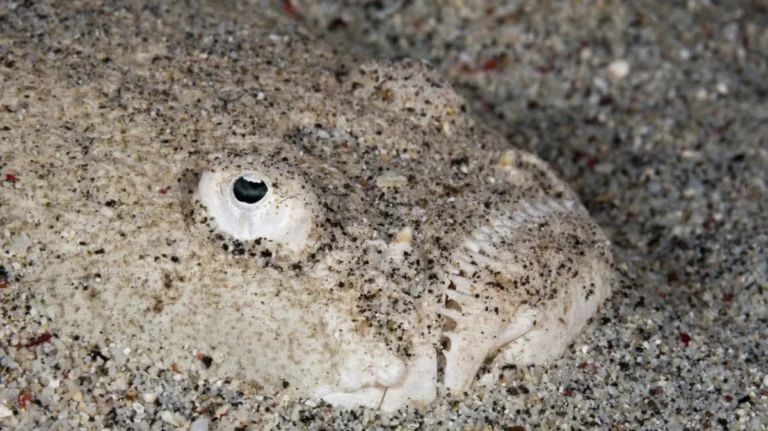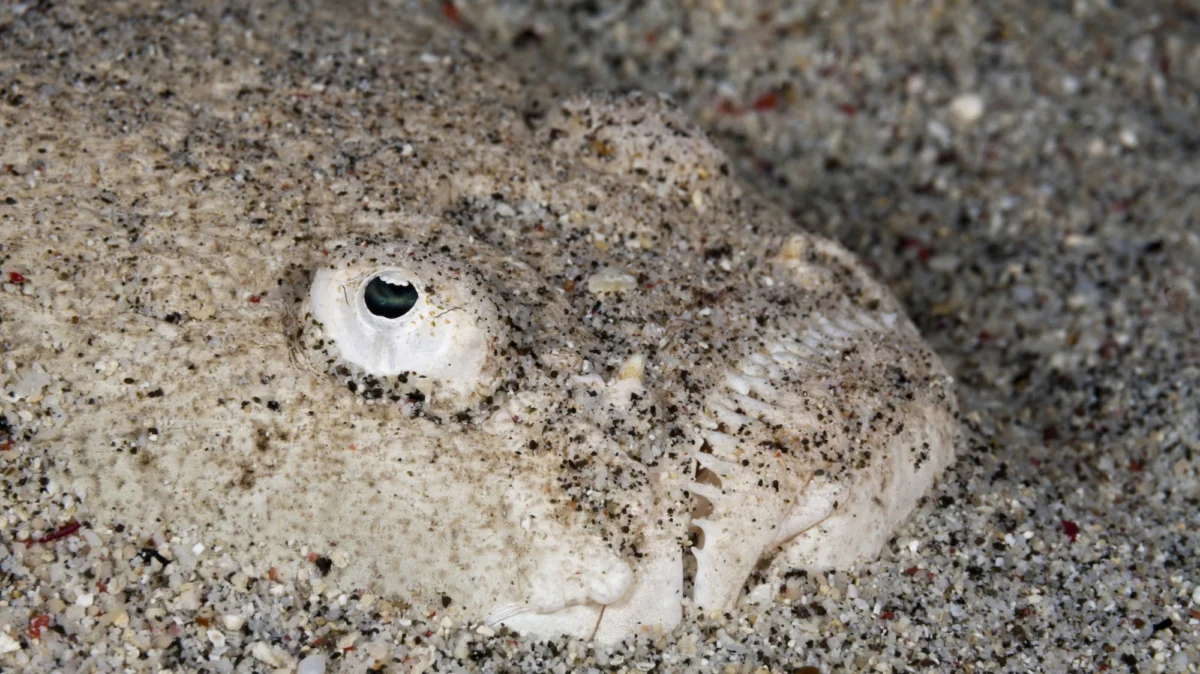
In the vast, shifting expanse of the tropical Pacific and Indian Oceans, where the seafloor is often little more than an endless, featureless desert of sand and silt, evolution has crafted one of the ocean’s most effective ambush predators. The whitemargin stargazer (Uranoscopus sulphureus) does not hunt through pursuit or speed. Instead, it employs a strategy of near-perfect concealment, turning the ocean floor into a biological trap. With its eyes, nostrils, and jagged, tooth-lined mouth positioned atop its head, the stargazer remains buried in the substrate, a living jack-o’-lantern staring perpetually toward the surface.
While its appearance is often described in ghoulish terms—earning it a reputation as a "nightmare" of the deep—the stargazer is a marvel of biological engineering. To understand this creature is to understand the extreme adaptations required for survival in an environment where there is nowhere to hide.
The Mechanics of Invisibility: Biological Adaptations
The whitemargin stargazer is part of the family Uranoscopidae, a group comprising roughly 50 species known for their bizarre anatomy. Unlike most fish, which rely on swimming speed or camouflage patterns to evade predators, the stargazer has opted for a lifestyle of absolute stillness.
Specialized Anatomy
The stargazer’s body is built for one purpose: burial. Its large, powerful pectoral fins function like shovels, allowing the fish to excavate a cavity in the sandy seafloor in a matter of seconds. Once it has settled into the sediment, the fish uses its unique morphology to maintain its position without needing to move.
A defining feature of the stargazer is its "fringes," or cirri, located around the mouth. These structures serve a vital, non-aesthetic function: they act as a filter, preventing sand and debris from entering the fish’s mouth and gills as it burrows. This allows the fish to breathe and wait in comfort while completely submerged. The positioning of its sensory organs—eyes on top of the head, directed upward—gives the fish its poetic name. It is, quite literally, a creature of the abyss that spends its entire existence looking toward the heavens.
Defensive Weaponry
Despite its sedentary lifestyle, the stargazer is far from defenseless. Positioned just above its pectoral fins are venomous spines, a formidable deterrent for any predator attempting to disturb it from above. For humans, particularly divers and snorkelers, these spines represent a genuine hazard. While rarely fatal, an encounter with the business end of a stargazer can result in excruciating pain and systemic reactions, a stern reminder that the seafloor is not a playground.
Chronology of Discovery and Classification
The scientific classification of the Uranoscopidae family has intrigued ichthyologists for centuries, primarily due to the family’s extreme morphological divergence from typical teleost fish.
- The Early Records: While indigenous coastal populations in the Indo-Pacific have long been aware of the "buried watcher," formal scientific documentation began in the 18th and 19th centuries as European naturalists explored the biodiversity of the Indian Ocean.
- 1800s – 1900s: Early taxonomists were struck by the unique skull structure of the stargazer. The consolidation of the family into the order Trachiniformes allowed scientists to better map how the fish evolved from more traditional, free-swimming ancestors.
- The Modern Era: With the advent of underwater photography and submersible technology, researchers have finally been able to document the hunting behavior of the stargazer in situ. Previously, we only knew what they looked like from specimens pulled in nets; now, we understand how they "trap" their prey in real-time.
Supporting Data: The Ambush Predator Paradigm
To understand the efficacy of the stargazer, one must look at the data regarding its hunting success. In an environment with low prey density, an active hunter would expend more energy than it gains. The stargazer’s strategy—known as "sit-and-wait" predation—is highly energy-efficient.
The Lethal Snapshot
Data collected by marine biologists observing Uranoscopus sulphureus indicates that the reaction time for a strike is measured in milliseconds. When a small fish, such as a cardinalfish, or a crustacean, such as a porcelain crab, wanders over the stargazer’s hiding spot, the predator senses the vibration through its lateral line system.
The strike is explosive. The stargazer surges upward, engulfing the prey before it can register a threat. This transition from "invisible" to "lethal" is so rapid that in many cases, the prey never realizes it is in danger until the moment of capture.
Environmental Distribution
The whitemargin stargazer is found at depths ranging from a few meters—near coastal reefs and lagoons—to several hundred meters on the continental shelf. Their distribution suggests they are generalists, capable of surviving in various sediment types, provided the substrate is loose enough for burrowing. Their range spans from the Red Sea across the Indian Ocean to the tropical western Pacific, making them a widespread, if rarely seen, inhabitant of these waters.
Official Responses and Ecological Implications
The presence of such specialized predators highlights the complexity of the "benthic" or bottom-dwelling ecosystem. Conservationists have increasingly used the stargazer as a focal point for the health of sandy-bottom environments.
The Human Interaction Factor
While the stargazer is not considered an endangered species, environmentalists argue that the degradation of shallow-water ecosystems poses a threat to bottom-dwelling specialists. As coastal development and sediment pollution alter the composition of the seafloor, the specific "burrowing" habitats required by the stargazer are being compromised.
"We often focus on coral reefs when we talk about ocean conservation," says Dr. Elena Vance, a marine ecologist focused on Indo-Pacific biodiversity. "But the sandy plains surrounding those reefs are equally vital. Species like the stargazer are the apex predators of these ‘deserts.’ When we dredge or disrupt these habitats, we are removing the top-tier managers of the micro-ecosystem."
Implications for Marine Management
The International Union for Conservation of Nature (IUCN) and regional fisheries departments have noted that while the stargazer is not a target for commercial fishing, it is often caught as bycatch in bottom-trawling operations. Because these fish are adapted for a life of concealment, they do not migrate away from trawling vessels, making them highly susceptible to habitat destruction.
Conclusion: The Beauty of the Bizarre
The whitemargin stargazer serves as a reminder that nature does not always prioritize the aesthetic. Evolution is a cold, calculating architect, and the stargazer is its masterpiece of efficiency. It has traded the ability to roam for the power to vanish, turning its own body into a fortress.
Whether viewed as a nightmare of the deep or a marvel of survival, the stargazer occupies a critical niche in the marine food web. It reminds us that for every creature we see dancing through the coral, there is another, equally fascinating life form waiting patiently beneath the sand, staring upward, and waiting for the world to pass by. As we continue to study these cryptic predators, we gain a deeper appreciation for the sheer ingenuity of life in the ocean—a place where, quite literally, the ground beneath your feet can be alive.
About the Author