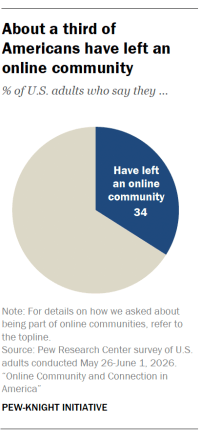
For decades, the promise of the internet was one of limitless connection—a digital town square where geography no longer dictated our social circles. Yet, as the calendar turns to late 2026, a significant shift is occurring in the American digital landscape. According to new research from the Pew-Knight Initiative, the "always-on" era of community engagement is facing a quiet but steady rebellion. Approximately one-third of U.S. adults have now made the deliberate choice to disconnect from an online community, citing a cocktail of burnout, toxic discourse, and shifting life priorities.
This phenomenon represents more than just a change in app usage; it reflects a broader existential recalibration of how Americans value their time, their peace of mind, and the quality of their digital interactions.
The State of Digital Disconnection: Key Findings
The survey, conducted by the Pew Research Center between May 26 and June 1, 2026, utilized a representative sample of 9,750 U.S. adults to probe the health of our online social fabric. The results reveal a stark reality: for a large portion of the population, the "community" aspect of the internet has lost its luster.
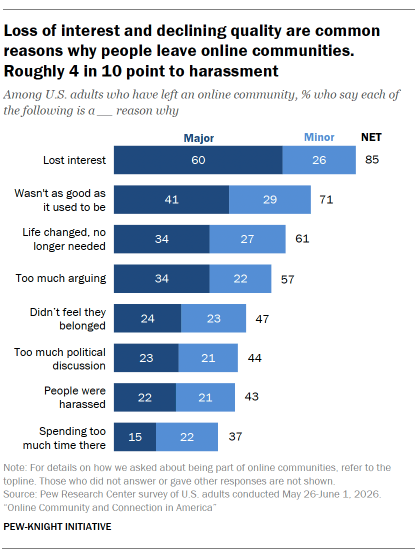
The primary driver of this exodus is remarkably simple: apathy. More than eight-in-ten people who have left an online community cite a "loss of interest" as the primary reason. This is the only factor that a majority of respondents categorized as a "major" reason for their departure. However, beneath this headline lies a complex web of social pressures, ranging from the rising tide of digital hostility to the simple, inevitable march of life transitions.
Chronology of the Shift: From Connection to Withdrawal
To understand why Americans are leaving, one must look at the evolution of online spaces over the last several years.
- Early 2000s – 2015: The "Gold Rush" of online connection. Social platforms and forums were largely viewed as auxiliary to real-world life, serving as hubs for niche interests and support networks.
- 2016 – 2022: The polarization of the public square. Online communities became increasingly entangled with national politics and heated public discourse, leading to what researchers call "context collapse," where every space feels like a political battlefield.
- 2023 – 2025: The "Burnout" phase. As screen time became a ubiquitous concern and the quality of moderation in many large-scale communities fluctuated, users began reporting higher levels of fatigue.
- 2026 (The Current Moment): The rise of intentional disconnection. Users are now actively auditing their digital lives, pruning communities that no longer provide value, and setting boundaries against toxic engagement.
The Drivers of Departure: A Data-Driven Analysis
While "loss of interest" serves as the umbrella term for most departures, the granular data reveals a more troubling picture of digital life.
The Toxicity Factor
The digital experience is being marred by conflict. Over half (57%) of those who have left an online community report that "too much arguing" was a factor in their decision. Furthermore, 43% explicitly pointed to harassment—a finding that underscores the persistent struggle platforms face in enforcing civility. This data aligns with long-term trends identified by Pew, which show that harassment is a structural, rather than incidental, feature of many high-traffic digital environments.
The Political Divide
Politics has become a major wedge in community cohesion. Among those who have exited a group, 41% said they left because politics was brought up too often. Interestingly, there is a clear partisan split in this motivation. Republicans are significantly more likely than Democrats to cite the intrusion of politics as a reason for leaving (50% vs. 39%). Among political leanings, liberal Democrats appear the most tolerant—or perhaps the most insulated—from political discourse, with only 32% citing it as a reason for their departure.
Time and Life Transitions
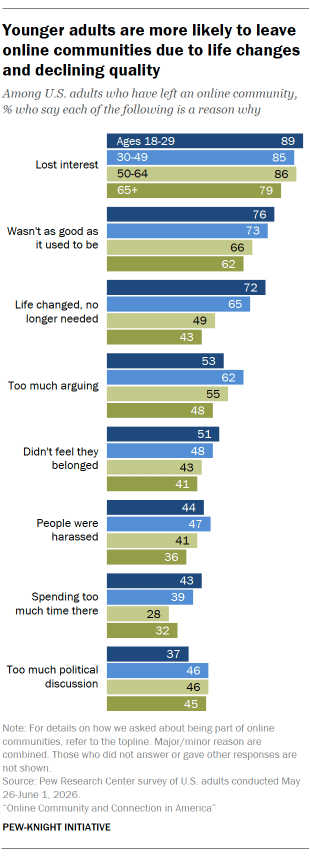
Digital minimalism is on the rise. With 37% of respondents citing excessive screen time as a reason for leaving, it is clear that many users are attempting to regain control over their focus. Additionally, age plays a critical role in why people leave. Younger adults (18–49) are much more likely to abandon communities as their life circumstances change—a testament to the fact that online groups are often tied to specific life stages, such as academic pursuits or early-career networking.
Age and Demographics: Who is Leaving?
The digital exodus is not evenly distributed across the population. Younger Americans, who are generally more active in online communities, are also the most likely to leave them.
- The 18-29 and 30-49 cohorts: These groups report higher rates of leaving communities, often citing "life changes" as the primary catalyst.
- The 50-64 bracket: 32% of these adults report having left an online community.
- The 65+ demographic: Only 19% report having left.
This suggests that for older generations, the communities they join—often centered around long-term hobbies, faith groups, or family—may be more stable, whereas younger users move through digital spaces with greater fluidity, shedding them as quickly as they adopt them.
Official Perspectives and Expert Insight
Jeffrey Gottfried, an associate director at the Pew Research Center, notes that the study was designed to define "community" broadly, encompassing everything from social media groups and discussion forums to video game guilds and messaging circles.
"We wanted to capture the nuance of what it means to feel part of a community," Gottfried explains. "By asking about shared interests and collective action, we found that while the desire for connection is innate, the mechanism for achieving that connection online is becoming increasingly fraught."
The Pew-Knight Initiative, which funded this study, emphasizes that this research is not merely about tracking app deletions. It is about understanding how the "civic health" of the nation is impacted when individuals feel forced to retreat from the digital public square due to toxicity or political exhaustion.
Implications for the Future of Digital Connection
What does this mean for the future of the internet? If the trend of "digital pruning" continues, we may see a transition from massive, all-encompassing social platforms to smaller, gated, and more heavily moderated environments.
The Rise of "Small Web" Culture
The data suggests that the "town square" model—where millions of strangers interact in a single, unmoderated feed—is increasingly untenable for a large segment of the public. Users are signaling a preference for communities that:
- Enforce Civility: Communities that prioritize strict moderation and conflict-reduction are likely to retain members longer.
- Maintain Focus: Groups that strictly limit political discourse are seeing higher retention rates among those who value "niche" connection over general debate.
- Provide Real Value: As users become more conscious of their screen time, communities that provide utility, education, or genuine support will survive, while those predicated on endless, low-stakes consumption are likely to fade.
The Civic Consequence
The most profound implication of this study is the potential for increased social atomization. If Americans feel they cannot find a "middle ground" online—and subsequently leave those spaces—they may retreat into even more insular, homogenous echo chambers. When individuals exit diverse online communities due to political friction, the opportunity for cross-partisan dialogue shrinks, further hardening the divides that already characterize American life.
As we look toward 2027 and beyond, the challenge for platform designers and policy makers will be to create digital architecture that fosters the benefits of community—support, belonging, and shared interest—without the corrosive side effects of unchecked hostility and political saturation. The "Great Online Exit" is currently underway, and it is a clear message to the tech industry: the quality of the conversation matters more than the volume of the connection.
About the Author