In the modern media landscape, the way an individual consumes news is rarely an isolated habit; it is a window into their broader relationship with society. A groundbreaking new analysis from the Pew Research Center, conducted under the auspices of the Pew-Knight Initiative, reveals that the news sources Americans rely on are deeply intertwined with their levels of civic engagement, political activity, and community involvement.
By categorizing the U.S. adult population into four distinct "engagement groups"—Mobilizers, Connectors, Spectators, and Outsiders—researchers have mapped the intersection of media diet and public participation. The study, which synthesizes data from 30 prominent news outlets, suggests that while the most engaged Americans are disproportionately represented in many news audiences, the patterns of engagement vary significantly depending on whether an outlet focuses on high-stakes political reporting or general broadcasting.
The Four Pillars of American Engagement
To understand the relationship between media and citizenship, the Pew Research Center developed a typology based on 19 specific metrics, ranging from voting and community volunteering to religious service attendance and news-following frequency.
1. The Mobilizers: The Civic Vanguard
The smallest segment of the population (9%), Mobilizers are the most active across all examined domains. They are the individuals most likely to attend town halls, donate to political campaigns, and follow news coverage with religious intensity. They do not just watch the world; they actively attempt to shape it.
2. The Connectors: The Community Pillars
Larger than the Mobilizers, Connectors are deeply involved in society. They are regular volunteers and active members of community organizations. While they are highly engaged, they are notably less focused on political activity than their Mobilizer counterparts, preferring to focus their energies on direct community impact.
3. The Spectators: The Informed Observers
Spectators represent a significant portion of the public. They possess high levels of interest in current events and follow the news closely, yet they are significantly less likely to participate in political or civic life outside of their homes. They consume the news, but they rarely intervene in the systems that the news describes.
4. The Outsiders: The Disengaged
Comprising the largest or nearly largest segment depending on the demographic, Outsiders are characterized by a lack of traditional civic participation. They are less likely to vote, volunteer, or follow the news. Their detachment from formal political and community structures makes them a unique demographic in the context of media consumption.
Chronology and Methodology: Building the Data Set
The findings presented here are the result of a rigorous, multi-phase research effort conducted throughout 2025 and 2026. The foundation of this analysis rests on two primary data pillars:

- The Media Consumption Survey (March 2025): Researchers surveyed 9,482 U.S. adults, presenting them with a curated list of 30 prominent news organizations. Participants were asked not only which sources they had heard of, but which they relied upon for regular news consumption.
- The Engagement Mapping (July–December 2025): In a separate, extensive survey of 5,195 adults (many of whom participated in the March study), the Center applied the 19-measure engagement framework. By cross-referencing this with the earlier media survey, analysts were able to identify which specific news audiences contained higher-than-average concentrations of Mobilizers, Connectors, Spectators, or Outsiders.
This dual-layered approach allows the Pew-Knight Initiative to move beyond simple demographics and provide a behavioral map of the American public.
Supporting Data: Where Do the Engaged Go?
The data reveals a stark divide between the audiences of political-centric digital outlets and those of major television networks.
The Mobilizer Concentration
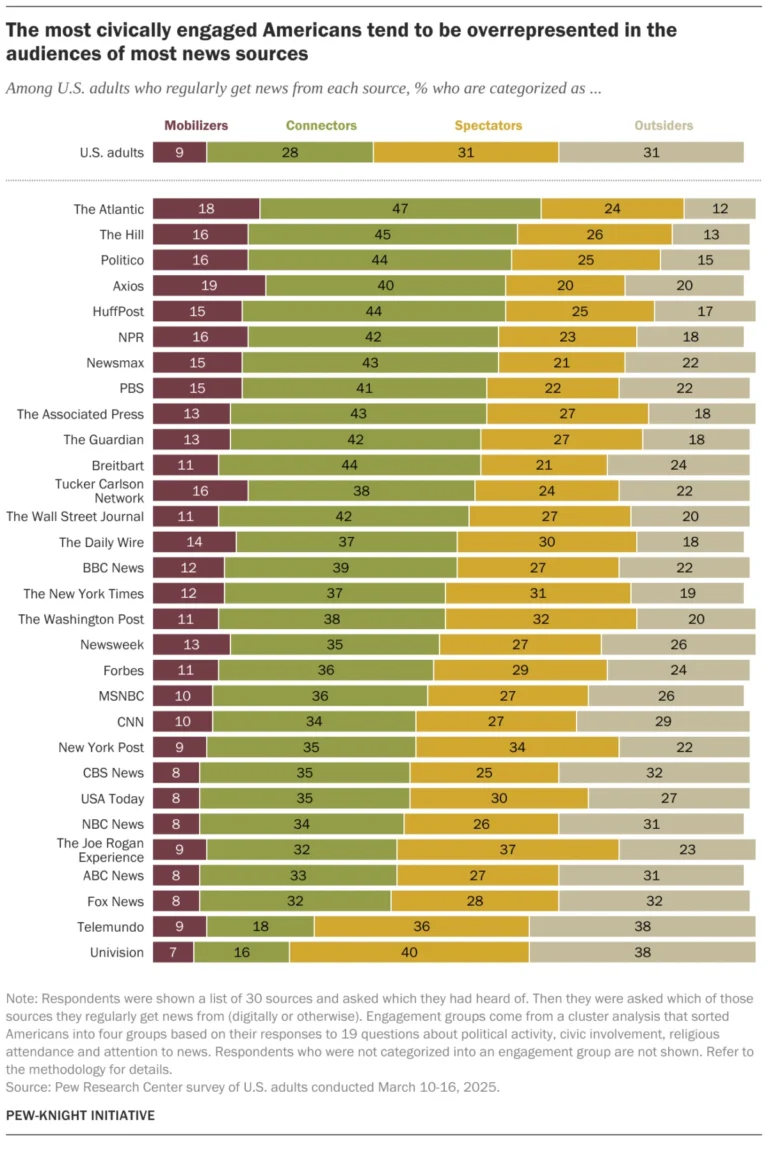
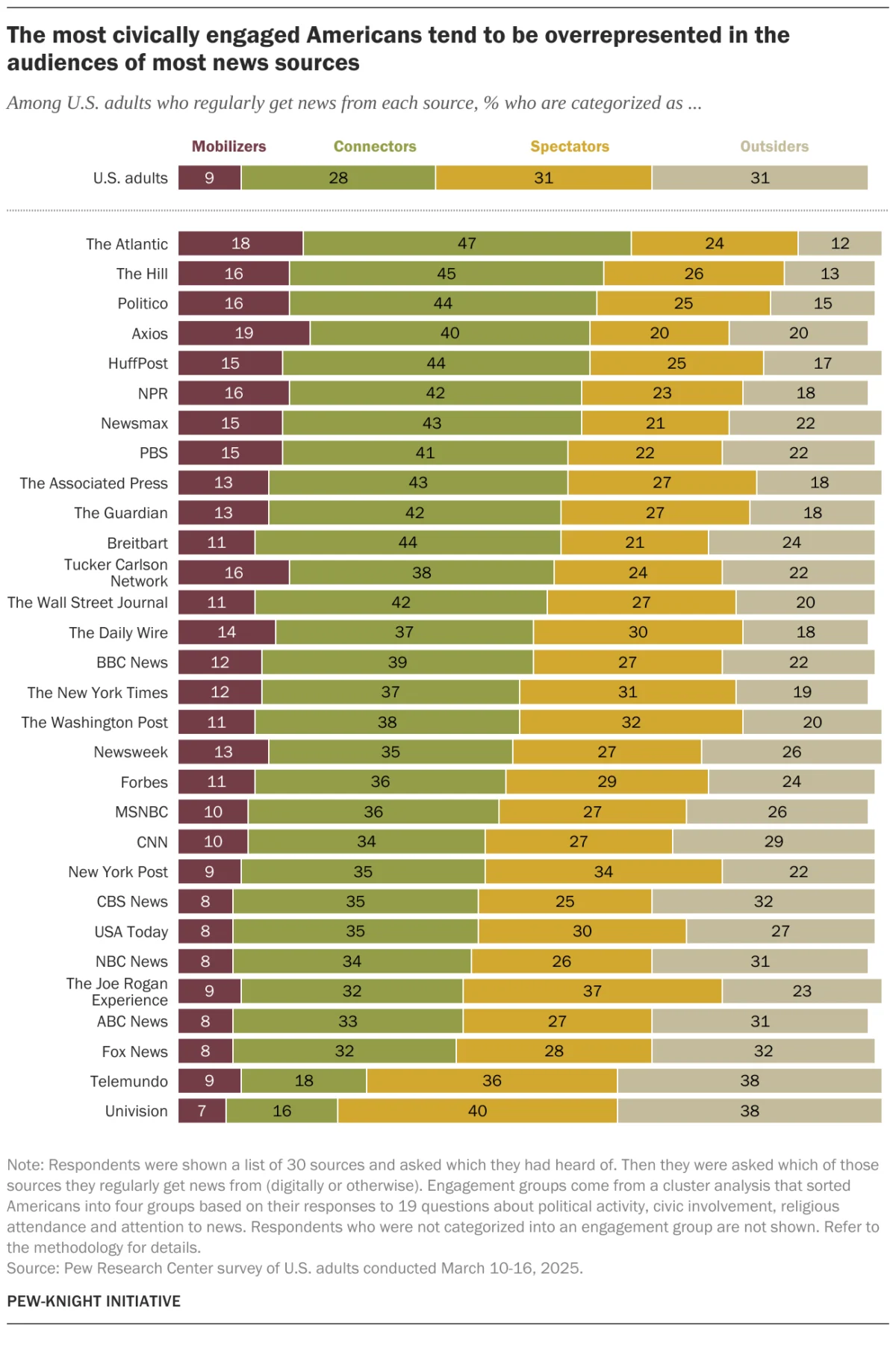
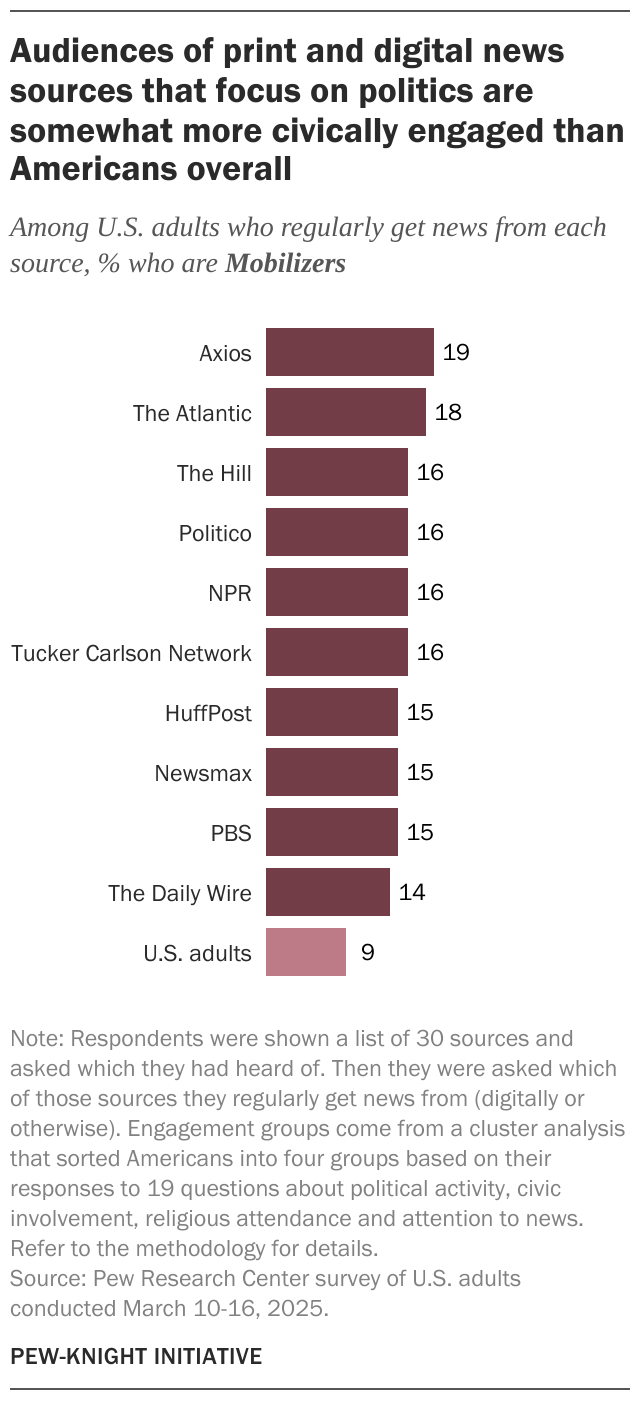
Political news outlets act as magnets for the most politically active segment of the population. For instance, while only 9% of the total U.S. adult population are classified as Mobilizers, they represent 19% of the audience for Axios. Similarly, high-intensity political outlets such as The Atlantic (18%), The Hill (16%), and Politico (16%) boast double the proportion of Mobilizers compared to the national average.
Public media, too, captures a segment of this highly active group. NPR and PBS both draw 16% and 15% of their audiences from the Mobilizer category, respectively. These figures suggest that audiences seeking granular, policy-heavy coverage are largely composed of those who already prioritize political influence as a primary pillar of their daily lives.

The Television Anomaly
Television news, particularly the major broadcast networks (ABC, CBS, and NBC), tends to mirror the general population more closely, often capturing a wider cross-section of engagement levels. However, the data highlights that some of the most prominent networks actually see higher concentrations of "Outsiders."
For instance, 31% of the U.S. population are Outsiders. The audience for ABC News and NBC News matches this statistic exactly (31%), while CBS News and Fox News slightly exceed it at 32%. This indicates that television news remains the primary entry point for Americans who are otherwise disengaged from the broader civic and political ecosystem.
Interestingly, Spanish-language networks Telemundo and Univision show a significant concentration of both Outsiders (38%) and Spectators (36%–40%). This trend is partially explained by the demographic makeup of Hispanic Americans, who, in this study, were more likely to fall into the "Spectator" category compared to their White or Black counterparts.
Official Perspectives and The Role of the Pew-Knight Initiative
The Pew-Knight Initiative, a collaborative effort between the Pew Research Center and the John S. and James L. Knight Foundation, was created to investigate the health of the American information ecosystem.

"The goal of this research is not merely to track ratings, but to understand the health of our democracy," a spokesperson for the initiative stated. "By identifying how different news sources serve different segments of the public, we gain insight into whether our media environment encourages civic participation or merely provides content for the already-engaged."
The research highlights a critical question: Does the media shape the citizen, or does the citizen select the media that reflects their pre-existing level of engagement? The report suggests a symbiotic relationship. As news consumption is one of the pillars used to define these engagement groups, it is clear that the habits of a "Mobilizer" or an "Outsider" are reinforced by the news sources they choose to trust.
Implications: The Future of Civic Health
The implications of this study are profound for both journalism and democracy.
The Information Gap
If news consumption is largely concentrated among the already-active (Mobilizers and Connectors), the "Spectators" and "Outsiders" are being left out of the high-level policy discussions presented by specialized outlets. This creates an information inequality where the most complex and analytical journalism is consumed primarily by those who are already participating in the political process.

The "Echo Chamber" of Action
The data suggests that the "Mobilizer" audience is, in effect, an echo chamber of action. When these individuals consume news from sources like The Atlantic or The Hill, they are consuming content that is designed for an active, highly political audience. Conversely, the "Outsider" audience—which is the largest in raw numbers—is not being reached by these sources, suggesting that major political shifts may be occurring in a bubble that excludes a large portion of the American public.
The Role of Broadcasters
Broadcast news and cable news channels retain a unique position as the "great equalizers." By capturing a representative slice of the American public—including a significant portion of Outsiders—they represent the most viable channel for mass-civic education. However, the challenge for these networks is whether they can transition "Spectators" and "Outsiders" into more active participants, or if their current model is destined to reinforce the status quo.
Future Research
As the Pew-Knight Initiative moves forward, the focus will likely shift to how digital platforms and algorithmic curation further exacerbate or mitigate these trends. With social media and search-based news discovery on the rise, the question remains: will technology continue to silo these engagement groups, or will it create new avenues for the "Outsiders" to enter the public sphere?
The findings of this report provide a baseline for the coming years. By mapping the "civic pulse" of the country, the research serves as a reminder that the health of a democracy is not just measured by the number of news stories produced, but by the number of citizens who feel empowered and informed enough to act upon them.
For now, the divide remains clear: the most engaged are well-served by a diverse array of political journalism, while the rest of the country relies on a television-heavy diet that reflects the status quo of American civic life. Bridging that gap will be the defining challenge for the media landscape in the years ahead.
About the Author