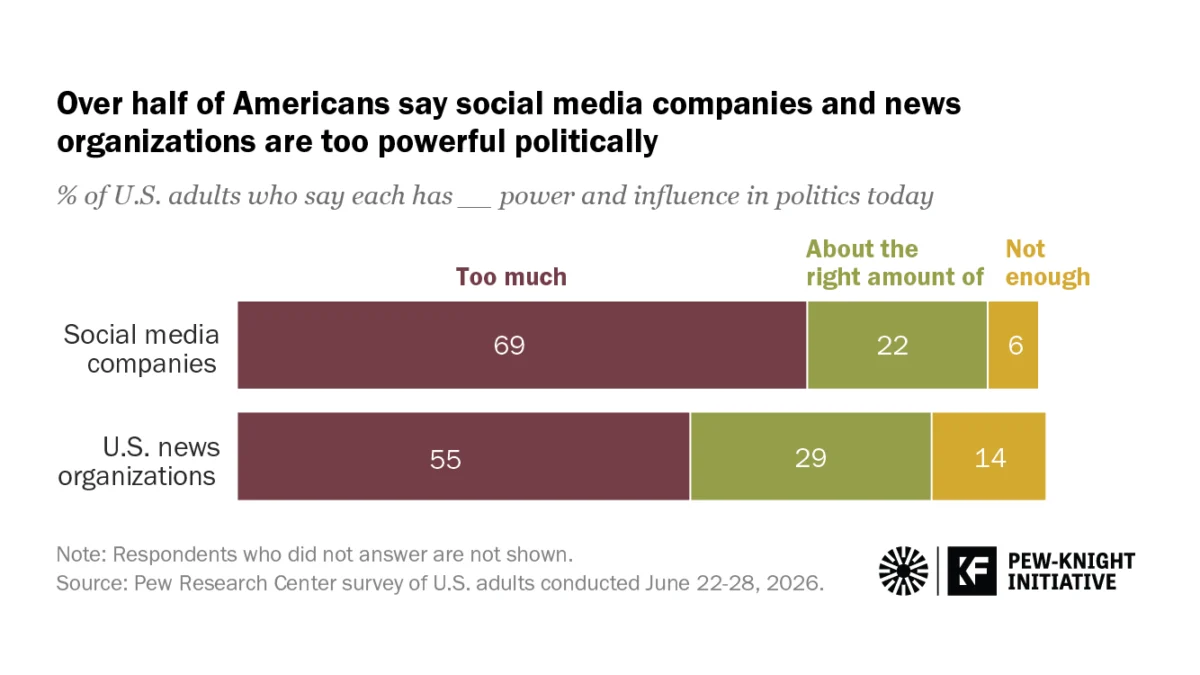
In the modern American landscape, the corridors of power are no longer confined to the marble halls of Washington, D.C. According to a comprehensive new study from the Pew Research Center, conducted under the auspices of the Pew-Knight Initiative, a significant majority of Americans now believe that the true architects of political influence are the entities that shape our digital and information environments: social media corporations and traditional news organizations.
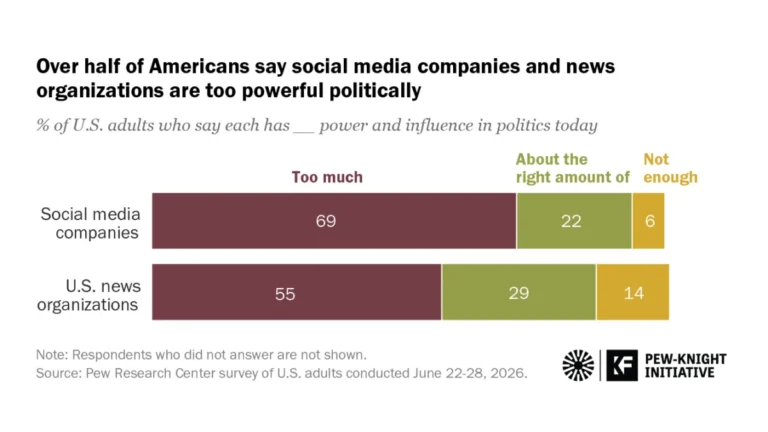
As the lines between civic discourse and digital platforms blur, the American public has reached a rare point of consensus. Roughly seven-in-ten U.S. adults (69%) contend that social media companies possess excessive power and influence in contemporary politics. Meanwhile, a smaller but still substantial majority (55%) apply the same critique to U.S. news organizations. These figures, derived from a June 2026 survey of 3,488 American adults, highlight a deep-seated public anxiety regarding the gatekeepers of democracy.
The Evolution of the Digital "Public Square"
To understand why these perceptions have taken root, one must examine the shifting mechanics of the "public square." Historically, the press was viewed as the "Fourth Estate," a necessary check on government power. However, the rise of the internet and the subsequent dominance of platforms like Facebook, X (formerly Twitter), Instagram, and TikTok have fundamentally altered this dynamic.
The Algorithmic Hand
Social media companies are no longer mere passive hosts of user content; they are active curators. By utilizing complex, proprietary algorithms, these platforms dictate what content reaches millions of eyes, often prioritizing engagement over accuracy. This curation effectively allows private tech firms to act as the primary arbiters of political discourse.
Many Americans recognize this influence. In previous research, the majority of those who rely on social media for news reported that they believe these platforms significantly influence the narratives they consume. Whether it is through content moderation policies, the removal of posts, or the subtle promotion of specific topics, the power to shape the political conversation has migrated from the town hall to the server farm.
The Diminishing Influence of Journalism
Ironically, while the public views news organizations as overly powerful in a political sense, there is a simultaneous perception that the influence of professional journalism is in terminal decline. Data from a 2025 study revealed that nearly half of Americans (49%) believe journalists are losing their societal relevance, a sentiment that suggests a growing disconnect between the traditional press and the average voter. This paradox—that news outlets are "too powerful" yet "fading in influence"—points to a complex frustration with the media’s role as a mediator of truth.
A Chronology of Public Distrust
The current climate of skepticism did not emerge overnight. It is the result of a long-term erosion of trust in institutional authority.
- Pre-2016: The rise of the smartphone and the explosion of social media platforms initially promised a democratization of information. However, concerns regarding data privacy and the echo-chamber effect began to surface as these platforms scaled globally.
- 2016–2020: The polarization of the political landscape brought the role of tech companies into sharp focus. Debates over "fake news," misinformation, and the role of algorithms in swaying elections became central to national discourse.
- 2021–2024: During this period, the public began to view both legacy media and tech platforms with increased suspicion. The COVID-19 pandemic and subsequent election cycles served as flashpoints where the credibility of news reporting and the moderation practices of social media companies were scrutinized by both sides of the aisle.
- 2025–2026: Recent data suggests that the "tech-backlash" has matured into a settled public view. The consensus now transcends political divides, with broad agreement that these corporations—tech and media alike—operate with an accountability deficit.
Data Analysis: The Partisan Divide
While the perception of excessive power is widespread, the lenses through which Republicans and Democrats view this influence differ significantly.
The Social Media Consensus
Interestingly, social media companies have managed to unite the polarized American electorate in their skepticism. The Pew-Knight survey found that 71% of Republicans and 69% of Democrats agree that social media companies hold too much power. This near-equal distribution suggests that fears regarding censorship, bias, and manipulation are non-partisan, even if the specific complaints—such as which ideologies are suppressed—differ by group.
The Divergence on Traditional Media
The unity breaks down, however, when the focus shifts to U.S. news organizations. Here, the partisan gap is stark:

- Republicans: 69% believe news organizations have too much political influence. This aligns with broader trends showing that Republicans are far less likely than Democrats to express confidence in journalists to act in the public’s best interest.
- Democrats: Only 43% hold the same view. This suggests that while Democrats are concerned about the influence of tech giants, they remain more inclined to view traditional news organizations as a necessary or legitimate force in the political process.
This divergence is mirrored in trust levels. Republicans, on average, demonstrate lower levels of trust in national and local news outlets, often perceiving these institutions as aligned with the political establishment or partisan interests.
Implications for Democracy and Governance
The implications of this widespread skepticism are profound. When a population views the primary sources of its information as "too powerful," the result is a fragmented reality and a decline in civic engagement.
The Legitimacy Crisis
When majorities of the public believe that their news and social media environments are manipulative, the potential for a "legitimacy crisis" increases. If voters believe that the information they receive is curated to serve the interests of powerful, non-elected elites, they are less likely to participate in traditional democratic processes or trust the outcomes of civic debates.
Regulatory Pressures
The data suggests that the public is primed for increased oversight. As the Pew-Knight Initiative’s research indicates, there is a clear demand for greater transparency. Whether this manifests as antitrust legislation, algorithmic transparency mandates, or stricter liability laws for content moderation, the "too much power" narrative is a strong political wind blowing toward increased regulation of Silicon Valley and the media industry.
The "Public Square" Paradox
Perhaps the most dangerous implication is the potential for the withdrawal of the public from these spaces. If citizens perceive the modern "public square" as an arena of influence rather than a place for democratic deliberation, they may retreat into smaller, more homogeneous information silos. This would exacerbate polarization, making consensus-building even more difficult in an already divided nation.

Moving Forward: The Role of the Pew-Knight Initiative
The Pew-Knight Initiative, a collaboration between The Pew Charitable Trusts and the John S. and James L. Knight Foundation, serves a critical role in documenting these shifts. By mapping the contours of public opinion, the initiative provides a baseline for policymakers, media leaders, and technology executives to understand the depth of the distrust facing their industries.
As we look toward the future, the challenge will be to reconcile the democratic need for an informed public with the reality that the institutions facilitating that information are viewed with deep-seated suspicion. Restoring trust will require more than just technological fixes; it will require a fundamental reassessment of how power is exercised in the information age.
The June 2026 survey data serves as a sobering reminder: the American public is watching the gatekeepers, and they are increasingly concerned by what they see. Whether this leads to reform or further institutional decline remains one of the defining questions of our time.
For those interested in the full data set, methodology, or the specific survey questions used in this study, the Pew Research Center has made the documentation available via their official portal, ensuring that the transparency of this research matches the gravity of the subject matter.
About the Author