In the wake of the 2026 midterm elections, political analysts and pollsters are grappling with a familiar but intensified conundrum: while the "direction" of the electorate was correctly identified, the "magnitude" of the Democratic surge was significantly understated. As the dust settles on state-level races and the composition of the new Congress, a comprehensive analysis by the Pew Research Center confirms that pre-election polling, while capturing the prevailing national mood, consistently failed to capture the full scope of Democratic performance.
The discrepancy has sparked a fierce debate within the data science and political communication communities. With vote counting largely complete, the data suggests that for the second time in recent cycles, the polling industry faced a systematic bias—not necessarily in predicting the winner, but in gauging the intensity of the voter turnout that ultimately shifted the balance of power.
The Main Facts: Directional Accuracy vs. Quantitative Misses
The central takeaway from the 2026 election is that the polls were not "wrong" in the binary sense—they correctly anticipated the shift in legislative control and the broader trends in voter sentiment. However, they were notably inaccurate in measuring the margins.
Pollsters accurately identified a deeply pessimistic national mood. Throughout the late summer and autumn of 2026, data consistently reflected a broad dissatisfaction with the economic policies of the Trump administration, even among segments of the electorate that had supported the President in his 2024 campaign. Furthermore, the surveys identified a significant "enthusiasm gap," noting that Democratic voters were consistently more engaged and more likely to participate in surveys than their Republican counterparts.
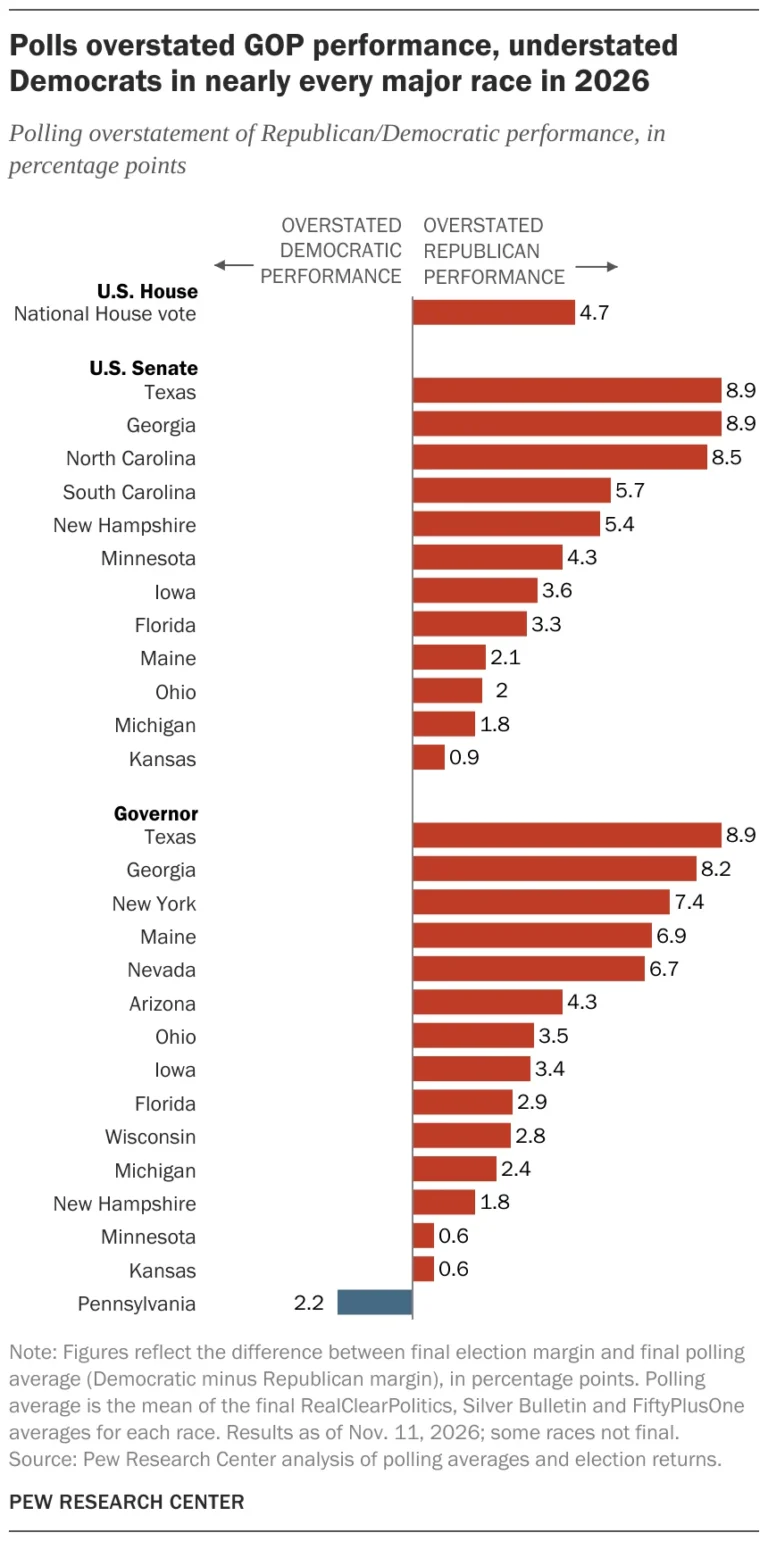
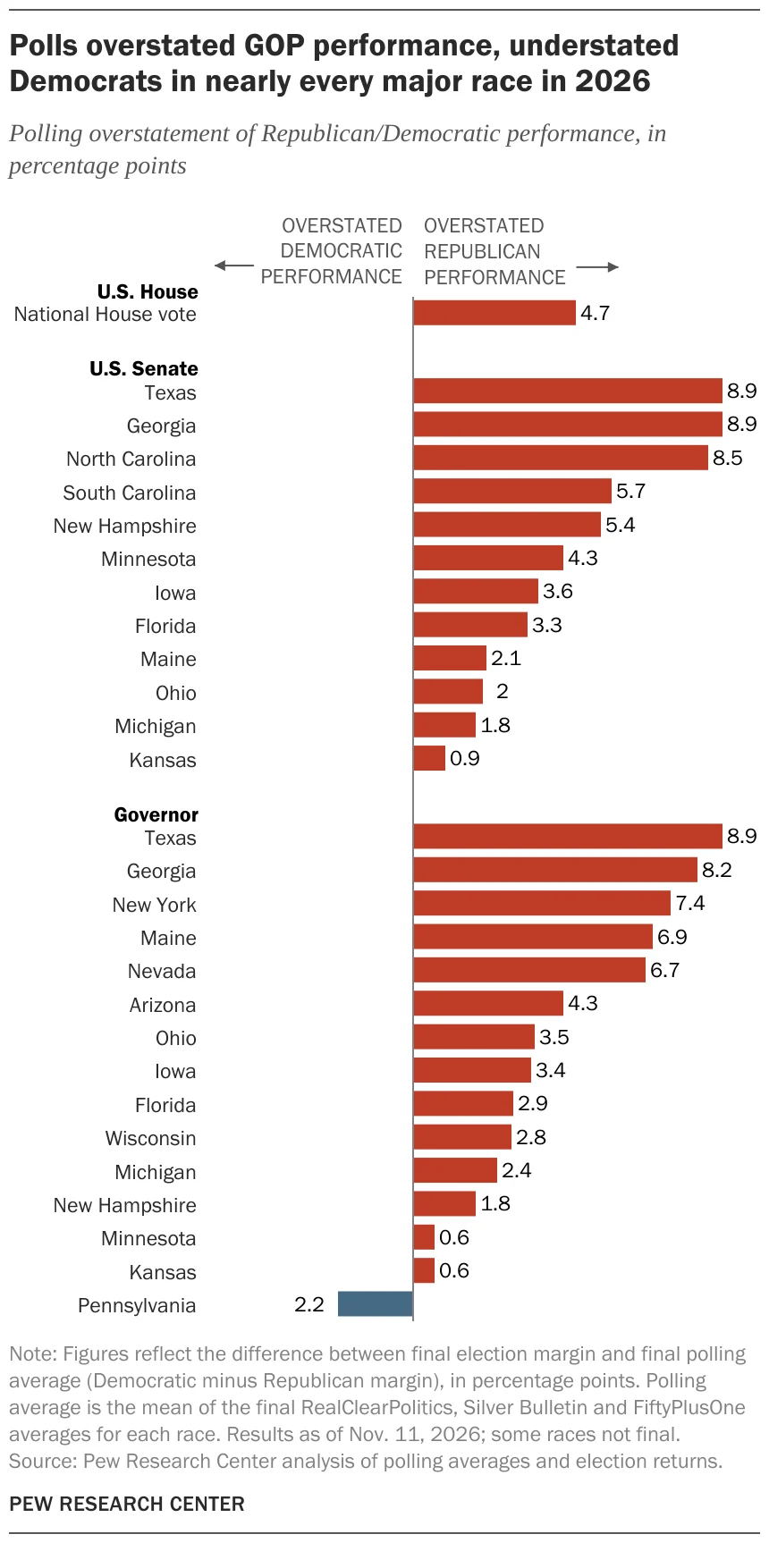
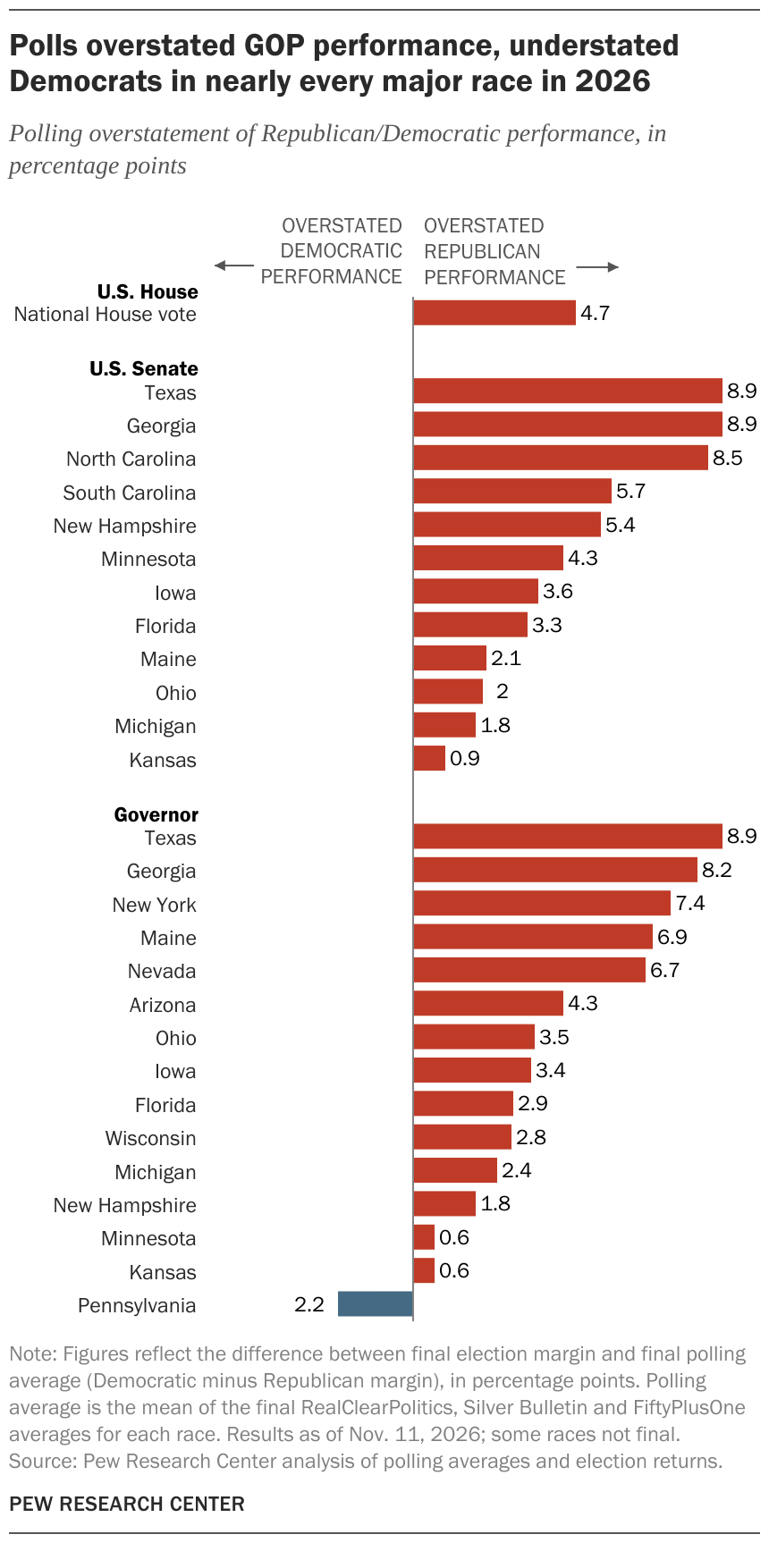
Despite these accurate insights, the final polling averages failed to translate that enthusiasm into an accurate seat-share forecast. In 21 of the 27 Senate and gubernatorial races analyzed, polls understated the Democratic margin by at least two percentage points. Across these races, the mean error was approximately four points—a margin that, in tightly contested environments, represents the difference between a landslide and a narrow squeaker.
Chronology: The Road to the 2026 Midterms
The journey toward the 2026 election was marked by distinct phases of political mobilization and polling volatility.
- Late Summer 2026: Initial polling began to reflect a divergence in voter sentiment. While President Trump’s approval ratings remained polarized, the "generic House ballot" began to lean toward Democratic challengers as inflation and cost-of-living concerns dominated the discourse.
- October 2026: As the election neared, a distinct pattern emerged: Democratic supporters were significantly more willing to participate in polling interviews. Analysts warned that this could lead to "non-response bias," where the final samples might be skewed toward the more talkative, highly motivated Democratic base.
- Election Day, November 2026: Early exit polls and initial vote tallies began to hint at a "Blue Wave" that exceeded the predicted margins in states like Texas, Georgia, and North Carolina.
- The Week After, November 11–12, 2026: Official counts reached a level of maturity that allowed for the first retrospective analysis of polling accuracy. Researchers began the painstaking process of comparing the pre-election polling averages—drawn from sources like RealClearPolitics, the Silver Bulletin, and FiftyPlusOne—against the certified or semi-certified reality on the ground.
Supporting Data: Dissecting the Discrepancy
The polling error was not uniform, but it was remarkably consistent in its direction. In states like Texas and Georgia, where the Senate and gubernatorial races were highly watched, the polling error reached as high as 8.9 percentage points in favor of the Democrats.
A critical component of this analysis is the "generic House ballot." Nationally, polls suggested a Democratic lead of approximately 9 points. By November 11, the actual vote share showed a lead of nearly 14 points—a 4.7-point error. This level of error is, according to the American Association for Public Opinion Research (AAPOR), larger than the errors observed in the 2018 or 2022 midterms.
Table: Polling Understatement of Democratic Margins
| Race/Category | Office | Error (Points) |
|---|---|---|
| Texas | U.S. Senate | 8.9 |
| Georgia | U.S. Senate | 8.9 |
| North Carolina | U.S. Senate | 8.5 |
| National House Vote | U.S. House | 4.7 |
| Arizona | Governor | 4.3 |
| Pennsylvania | Governor | -2.2 (Overstated) |
As noted in the data, the only major outlier was the Pennsylvania gubernatorial race, where polls slightly overstated the Democratic margin. This provides a crucial counter-narrative: the error was not a monolithic failure of polling methodology but a complex reaction to localized voter behavior and demographic turnout.
Official Responses and Expert Commentary
In the days following the publication of these findings, the polling industry has entered a period of intense introspection. Many experts argue that the traditional "likely voter" model is becoming increasingly obsolete in a high-turnout, highly polarized era.
"We are dealing with a shift in the sociology of polling," said one lead researcher at a major D.C. think tank. "When you have a segment of the population that is systematically less likely to talk to a pollster—whether out of distrust, busy schedules, or anti-institutional sentiment—the weighting models based on party affiliation or past voting history start to fray."
Other experts point to the "unique difficulties" of 2026. These included rapid shifts in the economic landscape in the final weeks of the campaign and the increasing difficulty of reaching voters via traditional phone-based polling. The reliance on online panels and weighted samples, while robust in theory, may have failed to capture the sudden surge of "low-propensity" voters who were mobilized by specific local economic concerns.
Implications: The Future of Election Forecasting
The implications of the 2026 polling miss are profound for the media, political strategists, and the public.
1. The Erosion of Public Trust
Every time polls "miss," the public’s faith in institutional data diminishes. If the gap between pre-election surveys and actual results continues to widen, the media’s ability to frame the "narrative" of an election will be severely compromised. There is a growing consensus that reporting should focus less on "who is winning" and more on the range of potential outcomes.
2. Methodological Overhaul
The polling industry is expected to accelerate its move toward hybrid modeling. This includes incorporating more granular, ground-level data and perhaps moving away from nationalized generic ballots, which are increasingly decoupled from the idiosyncratic nature of local House district races.
3. Strategy and Resource Allocation
For political campaigns, the 2026 miss could be costly. If campaigns rely on inaccurate polling to allocate their advertising dollars and field operations, they risk leaving winnable districts under-resourced or over-investing in "safe" states. Moving forward, campaigns will likely prioritize internal polling and real-time voter turnout modeling over public-facing averages.
4. A More Nuanced Understanding of the Electorate
Finally, the 2026 cycle proves that "the economy" is not a monolith. The polling accurately detected that voters were angry about the economy, but it failed to anticipate that this anger would be channeled into a high-turnout push for change rather than apathy. Future research must bridge the gap between "sentiment" and "action."
As we look toward the next cycle, the 2026 experience serves as a sobering reminder: the landscape of American democracy is shifting faster than the tools we use to measure it. While we have more data than ever before, the challenge lies not in the collection of information, but in the accurate interpretation of a highly volatile, deeply divided, and increasingly unpredictable electorate. The "polling paradox" is not just a statistical anomaly; it is a reflection of a nation in the midst of a significant political realignment.
About the Author