In the corridors of corporate power, the narrative surrounding sustainability is undergoing a fundamental transformation. For years, the Chief Sustainability Officer (CSO) was often viewed through the lens of corporate social responsibility (CSR)—a role focused on reputation management, philanthropy, and perhaps the occasional efficiency project. However, according to the 8th biennial survey of CSOs at publicly traded U.S. companies, conducted by the Weinreb Group, that era has officially ended.
The new mandate for the modern CSO is not merely about "doing good" or even "saving money"; it is about survival and resilience. The report highlights a seismic shift in how sustainability teams create business value, with risk mitigation now trumping cost savings as the primary driver of organizational impact.
Main Facts: The Rise of the "Resilience Architect"
The Weinreb Group’s latest findings reveal a profession in the midst of a sophisticated pivot. As global markets grapple with climate-induced disruptions, tightening regulatory frameworks, and increasingly fragile supply chains, the CSO has emerged as a critical guardian of enterprise value.
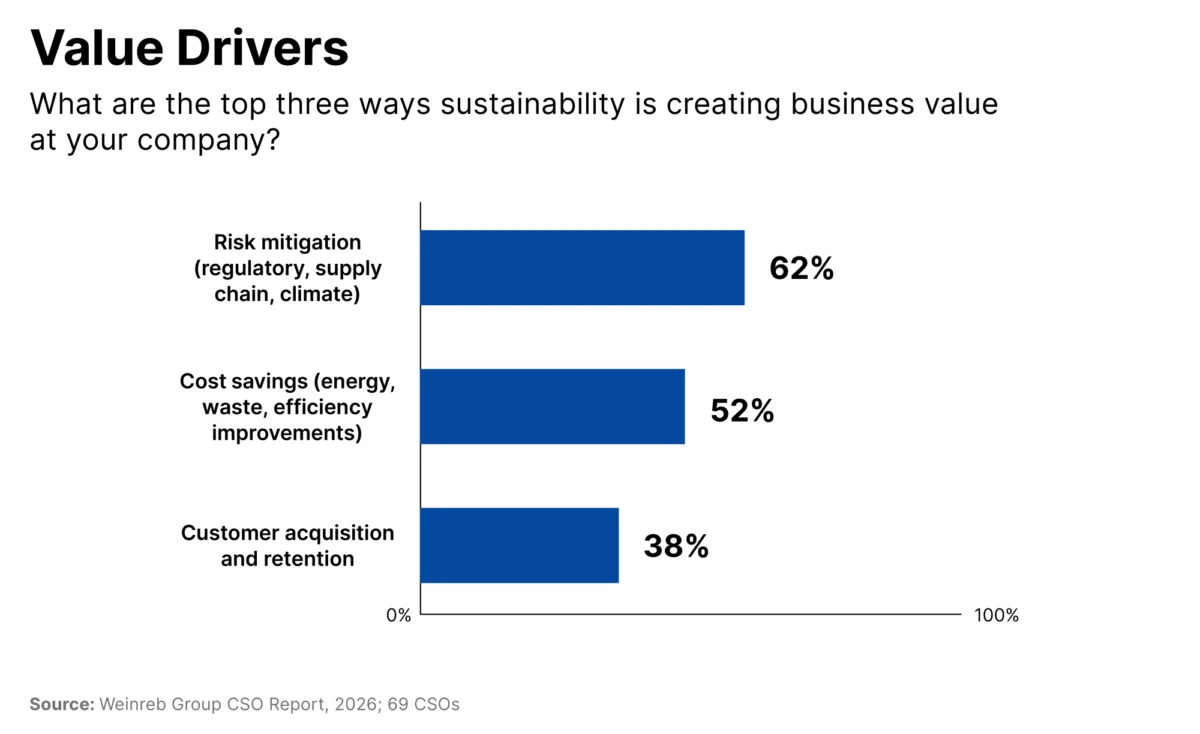
According to the survey, which gathered insights from nearly 70 CSOs at major U.S. public companies, more than 62 percent of respondents identified the ability to address regulatory, supply chain, and climate risks as their most effective way to resonate with the C-suite. This marks a departure from previous years, where the "business case" for sustainability was more frequently built on the foundations of operational cost savings or brand enhancement.
While cost savings (cited by 52 percent) and customer acquisition/retention (cited by 38 percent) remain significant pillars of the CSO’s value proposition, they have been eclipsed by the urgent need to "see around corners." The modern CSO is increasingly functioning as a high-level risk officer, tasked with navigating an era of unprecedented volatility.
Chronology: The Evolution of the CSO Role (2023–2026)
To understand the current state of the profession, one must look at the trajectory of the role over the last several biennial cycles.
In the early 2020s, the CSO role saw a "hiring boom" as companies rushed to set Net Zero targets and respond to the surge in ESG (Environmental, Social, and Governance) investing. By 2025, the number of individuals holding the CSO title at U.S. public companies peaked at 216. However, the 2026 data shows a slight contraction to 193 executives.

This decrease is not necessarily a sign of waning interest in sustainability; rather, it suggests a period of consolidation and integration. The "honeymoon phase" of ambitious goal-setting has transitioned into the "execution phase" of operational reality.
A pivotal moment in this timeline occurred in early 2025, exemplified by the spirits giant Suntory. In January of that year, the company appointed its CSO, Kim Marotta, to also head its risk management department. This move signaled a broader corporate realization: environmental risks are no longer externalities; they are core business risks. By February 2025, Marotta’s dual role became a blueprint for other organizations seeking to bridge the gap between sustainability strategy and enterprise risk management (ERM).
Supporting Data: Drivers and Challenges Shaping the Strategy
The Weinreb Group report provides a data-driven look at the forces currently steering corporate sustainability strategies. The "why" behind sustainability has shifted from internal desire to external pressure.
The Primary Drivers
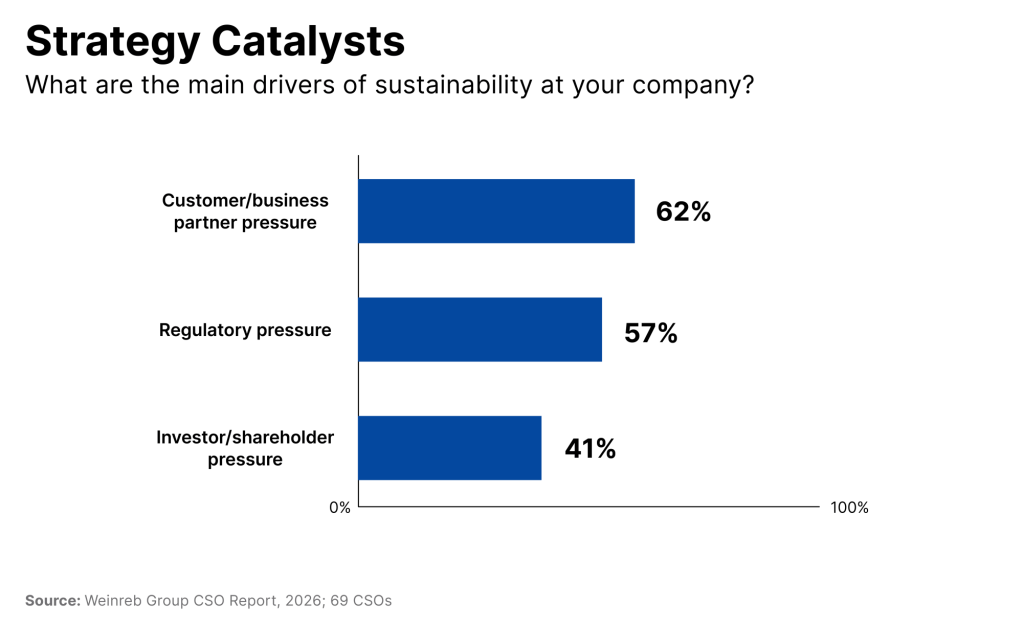
The survey identifies three major external forces shaping current sustainability agendas:
- Customer and Business Partner Pressure (62%): Companies are increasingly being audited by their own clients. In the B2B sector, a company’s sustainability profile is now a prerequisite for being part of a Tier-1 supply chain.
- Regulatory Pressure (57%): With the implementation of the SEC’s climate disclosure rules and the far-reaching impact of the EU’s Corporate Sustainability Reporting Directive (CSRD), compliance has become a non-negotiable driver.
- Investor and Shareholder Pressure (41%): Despite political headwinds in certain regions, institutional investors continue to demand transparency regarding long-term climate risk and transition plans.
The Growing Burden of Complexity
The challenges facing CSOs have evolved alongside their responsibilities. Market and economic uncertainty topped the list of hurdles at 62 percent, followed closely by regulatory requirements at 57 percent.
The complexity of these challenges is reflected in the expanding scope of the role. Approximately 42 percent of CSOs reported that their responsibilities had broadened significantly in the past 12 months. This expansion often includes oversight of human rights in the supply chain, circular economy transitions, and increasingly, the integration of sustainability data into financial reporting systems.
The Shifting Reporting Line
One of the most startling data points in the Weinreb report concerns the CSO’s place in the organizational hierarchy. Direct reporting lines to the CEO have plummeted.
- 18 months ago: 33% of CSOs reported directly to the CEO.
- Today: Only 14% report directly to the CEO.
Instead, a growing number of CSOs are being moved under the umbrella of the legal department or the Chief Financial Officer (CFO). While some might view this as a "demotion," industry analysts suggest it is actually a sign of "institutionalization." Moving sustainability under Legal or Finance indicates that the function is now tied to compliance, risk, and fiduciary duty—areas that carry significant weight in the boardroom.
Official Responses: Voices from the Field
The leaders currently occupying these roles describe a profession that is becoming more disciplined and strategically aligned with core business functions.
Kim Marotta, CSO and Head of Risk Management at Suntory, emphasized the clarity that comes with combining these two functions. "What enterprise risk management has given me is the opportunity to see the big picture," she noted. "Instead of just having environmental risks, they’re business risks."
This sentiment is echoed by Sophie Beckham, CSO at International Paper, who participated in the survey. Beckham views the role as a forward-looking necessity for any company hoping to survive the next decade. "CSOs are the futurists of the corporate context," Beckham stated. "My mandate is to see around corners, build resilience into our business model and create value that will help my company not just navigate but thrive when facing emerging risks and opportunities."
Ellen Weinreb, CEO of the Weinreb Group, noted that the resilience of the executives themselves is as important as the resilience of the companies they serve. "After tracking the CSO role for so many years, what heartens me the most is the resilience of the people who hold this title," Weinreb said. "There’s rarely a playbook for what they do, yet they negotiate every new challenge with grace and determination."
An anonymous respondent in the report summed up the current state of the industry succinctly: "We are reaching a tipping point where ‘sustainable business’ is simply ‘smart business.’"
Implications: The Future of the "Embedded" CSO
The findings of the Weinreb Group report suggest several long-term implications for the future of corporate governance and the labor market for sustainability professionals.
1. The Democratization of Sustainability
One of the most significant trends identified is the shift of sustainability headcount out of a centralized "Sustainability Office" and into other business units. 42 percent of respondents reported that more individuals were being hired to add a sustainability perspective directly into procurement, operations, finance, and product development teams. This suggests that in the future, "sustainability" may not be a standalone department, but a foundational skill required across all corporate functions.
2. The Legalization of ESG
As CSOs move under the reporting line of General Counsels, the language of sustainability is becoming more technical and legally grounded. This "legalization" of the field helps protect companies from greenwashing accusations and ensures that climate disclosures meet the same rigorous standards as financial disclosures. However, it also requires CSOs to possess a high degree of literacy in international law and regulatory policy.
3. Resilience as a Competitive Advantage
In an era of climate-driven supply chain failures and volatile energy prices, companies that successfully mitigate these risks will have a lower cost of capital and higher operational stability. The CSO is no longer just a steward of the environment; they are a steward of the company’s balance sheet.
4. The End of the "Generalist"
The slight contraction in the number of CSO titles at public companies suggests that the market is moving away from sustainability generalists in favor of specialists who can integrate these concepts into risk management, legal, and finance. The role is becoming more professionalized, more data-driven, and more essential to the strategic core of the business.
As the corporate world moves toward 2030, the Weinreb Group’s 8th biennial survey serves as a definitive marker. The Chief Sustainability Officer has moved from the periphery of the corporate structure to the very center of risk management. For the modern organization, sustainability is no longer an elective—it is the ultimate strategy for risk mitigation in an increasingly uncertain world.
About the Author