The "speed to power" race among the world’s most influential technology titans has reached a fever pitch, but it comes with a staggering environmental cost. As Amazon, Google, and Microsoft funnel a collective $750 billion into data center expansion for 2025 and 2026 alone, the sheer energy requirements of artificial intelligence are upending long-standing climate commitments.
In their most recent 2025 environmental sustainability updates, all three hyperscalers reported double-digit increases in greenhouse gas emissions. This surge is primarily driven by the insatiable electricity demands of the next generation of data centers—facilities designed to house the high-performance GPUs necessary for generative AI. With emissions from power consumption jumping by more than one-third at Amazon and Google, and by over 20 percent at Microsoft, the tech industry faces a reckoning: can the promise of AI-driven innovation coexist with a planet-saving net-zero agenda?
Main Facts: The Price of the AI Revolution
The central conflict lies in the divergence between corporate sustainability timelines and the immediate, aggressive rollout of AI infrastructure. While these companies have spent the last decade positioning themselves as leaders in the green transition, the 2025 fiscal data suggests that the "AI arms race" is currently winning out over decarbonization.
The Scale of Consumption
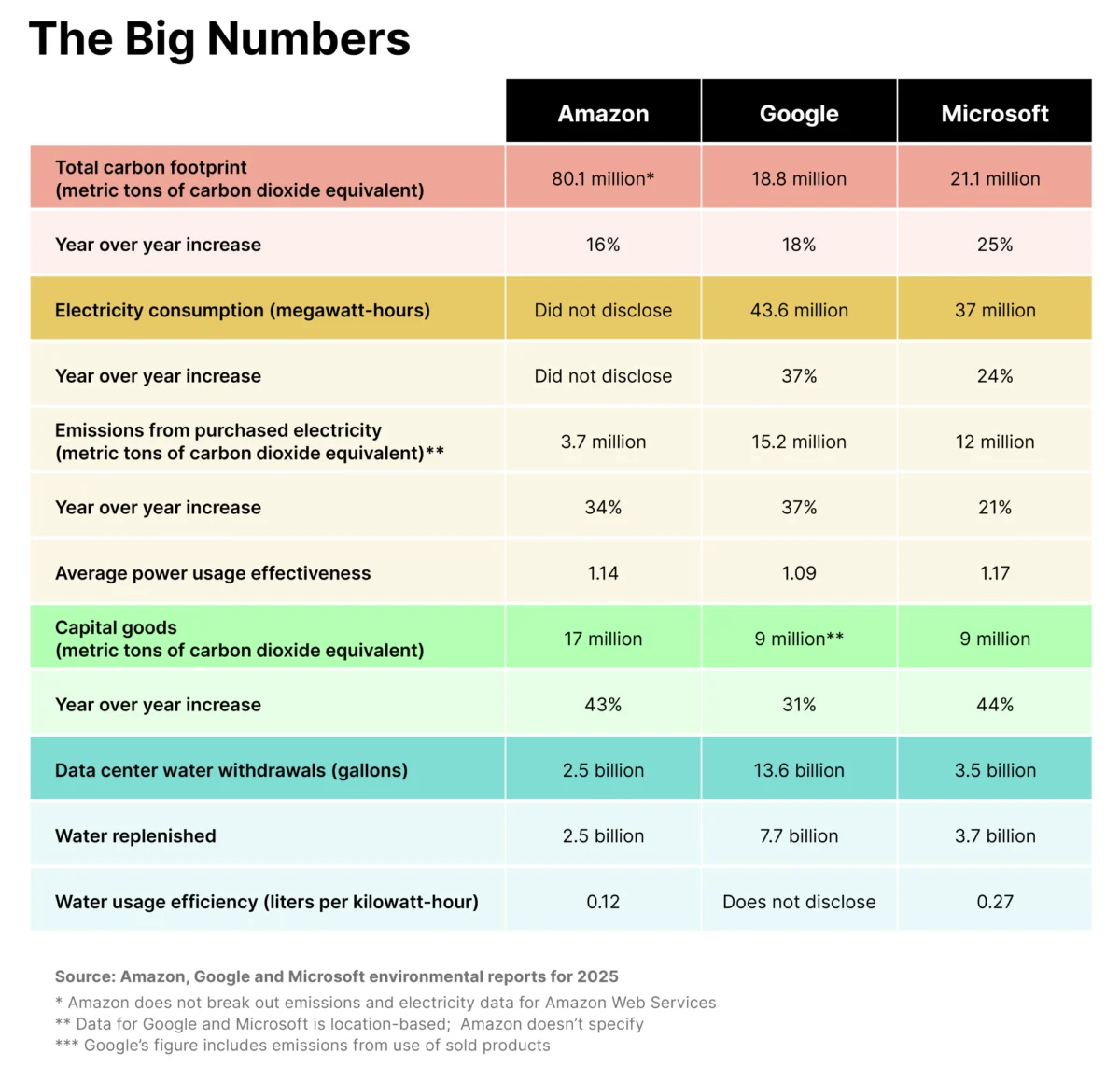
Google’s electricity consumption surged by 37 percent in 2025, reaching a staggering 43.6 million megawatt-hours. To put this in perspective, this single-year increase is roughly equivalent to the amount of energy required to power the entire state of Washington for one year. Since 2019, Google’s total power consumption has ballooned by 250 percent, a trajectory that makes its goal of achieving net-zero emissions by 2030 appear increasingly precarious.
The Emissions Spike
The reporting of Scope 2 emissions—those generated from the purchase of electricity—reveals a troubling trend across the board:
- Google: Reported a 37 percent increase in location-based electricity emissions from 2024 to 2025.
- Amazon: Reported a 34 percent increase in Scope 2 emissions. Notably, Amazon has faced criticism for a lack of transparency, failing to specify whether these figures are location-based (regional grid averages) or market-based (accounting for renewable energy certificates).
- Microsoft: Reported a 21 percent increase in location-based Scope 2 emissions, with overall electricity consumption rising 24 percent to 37 million megawatt-hours.
Efficiency vs. Volume
Despite these rising totals, the companies argue they are becoming more efficient. Power Usage Effectiveness (PUE) is the industry standard for measuring data center efficiency—a ratio of the total power used by the facility versus the power delivered to the actual computing equipment. A score of 1.0 is considered perfect.
- Google leads the group with a ratio of 1.09.
- Amazon follows at 1.14.
- Microsoft trails at 1.17.
However, efficiency gains are being vastly outpaced by the sheer volume of new hardware being deployed. Even the most efficient data center in the world cannot offset the carbon footprint of adding hundreds of thousands of energy-intensive chips to the global grid.
Chronology: From Pledges to the Power Crunch
The current crisis did not emerge in a vacuum. It is the result of a decade of aggressive climate posturing meeting a sudden, transformative technological shift.
2019–2021: The Era of Bold Pledges
Between 2019 and 2021, the "Big Three" set their most ambitious targets. Microsoft pledged to be "carbon negative" by 2030; Amazon co-founded The Climate Pledge to reach net-zero by 2040; and Google committed to operating on 24/7 carbon-free energy by 2030. During this period, renewable energy was relatively cheap, and data center growth was steady but predictable.

2023: The Generative AI Explosion
The launch of ChatGPT and subsequent Large Language Models (LLMs) changed the energy calculus overnight. Training a single model can require as much energy as hundreds of homes use in a year, and the "inference" (the daily use of the AI) requires even more.
2024–2025: The Infrastructure Pivot
Recognizing that AI dominance requires massive "compute," the companies pivoted their capital expenditure (CapEx) toward data centers. The 2025 environmental reports, published in mid-2025, are the first to show the full-year impact of this pivot.
2025–2026: The $750 Billion Surge
The industry is currently in the midst of a two-year investment cycle totaling three-quarters of a trillion dollars. This funding is dedicated to building "AI Factories"—data centers that require five to ten times the power density of traditional facilities.
Supporting Data: Regional Grids and Accounting Nuances
To understand why emissions are rising despite massive investments in wind and solar, one must look at how carbon is accounted for and where the power is being drawn.
Scope 2 Accounting: Location vs. Market
The Greenhouse Gas Protocol allows companies to report emissions in two ways. Location-based reporting uses the average carbon intensity of the local grid where the data center sits. Market-based reporting allows companies to subtract renewable energy certificates (RECs) and Power Purchase Agreements (PPAs) from their total.
The 2025 data shows that even with massive PPA portfolios, the "location-based" numbers are skyrocketing. This indicates that while companies are buying green energy elsewhere, their actual physical data centers are still drawing "dirty" power from fossil-fuel-heavy grids in regions like Northern Virginia, Ohio, and Southeast Asia.
The Asia Factor
Decarbonizing in North America and Europe is difficult, but in Asia, it is an uphill battle.
- Amazon currently supports 2.2 gigawatts of clean energy in the Asia-Pacific region, but this is a fraction of its 40-gigawatt global portfolio.
- Microsoft has launched the Southeast Asia Clean Energy Facility with a $230 million initial investment to jumpstart early-stage projects in markets where the grid is still dominated by coal.
- Google has explicitly identified Asia as its primary "sticking point" for achieving carbon-free electricity, citing a lack of regulatory frameworks for green energy procurement.
Official Responses: Bottlenecks and Strategic Pivots
The tech giants are not denying the surge in emissions. Instead, they are pointing toward systemic failures in the global energy infrastructure as the primary culprit.
Google’s Stance: The Grid Bottleneck
In its 2025 environmental report published on June 30, Google was candid about the obstacles. “As the rapid evolution of AI is increasing our energy needs, the shift to clean energy is hitting major bottlenecks—like long delays in connecting new energy projects to the grid, fragmented power grids, and a shortage of reliable, around-the-clock clean power,” the company stated. Google’s message is clear: they are willing to buy the power, but the world’s grids aren’t ready to deliver it.
Amazon’s Nuclear Bet
Amazon has taken a more aggressive, "hard-tech" approach to solving the power gap. In June 2024, the company contracted for nearly 2 gigawatts of nuclear power and signed deals for two new nuclear projects scheduled for 2026. Amazon’s strategy relies on "firm" power—energy that doesn’t stop when the sun goes down or the wind stops blowing.
Microsoft’s Diversified Portfolio
Microsoft is leaning into cutting-edge technology. Beyond standard wind and solar, the company is backing next-generation fusion technologies. While fusion remains years away from commercial viability, Microsoft’s willingness to sign advance purchase agreements signals a desperate need for high-density, carbon-free baseload power.
Implications: The Future of Net-Zero and the Grid
The current trajectory of Big Tech’s energy use has profound implications for the global fight against climate change and the stability of municipal power grids.
The Nuclear Renaissance
One of the most significant "side effects" of the AI boom is the sudden revitalization of the nuclear industry. Because AI data centers require 24/7 power, intermittent sources like solar and wind are insufficient on their own. This has led to a surge in interest in Small Modular Reactors (SMRs) and the life-extension of aging nuclear plants. Big Tech is now the primary financier of the next generation of nuclear energy, a role previously held exclusively by governments.
Battery Storage as a Linchpin
To bridge the gap when renewables are unavailable, massive battery investments are becoming mandatory. By the end of 2025, Amazon had 15 solar projects paired with energy storage, totaling 2.3 gigawatts. Google and Meta are also betting on long-duration energy storage (LDES) to extend the value of their solar and wind contracts into the night.
The Threat to Public Utilities
As these companies lock up gigawatts of power, there is growing concern about the impact on residential consumers. In regions like Northern Virginia (the data center capital of the world), the sheer demand from tech giants is forcing utilities to keep coal and gas plants online longer than planned, potentially driving up costs for local taxpayers and delaying regional decarbonization goals.
The Credibility Gap
Finally, there is the issue of corporate accountability. If the world’s wealthiest companies—with nearly unlimited capital—cannot meet their climate goals because of "grid bottlenecks," what hope is there for the rest of the global economy? The 2025 data suggests that for Amazon, Google, and Microsoft, the "speed to power" required for AI dominance is currently a higher priority than the "speed to zero" required for the climate.
As we move toward 2030, the tension between these two goals will only intensify. The $750 billion currently being spent on data centers will either be the catalyst for a total overhaul of the global energy grid, or it will be remembered as the moment the tech industry’s climate ambitions were sacrificed at the altar of artificial intelligence.
About the Author