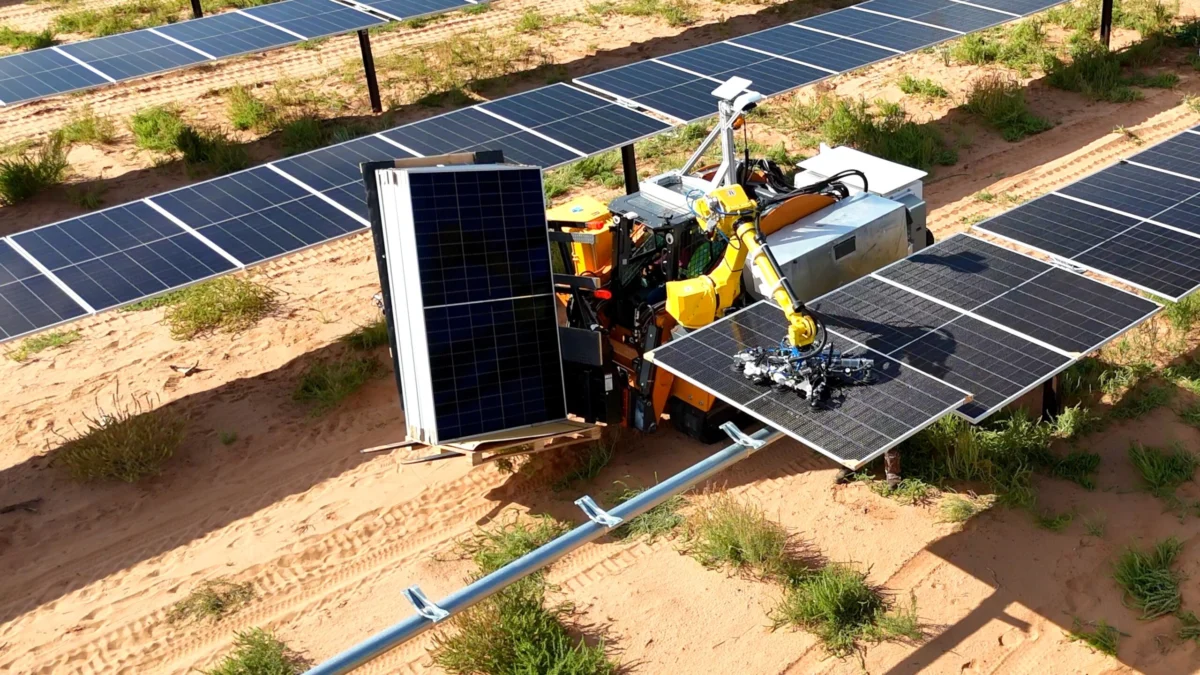
As the global race toward decarbonization accelerates, the world faces a paradoxical bottleneck: while capital and political will for renewable energy are at an all-time high, the physical labor required to build the necessary infrastructure is in dangerously short supply. The construction of massive solar farms is a grueling, labor-intensive process, and the industry is struggling to find the workers needed to meet ambitious climate targets.
Enter Gritt, a startup founded by Carnegie Mellon-trained roboticists Puneet Puri and Vishal Dugar. By leveraging the latest breakthroughs in artificial intelligence, Gritt is attempting to solve the “unstructured environment” problem that has long plagued industrial robotics, turning the construction site into a theater of precision automation.
The Core Problem: Scaling Infrastructure in a Labor-Constrained World
The transition to solar energy is one of the most critical industrial undertakings of the 21st century. However, the sheer scale of the required deployment is staggering. To meet global climate goals, countries must install solar panels at a pace that traditional, human-only labor forces are struggling to sustain.
Construction sites are inherently chaotic. Unlike the clean, controlled, and predictable environment of a factory floor—where industrial robots have thrived for decades—a solar field is subject to uneven terrain, shifting weather, and unpredictable obstacles. Historically, this unpredictability made robotics cost-prohibitive and technically unreliable.
Gritt’s founders recognized that the solution was not to force the construction site to act like a factory, but to create an "intelligence" capable of navigating the chaos of the real world. By focusing on software-defined hardware, Gritt is positioning itself as the "brain" for the machines building the green future.
Chronology: From Stealth to Scale
Gritt’s journey from a research-driven concept to a venture-backed disruptor has been rapid:
- The Foundation: Founded by Puneet Puri and Vishal Dugar, both alumni of Carnegie Mellon University’s prestigious robotics program, the company focused on building a generalizable intelligence for physical labor.
- Seed Stage: The company initially secured funding from First Round Capital, Climactic, Congruent Ventures, and VSC Ventures, allowing them to iterate on their AI models and test prototypes in real-world environments.
- Strategic Growth: Throughout its stealth period, Gritt focused on perfecting its ability to handle off-the-shelf industrial equipment, specifically skidders and robotic arms from manufacturers like Kawasaki.
- The Series A Breakout: On Tuesday, Gritt officially exited stealth mode, announcing a $26 million Series A funding round led by Obvious Ventures, with participation from Union Square Ventures and Active Impact Investment. This brought the company’s total funding to $34 million.
- Current Deployment: Gritt currently has two systems actively operating in the field, with contracts in place to assist in the installation of 2.8 gigawatts of solar capacity over the next 18 months. The company aims to have 48 operational systems deployed within the next six months.
Supporting Data: Efficiency at the Solar Edge
The numbers behind Gritt’s technology are compelling for power construction companies facing labor shortages. According to the company, a standard eight-person crew typically installs roughly 800 solar panels per day. By integrating Gritt’s AI-powered systems—which utilize off-the-shelf robotic arms to pick, carry, and position panels with sub-millimeter accuracy—the same eight-person crew can increase their output to between 3,000 and 4,000 panels per day.
This represents a four-to-five-fold increase in productivity. For contractors, the value proposition extends beyond raw speed. By automating the most physically demanding and repetitive tasks—such as lifting 100-pound panels overhead—Gritt is not only mitigating the labor shortage but also significantly reducing the risk of workplace injury, a primary concern in the construction industry.
Official Responses and Industry Perspectives
The investment community has taken note of Gritt’s unique approach to the hardware-software divide. Andrew Beebe, a partner at Obvious Ventures who led the Series A round, praised the founders’ ability to bridge the gap between high-level robotics research and the "dirty, dull, and dangerous" reality of construction.
"There are people who used to build rockets that went into space and had infinite budget for the smallest little part, and then there are people who know what it means to get into dirty, dull, and dangerous jobs and scale them like mad," Beebe said. "These guys are in the second camp, and that’s a special kind of entrepreneur that has the technical chops, the AI, and the machine vision skills to make it work."
The enthusiasm is echoed by those on the front lines of construction. While one major industry partner requested anonymity for competitive reasons, they highlighted the ease with which the system can be deployed in remote, hard-to-reach sites where recruiting a full manual labor crew is often an insurmountable hurdle.
The Technological Edge: Why Now?
The fundamental shift enabling Gritt’s success is the maturation of "generalizable AI." Five years ago, robotics required custom-built software for every specific, minor variation of a task. Today, the same underlying AI pipeline can be adapted to new functions with minimal retraining.
CEO Puneet Puri notes that the adaptability of their software is a key differentiator. While it previously took weeks of development to teach a robot to stack cinder blocks, the current AI model can be trained to tie rebar in a single day. This agility allows Gritt to move beyond panel installation and into other labor-intensive domains, such as post-drilling and rack construction.
Competitive Landscape: The Hardware Dilemma
Gritt is not operating in a vacuum. Competitors such as Luminous Robotics, Cosmic, and China’s Trinabot are also vying for dominance in the solar installation space. However, Gritt’s strategy differs significantly from these rivals.
While many competitors are focused on building proprietary, custom-designed robots from the ground up, Gritt has opted for an "off-the-shelf" strategy. By utilizing existing, field-proven hardware and overlaying it with their proprietary AI "brain," Gritt claims to achieve a leaner cost structure and faster deployment cycles. This "hardware-agnostic" approach allows the company to pivot quickly as better, cheaper robotic hardware hits the market, rather than being tied to the R&D cycles of their own physical manufacturing.
Future Implications: The "Physical AI" Layer
Looking beyond the current scope of solar panel installation, Gritt envisions a future where its technology serves as a comprehensive management layer for the entire construction site. The founders believe that by placing a suite of sensors and AI-driven logic into the field, they can do more than just install hardware.
They envision a system that acts as an "on-site manager." For example, if an AI-equipped unit detects an open trench during an incoming storm, it could automatically notify workers to secure the area, preventing costly water damage to delicate components. It could similarly monitor inventory, track project progress, and manage logistics in real-time.
"Gritt becomes now this layer of physical AI, which is doing this dextrous, labor-intensive task, plus it can help you take decisions on the site," Puri explained.
Conclusion: A New Era for Infrastructure
The rise of Gritt highlights a critical evolution in the tech sector: the pivot from digital-only AI to "Physical AI." As the world struggles to build the infrastructure of tomorrow, the ability to automate the physical construction process will be a major differentiator for global economies.
By combining the precision of robotics with the flexibility of modern AI, Gritt is not just installing solar panels; it is laying the groundwork for a more efficient, safer, and more scalable way to build the physical world. With three of the top 10 US power construction companies already under contract, the company has signaled that the era of the autonomous, AI-managed construction site is not a distant dream—it is happening today.
About the Author