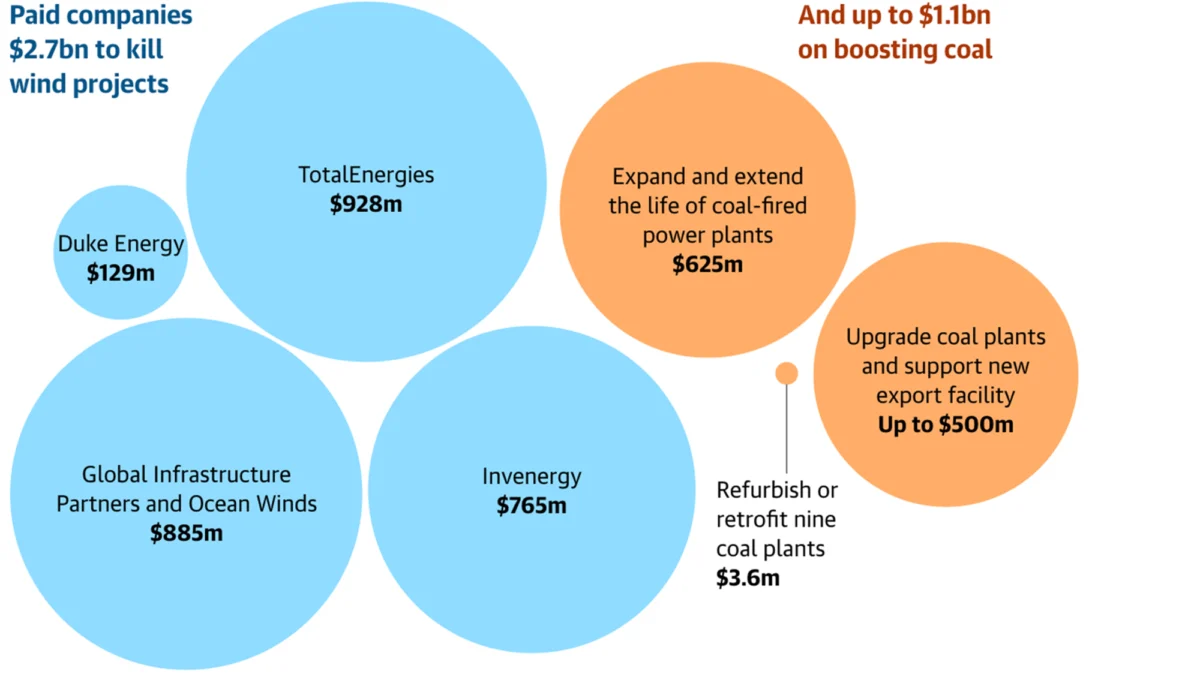
In a profound shift in American energy policy, the Trump administration has embarked on a multi-billion-dollar crusade to dismantle the nascent offshore wind industry while aggressively propping up the nation’s aging coal infrastructure. According to federal spending records and departmental announcements, the administration has directed $2.7 billion in taxpayer funds toward neutralizing offshore wind projects, while simultaneously funneling $1.1 billion into the life-extension of coal-fired power plants.
Critics argue that this reallocation of federal resources represents a departure from market-driven energy principles, serving to enrich fossil-fuel donors who contributed record sums to the president’s most recent campaign. While the administration frames these moves as a return to energy independence and a rejection of "green subsidies," analysts warn that the policy is creating a "double-tax" on American consumers: one through the immediate use of federal funds, and another through inflated electricity bills as utilities are steered toward more expensive, less efficient power sources.
A Chronology of Policy Reversal
The administration’s strategy began to take shape in early 2026, marking a stark departure from the previous decade’s push toward decarbonization.
- March 2026: The Department of the Interior initiated a series of controversial agreements with energy developers, most notably a deal with the French energy giant TotalEnergies. The federal government agreed to pay the company to abandon its offshore wind leases, triggering a wave of lawsuits from a coalition of seven Democratic-led states alleging that the use of public funds to terminate green energy contracts is illegal.
- Late June 2026: The Department of Energy (DOE) announced the allocation of $500 million under the Defense Production Act to expand the capacity of 13 existing coal plants and fund a controversial coal export terminal in Oakland, California.
- July 2026: As the administration continues to settle with developers, the cumulative cost of these "lease buybacks" has reached an estimated $2.7 billion, effectively halting eight major offshore wind projects that were previously cleared for development.
This sequence of events has drawn sharp condemnation from environmental groups and energy economists, who point out that there is no historical precedent for the federal government paying private developers to relinquish legally acquired energy leases.
The Economic Mirage: Subsidizing the Dying
The administration’s efforts to bolster coal are occurring at a time when the fossil fuel industry is struggling against the lower operational costs of renewable energy. According to the research organization Energy Innovation, 99 percent of existing coal-fired power plants in the United States now cost more to operate than it would to replace them with modern wind or solar alternatives.
Despite these market realities, the Department of Energy has aggressively intervened. In September 2025, the DOE announced a $625 million initiative to "expand and extend the life" of coal plants, which included $350 million for "modernization" and $175 million specifically targeted at supporting coal-reliant rural communities.
"Coal has largely died because of economics," says Jenny Rowland-Shea, senior director for conservation policy at the Center for American Progress. "Forcing it to stay afloat is not a good energy decision, nor is it a good economic decision for taxpayers. We are effectively paying a premium to keep obsolete technology on life support."
This sentiment is backed by a 2025 analysis from Grid Strategies, which found that if all 35,000 megawatts of fossil fuel power plants currently slated for retirement by 2028 were kept in operation through federal mandates, it would cost American ratepayers at least $3.1 billion by the end of 2028.
The Official Defense: A Return to Reliability?
The Trump administration maintains that its actions are necessary to ensure grid stability and protect consumers from what they describe as the "unreliable" nature of intermittent renewables.
In an email communication, DOE spokesperson Ben Dietderich defended the spending, stating that the administration is "proud" of its efforts to restore coal. "Before President Trump ended the Green New Scam, taxpayers paid the bill for trillions of dollars of so-called green energy subsidies," Dietderich wrote. He further argued that these subsidies led to the "premature shutdown" of essential fossil fuel plants, which he claims increased the risk of blackouts and drove up energy costs.
White House spokesperson Taylor Rogers took a slightly different approach, disputing the claim that taxpayer money is being spent to kill wind projects. "The administration is returning the money that companies bid on offshore wind projects that are unable to be built due to national security concerns," Rogers stated. "Those companies are voluntarily redirecting those returned bid amounts to energy projects that will provide affordable, reliable, and secure energy for American families."

When pressed on the cost-effectiveness of these measures, Rogers added that without federal intervention, offshore wind projects are "not only the costliest source of power, but also the least dependable."
Environmental and Public Health Implications
The shift back to coal carries significant consequences beyond the ledger. Coal remains the most carbon-intensive fossil fuel, and its combustion is a primary driver of particulate matter pollution. A 2023 study from the Harvard T.H. Chan School of Public Health estimated that between 1999 and 2020, roughly 460,000 deaths in the United States were directly attributable to air pollution from coal-fired power plants.
By extending the lifespans of these facilities, the administration is effectively locking in decades of emissions. Gabrielle Levy, a spokesperson for the Climate Action Campaign, notes that the impact is twofold: "We are paying as taxpayers to keep economically unviable plants open, and meanwhile, those plants are doing immeasurable harm to local environments and public health—costs that the public ultimately bears in medical expenses and climate-related disasters."
Systemic Changes and the "One Big Beautiful Bill"
The administration’s strategy is not limited to direct spending. It has utilized regulatory maneuvering to tilt the playing field toward coal and gas. A key component of this effort was the "One Big Beautiful Bill Act," which included a provision slashing royalty rates on federal coal from 12.5 percent to 7 percent.
This reduction drastically lowers the revenue that state and federal governments receive from mining on public lands. In Wyoming alone, forecasters estimate this royalty cut will cost the state $50 million annually. The administration has also streamlined the permitting process for fossil fuel projects while simultaneously creating bureaucratic hurdles for renewable energy initiatives.
In one notable instance in October, the administration held the largest U.S. coal leasing sale in over a decade. The event resulted in only a single bid, which amounted to a fraction of a penny per ton—a move critics cited as evidence of a desperate attempt to prop up a dying industry.
The Political Calculus
The political divide over these energy policies is stark. Jay Inslee, the former governor of Washington, characterized the administration’s strategy as a form of "mugging."
"Trump is getting Americans coming and going," Inslee said. "He’s forcing higher power bills on them by blocking clean energy, then he’s fattening the wallets of his cronies—all with billions of our tax dollars."
As the legal battles continue to play out in federal courts, the long-term impact of this policy pivot remains to be seen. The administration’s supporters argue that the protection of the coal industry is a necessary step to secure the nation’s energy future against foreign dependency. However, for many economists and environmental advocates, the policy represents a fundamental misreading of global energy trends.
With data centers and artificial intelligence expansion driving an unprecedented surge in electricity demand, the competition for reliable, low-cost power is intensifying. By tethering the U.S. grid to the cost-heavy legacy of coal, the administration may find that its attempt to "reinvigorate" the past ultimately leaves the American consumer less prepared for the demands of the future.
About the Author