July 15, 2026 — New York, NY
The era of "unbounded corporate ambition" in sustainability appears to be coming to a close, replaced by a period of rigorous prioritization and strategic retrenchment. According to new research released today by BSR (Business for Social Responsibility) and GlobeScan, the landscape for environmental, social, and governance (ESG) initiatives has shifted from broad, often aspirational commitments to a "constrained and selective" phase.
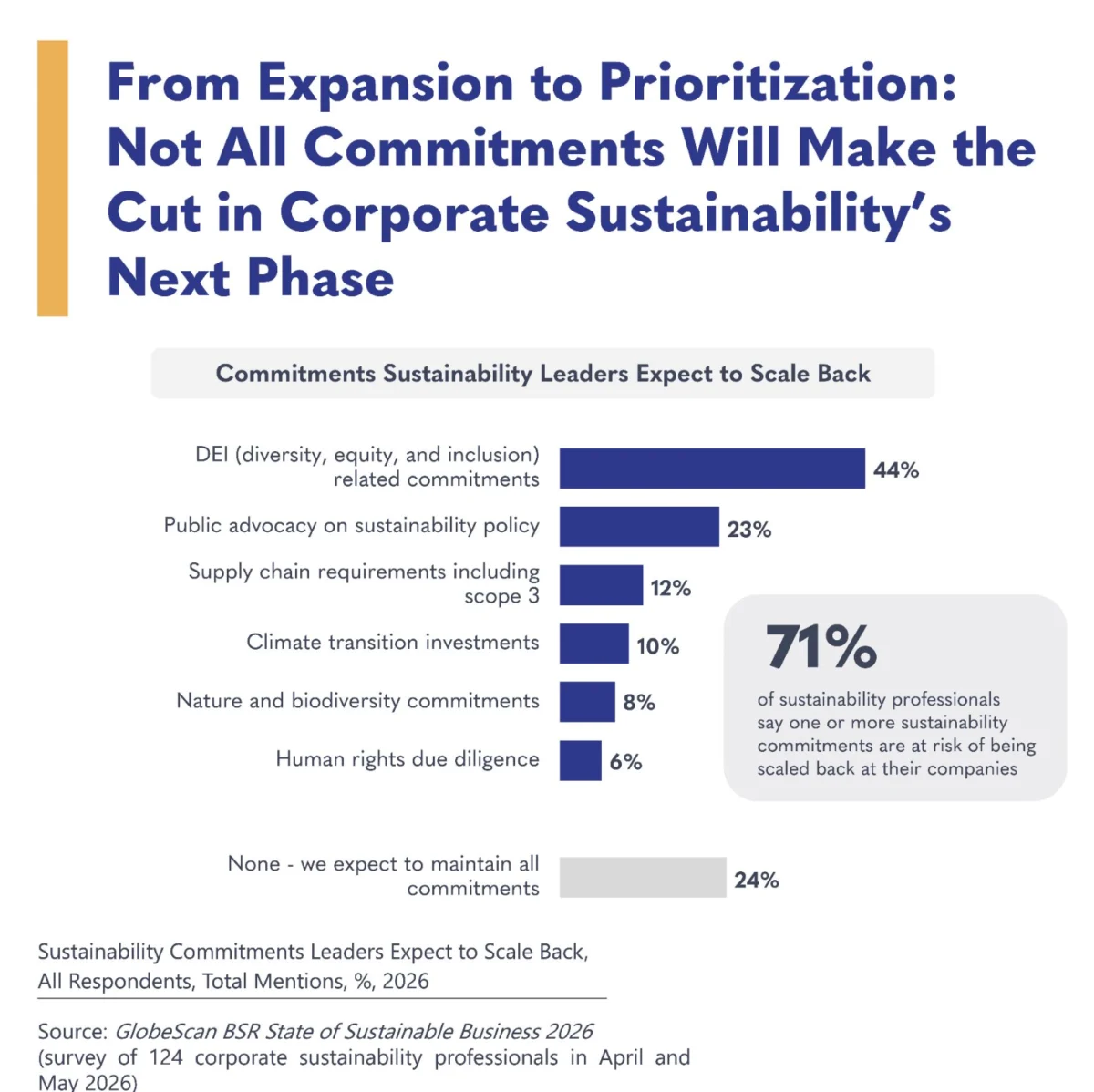
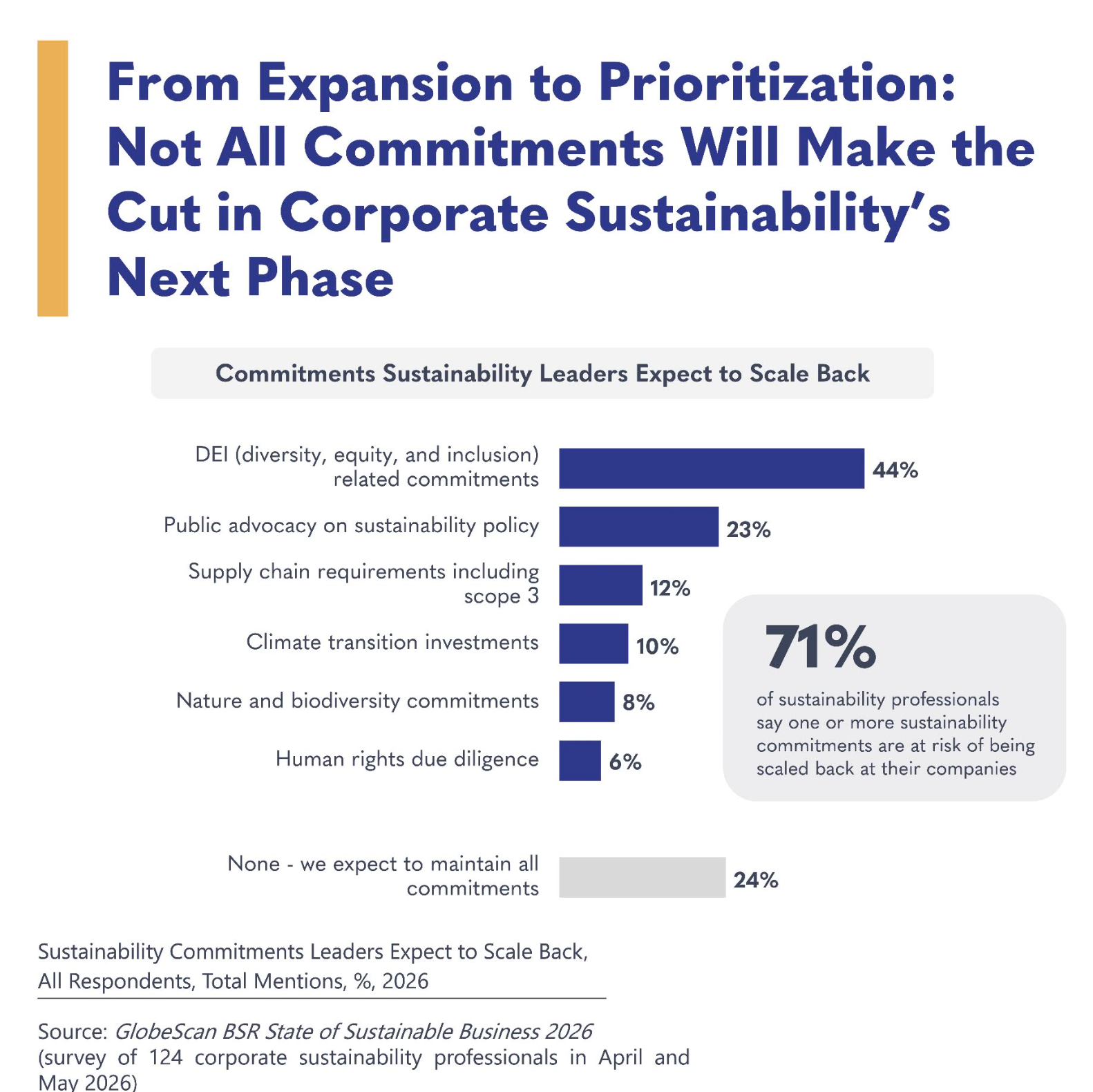
The report, which surveyed sustainability professionals at global corporations with annual revenues exceeding $1 billion, reveals a stark reality: 71 percent of respondents admit that one or more of their company’s sustainability commitments are at risk of being scaled back or deprioritized. This marks a significant departure from the previous decade, where corporate leaders frequently competed to announce increasingly bold targets in climate, equity, and supply chain transparency.
As the corporate world navigates a complex web of heightened regulatory demands, political polarization, and shifting economic drivers, the "Sustainability Retrenchment" of 2026 reflects a broader move toward pragmatism. Companies are no longer asking how many commitments they can make, but rather how many they can realistically—and profitably—deliver.
Main Facts: The Retreat from Universal Ambition
The BSR/GlobeScan data paints a picture of a corporate sector under pressure. While the 2010s and early 2020s were characterized by a "more is more" approach to sustainability, the mid-2020s have introduced a "less but better" philosophy—or, in some cases, simply "less."
Key findings from the study include:
- The 71 Percent Threshold: Nearly three-quarters of sustainability leaders at billion-dollar firms report that their organizations are likely to roll back at least one major commitment.
- A Minority of Resilience: Less than 25 percent of surveyed professionals believe their companies will maintain every single one of their current sustainability goals.
- DEI Under the Microscope: Diversity, Equity, and Inclusion (DEI) initiatives are the most vulnerable, with 44 percent of respondents identifying them as being at high risk of rollback.
- The Silence of Advocacy: Public advocacy on sustainability policy is the second most likely area to be cut, with 23 percent of professionals expecting a retreat from public-facing political engagement.
- The "Sticky" Priorities: Climate transition investments, supply chain requirements, and human rights due diligence appear to be the most resilient categories, flagged significantly less often for potential cuts.
These figures suggest that while the "S" (Social) in ESG is being heavily scrutinized and often pruned, the "E" (Environmental) and "G" (Governance) components—particularly those tied to hard assets and legal compliance—remain central to corporate strategy.
Chronology: From the "Age of Aspiration" to the "Age of Realignment"
To understand the current state of corporate sustainability, one must look at the trajectory of the last decade. The shift observed in 2026 is the culmination of three distinct phases in the evolution of corporate responsibility.
2015–2020: The Age of Aspiration
Following the Paris Agreement in 2015, corporate sustainability became a primary tool for brand differentiation. This era was characterized by "Net Zero" pledges and the rise of the "purpose-led" brand. Drivers were largely voluntary and driven by consumer sentiment and the burgeoning ESG investment movement. Sustainability departments grew rapidly, often operating in silos away from the core financial decision-making of the firm.

2021–2024: The Era of Scrutiny and Backlash
The post-pandemic world brought a new level of rigor. Investors began demanding "receipts" for green claims, leading to the rise of anti-greenwashing litigation. Simultaneously, particularly in the United States, a political backlash against "woke capitalism" put DEI and climate advocacy in the crosshairs of legislative and legal challenges. By 2024, many companies began "greenhushing"—continuing their work but ceasing to talk about it publicly to avoid political or legal heat.
2025–2026: The Great Calibration
By the time of the April/May 2026 survey, the environment had shifted again. The introduction of mandatory reporting frameworks—such as the EU’s Corporate Sustainability Reporting Directive (CSRD) and the SEC’s climate disclosure rules—turned sustainability from a marketing exercise into a compliance mandate. Faced with the high cost of data collection and the legal risks of non-compliance, companies have begun shedding "peripheral" commitments to focus resources on meeting these new, mandatory standards.
Supporting Data: Why DEI and Advocacy are Facing the Axe
The BSR/GlobeScan research provides granular insight into which specific areas of sustainability are being sacrificed and why.
The Vulnerability of DEI (44%)
The fact that DEI-related commitments are nearly twice as likely to be scaled back as any other category is a reflection of both legal and political shifts. Following landmark court rulings regarding affirmative action and a wave of "anti-DEI" shareholder activism, many large corporations have moved to rephrase or reduce their specific headcount targets. Professionals in the survey noted that while "inclusion" remains a value, the specific, measurable "equity" targets that were popular in 2020 are now viewed as high-risk liabilities.
The Retreat from Public Advocacy (23%)
For years, CEOs were encouraged to be "activist leaders," speaking out on climate policy and social justice. The 2026 data shows a marked retreat. Companies are increasingly wary of the "double-edged sword" of advocacy, where taking a stand on sustainability policy can alienate specific blocks of customers or invite regulatory retaliation from opposing political factions.
The Resilience of Climate and Supply Chain
In contrast, climate transition investments and human rights due diligence are seeing much lower rates of rollback. The reason is largely structural. Transitioning to renewable energy is increasingly seen as a hedge against volatile fossil fuel prices, and supply chain transparency is now a legal requirement in many jurisdictions (such as the German Supply Chain Due Act). These are no longer "optional" commitments but are embedded in the "license to operate."
Official Responses: Industry Perspectives on the Shift
The sentiment among those leading these efforts is one of cautious pragmatism. James Morris, who leads GlobeScan’s San Francisco office, suggests that this tightening of scope is not necessarily a sign of failure, but a sign of maturity.
"Sustainability professionals are moving from expanding agendas to prioritizing a smaller set of commitments," Morris noted in the report. "Faced with tighter resources, increasing regulatory demands, and growing pressure to demonstrate business value, sustainability teams are growing more selective in where they invest time and effort."
His perspective is echoed by many in the field who believe that the "scattergun" approach of previous years—where a company might have 50 different sustainability goals—was unsustainable. The current contraction is seen by some as a "clearing of the brush," allowing companies to focus on the 5 or 10 goals that actually move the needle for their specific business model.
However, critics warn that this "pragmatism" could be a smokescreen for a loss of urgency. Environmental NGOs have expressed concern that by scaling back on "advocacy," corporations are leaving the heavy lifting of policy change to a public sector that is already struggling to meet the goals of the Paris Agreement.
Implications: The Future of the Sustainability Profession
The findings of the BSR/GlobeScan research have profound implications for how sustainability will be managed in the latter half of the 2020s.
1. Integration over Isolation
As companies scale back on broad commitments, the remaining goals must be integrated into the core business strategy. The era of the "Sustainability Report" as a standalone glossy brochure is over. Success in this new phase will depend on whether sustainability metrics can be translated into the language of the CFO: performance, resilience, and growth.
2. The Rise of the "Sustainability Controller"
With the shift toward regulatory compliance, the profile of the sustainability professional is changing. The role is moving away from communications and "purpose" and toward data management, legal compliance, and internal auditing. The "Sustainability Controller" is becoming as important as the "Chief Sustainability Officer."
3. A Focus on Tangible Outcomes
As resources tighten, the "social" side of sustainability is likely to become more focused on internal workforce development and tangible human rights protections within the supply chain, rather than broad societal advocacy. This "inward turn" reflects a desire to control what can be measured and defended in a court of law or a boardroom.
4. The Competitive Advantage of Resilience
Companies that successfully navigate this calibration without losing momentum on climate and human rights will likely emerge with a competitive advantage. As regulatory requirements become more stringent, those that have embedded these "sticky" commitments into their operations will be better positioned to secure investment and maintain stakeholder trust.
Conclusion: A More Prudent Path Forward
The 2026 BSR/GlobeScan survey marks a turning point in the history of corporate responsibility. The 71 percent of companies scaling back are not necessarily abandoning their values, but they are undeniably narrowing their focus.
As the profession enters this more pragmatic phase, the "Age of Aspiration" has given way to the "Age of Accountability." In this new environment, the companies that thrive will be those that stop trying to be everything to everyone and instead focus on delivering measurable, transparent results on the issues most material to their business and the planet. The "Great Calibration" may be painful for those who championed the expansive goals of the early 2020s, but it may also be the necessary step toward making corporate sustainability truly sustainable.
About the Author