For the better part of the last decade, corporate strategy has been defined by a singular, urgent mission: hardening the supply chain. Following the chaotic disruptions of the COVID-19 pandemic, the "just-in-time" model was largely discarded in favor of "just-in-case" inventory strategies, localized sourcing, and increased internal redundancy. However, according to a sobering new analysis from Zurich-based insurance giant Swiss Re, many of the world’s largest corporations may be walking into a trap of their own making by focusing too narrowly on their own four walls.
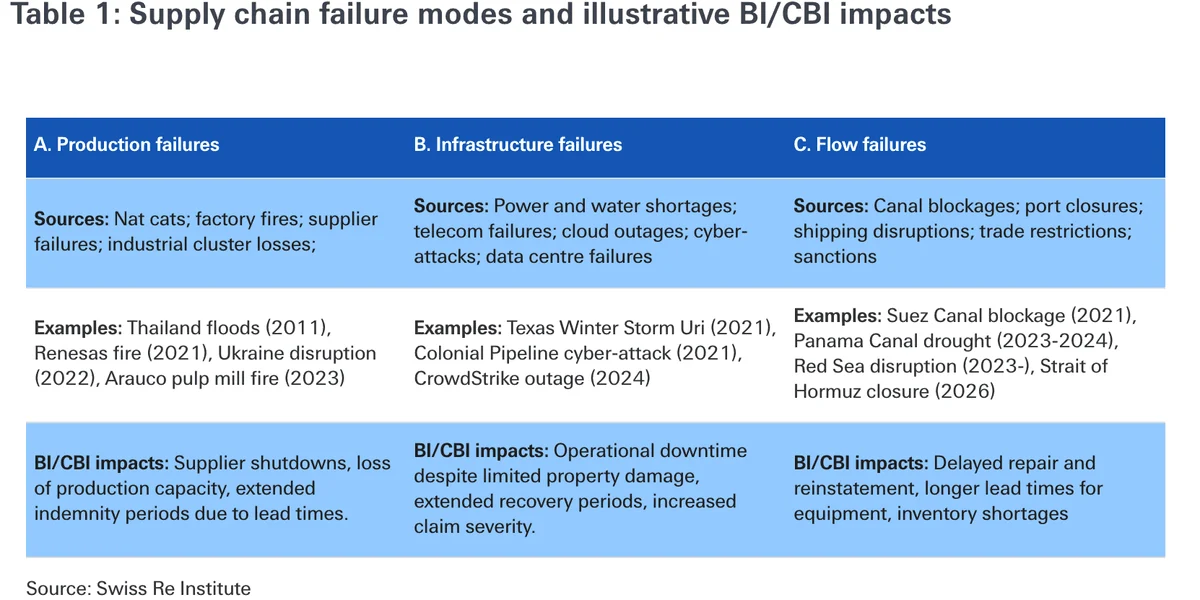
In their latest report, “Emerging Risks: Hidden Dependencies in Global Supply Chains,” Swiss Re warns that the modern globalized economy has created a web of interdependencies so complex that a company’s own internal resilience is largely moot if the ecosystem surrounding it collapses. As geopolitical volatility, climate-driven natural disasters, and crumbling infrastructure become the "new normal," the risk of catastrophic business interruption is increasingly shifting from the factory floor to the invisible connections that hold the global economy together.
The Main Facts: A Blind Spot in Risk Management
The fundamental issue identified by Swiss Re is a profound disconnect between internal risk assessment and external reality. While corporations have become adept at mapping their own physical assets—fortifying warehouses against hurricanes or diversifying manufacturing sites to avoid regional instability—they are largely flying blind regarding their tier-two and tier-three suppliers, as well as the broader logistical infrastructure upon which they depend.
The report posits that in an era of hyper-interconnectivity, the definition of "business interruption" has evolved. It is no longer just about a fire in one’s own warehouse; it is about the power grid failure three states away that shuts down a regional transport hub, or a port strike in a foreign nation that halts the flow of essential components.
"Businesses have become much better at understanding the risks to their own facilities," says Adrian Hall, US CEO of Swiss Re Corporate Solutions. "The next challenge is understanding the dependencies beyond their own operations that can determine whether they recover quickly or face prolonged disruption."
The study highlights that this is not merely a theoretical concern. With the ongoing conflict in the Middle East marking the fourth major global supply shock in just six years, the frequency of these "black swan" events is increasing. The data suggests that companies are failing to account for the "compounding effect" of disruptions—where a minor logistics bottleneck or a localized power failure creates a ripple effect that turns a manageable delay into a long-term fiscal catastrophe.
Chronology of Disruption: A Six-Year Stress Test
To understand the urgency of the Swiss Re report, one must look at the recent historical trajectory of the global supply chain. The last six years have served as a relentless stress test, exposing the fragility of lean global networks.
- 2018–2019: The Trade War Era. The escalation of trade tensions between the U.S. and China forced companies to reconsider their reliance on singular manufacturing hubs. However, most companies focused on shifting their own production sites rather than auditing the entire supplier ecosystem.
- 2020–2021: The Pandemic Shock. COVID-19 laid bare the "hidden dependencies" of the global supply chain. Companies discovered that their internal production was secure, but their reliance on raw materials from a single, locked-down region in Asia paralyzed global output.
- 2022: The Energy and Geopolitical Crisis. The invasion of Ukraine caused immediate, widespread disruption to energy markets and essential commodities. It proved that geopolitical events occurring thousands of miles away could instantly impact the operational viability of firms in North America and Europe.
- 2023–2024: Infrastructure and Regional Conflict. The current climate is defined by the intersection of climate-related infrastructure failures and renewed geopolitical tension in the Middle East. These events have highlighted that "Contingent Business Interruption" (CBI)—losses suffered due to the failure of a supplier or customer—is now as likely to cause financial ruin as traditional direct losses.
Supporting Data: The Transparency Gap
The statistics provided by Swiss Re are perhaps the most damning indictment of current corporate governance. Analyzing the Fortune 500 in Europe, the report reveals a stark "transparency gap" that leaves shareholders and stakeholders vulnerable to unknown risks.
- 43% of these major companies report assessing physical risks to their own facilities. This is a baseline expectation for modern risk management.
- 7% of these same companies publicly disclose that they extend these risk assessments to their supplier facilities.
- Less than 2% disclose assessing the wider, systemic infrastructure (power, telecommunications, water, and transport logistics) upon which they rely.
This data suggests that for the vast majority of the world’s largest companies, the supply chain is treated as a "black box." If a key supplier’s factory is flooded, or if a critical shipping lane is restricted due to political instability, the parent company likely has no actionable contingency plan in place. This lack of data is not just an operational oversight; it is a fiduciary failure that leaves companies exposed to sudden, unhedged financial volatility.
Official Responses and the Strategic Shift
Industry leaders and risk management experts are beginning to echo Swiss Re’s call to action. The traditional model of "buying insurance and hoping for the best" is being replaced by a demand for granular, data-driven visibility.
"Supply chains today are more interconnected than ever," notes Adrian Hall. "A disruption at a supplier, a power provider or a transport hub can have consequences well beyond the location where the event occurs. Better visibility into those dependencies helps businesses make more informed risk management decisions and build greater resilience over the long term."
The response from the insurance sector is also evolving. Insurers are now pushing clients to adopt more sophisticated modeling tools. By leveraging AI and satellite imagery, companies can now simulate how a disaster in a remote part of the world might impact their local assembly lines. However, as the Swiss Re report notes, these tools are only as effective as the data fed into them. Many firms currently lack the basic "data hygiene" required to map their sub-tier suppliers or understand the cascading dependencies of their logistics providers.
Implications: The Future of Resilience
The implications of the Swiss Re report are clear: companies that fail to map their external dependencies will continue to be victims of their own lack of foresight. As we look toward the remainder of the decade, several strategic shifts are likely to become industry standards.
1. The Rise of "Supply Chain Mapping" as a Fiduciary Duty
Investors are increasingly demanding that companies provide transparency regarding their supply chains. We can expect to see ESG reporting standards begin to incorporate supply chain resilience metrics, forcing companies to move beyond the 7% threshold of supplier assessment.
2. Moving from BI to CBI Coverage
The traditional focus on Business Interruption (BI) insurance is shifting toward Contingent Business Interruption (CBI). As companies realize that the biggest risks lie outside their walls, insurance policies will become more focused on the solvency and operational health of third-party vendors and logistical partners.
3. Investment in Data Infrastructure
Companies will need to invest heavily in the "plumbing" of their supply chains. This means digitizing supplier relationships, utilizing real-time tracking of raw materials, and creating "digital twins" of their supply chain networks to run simulations against potential disasters.
4. Regionalization vs. Globalization
The "hidden dependency" issue may lead to a permanent shift toward regionalization. If a company cannot adequately assess the risks of a distant supplier, the "safe" decision may be to bring production closer to home, even if it comes at a higher cost. The premium for resilience is currently being priced into the cost of goods sold.
Conclusion: The Era of Radical Transparency
The Swiss Re report serves as a wake-up call for the corporate world. For years, the global supply chain has been a marvel of efficiency, built on the assumption that the world would remain stable and predictable. That assumption has been shattered.
The path forward is not necessarily to abandon globalization, but to mature it. Companies must move away from the dangerous assumption that their own internal stability equals total resilience. By adopting a "radical transparency" approach—where every tier of the supplier network is mapped, modeled, and understood—firms can turn their supply chains from a source of systemic risk into a competitive advantage.
As geopolitical tensions and climate shocks continue to disrupt the status quo, the companies that thrive will be those that have stopped looking only at their own walls, and started looking at the entire, fragile, and deeply interconnected world beyond them. The era of the "black box" supply chain is ending; in its place, a new, more transparent, and more resilient model must emerge to survive the challenges of the 21st century.
About the Author