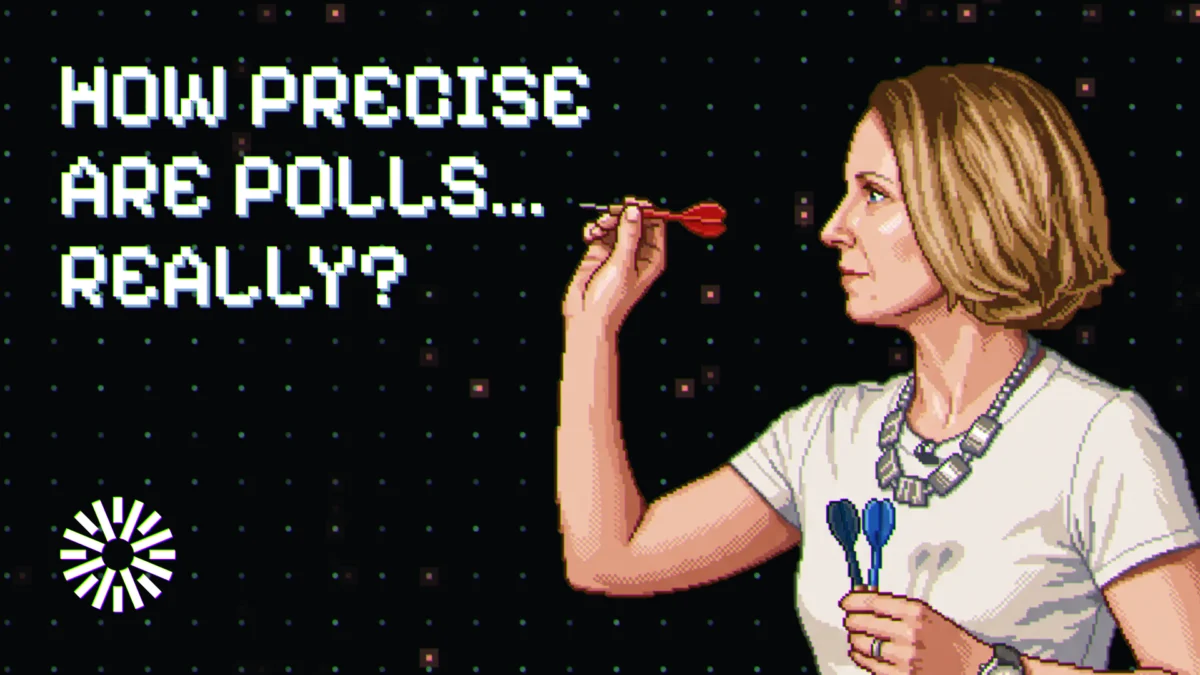
In an era defined by data-driven decision-making, public opinion polling has become the bedrock of political strategy, corporate marketing, and social research. Yet, for all its prominence, the mechanics of polling remain a source of significant public confusion. When a news outlet reports that a candidate is leading by four points with a "margin of error of plus or minus 3 percentage points," what does that actually mean?
The truth, as professional pollsters often explain, is that precision is not a singular point on a graph, but a range of probability. Understanding the "wiggle room" inherent in statistical sampling is not merely an academic exercise; it is essential for a healthy democracy and an informed electorate.
Main Facts: What is the Margin of Error?
At its core, the margin of error (MOE) is a statistical measure that quantifies the uncertainty inherent in any sample-based survey. Because it is physically and financially impossible to interview every single person in a population, researchers select a representative subset. The margin of error tells us how closely the results from that sample are likely to reflect the views of the entire population.
The Mathematics of Uncertainty
The MOE is primarily driven by sample size. As the number of respondents increases, the margin of error decreases—though it does so at a diminishing rate. For instance, moving from 500 to 1,000 respondents significantly boosts precision, but moving from 2,000 to 2,500 offers marginal gains.
However, the MOE is not a catch-all for every potential error. It specifically accounts for "sampling error"—the chance that the specific people chosen for a survey happen to be slightly different from the general population. It does not account for non-sampling errors, such as question wording bias, respondent dishonesty, or the difficulty of reaching certain demographic groups (non-response bias).
Chronology of Polling Evolution
To understand where we are today, we must look at the historical trajectory of survey methodology:
- The Early 20th Century (The Straw Poll Era): Early polling, such as that conducted by The Literary Digest, relied on massive but unrepresentative samples (often using telephone directories or car registrations). This culminated in the infamous 1936 prediction that Alf Landon would defeat Franklin D. Roosevelt, a catastrophic failure that highlighted the danger of "selection bias."
- The Mid-Century Scientific Shift: Pioneers like George Gallup introduced quota sampling and later probability sampling, which prioritized the randomness of selection over the sheer volume of respondents. This era established the mathematical foundations for the margin of error.
- The Digital Revolution (Late 1990s–2010s): The decline of landline telephones necessitated a shift toward random-digit dialing (RDD) and, eventually, online panels. This introduced new complexities, as pollsters had to develop sophisticated weighting techniques to ensure online samples mirrored the broader electorate.
- The Contemporary Era (2020–Present): Today, pollsters grapple with "hidden" biases. Recent election cycles have highlighted a "non-response" phenomenon, where certain segments of the population become increasingly difficult to survey, requiring more complex adjustments to raw data.
Supporting Data: Why "Wiggle Room" Matters
The importance of the margin of error is best illustrated by looking at "dead heat" scenarios. If Candidate A is at 48% and Candidate B is at 46% with a 3-point margin of error, the race is statistically tied.
Statistical Confidence Intervals
Most professional polling firms operate with a 95% confidence level. This means that if they conducted the same survey 100 times, the true population value would fall within the reported margin of error in 95 of those instances.
Data from the Pew Research Center’s Methods 101 series highlights that when two groups are compared (e.g., how men vs. women view a specific policy), the margin of error for those subgroups is significantly larger than the margin of error for the total sample. This is a common pitfall for casual observers who assume that a national poll’s precision applies equally to every demographic slice of that data.
Official Responses and Expert Consensus
The consensus among elite research institutions—such as the American Association for Public Opinion Research (AAPOR) and the Pew Research Center—is that transparency is the best remedy for public skepticism.
"Polling is not prophecy," says Dr. Elena Vance, a lead methodologist at a prominent non-partisan research firm. "When we provide a margin of error, we are essentially defining the boundaries of our own limitations. The public needs to understand that we are measuring a fluid human sentiment, not a static physical constant like gravity."
Many organizations are now moving toward "Total Survey Error" frameworks, which attempt to communicate to the public that while sampling error is measurable, other factors like coverage error and measurement error are equally important. By openly discussing these variables, pollsters are attempting to rebuild trust in an age of misinformation.
Implications for Democracy and Society
The misunderstanding of polling data has profound implications for public discourse. When news headlines ignore the margin of error, they create "false certainty." This can lead to:
- Voter Apathy or Overconfidence: If a poll suggests a candidate is winning by a wide margin, supporters may feel their vote is unnecessary, potentially altering the actual outcome of an election.
- Policy Misalignment: Politicians often use polling to gauge the popularity of specific policies. If the data is misinterpreted, leaders may prioritize short-term, superficial shifts in opinion over long-term, substantive public needs.
- The "Bandwagon Effect": Human psychology dictates that people often gravitate toward what they perceive as the winning side. Over-reporting of polling leads can artificially inflate a candidate’s momentum.
The Road Ahead
As technology evolves, so too must the tools used to measure the public pulse. The rise of AI-driven survey sentiment analysis and the potential for synthetic data suggest that the future of polling will be as much about data science as it is about sociology.
However, the fundamental principle remains unchanged: a poll is only as good as the transparency of its methods. As audiences continue to consume data at an unprecedented rate, the ability to read beyond the headline—and to respect the "wiggle room"—will become a vital component of media literacy.
Ultimately, the goal of professional polling is not to predict the future with 100% accuracy, but to provide a structured, scientific snapshot of the present. By acknowledging the limits of our measurements, we gain a more honest, albeit complex, understanding of the society in which we live. Whether it is through educational video series or detailed methodology disclosures, the ongoing mission is clear: to ensure that when we look at the numbers, we see the people behind them, rather than just the math.
About the Author