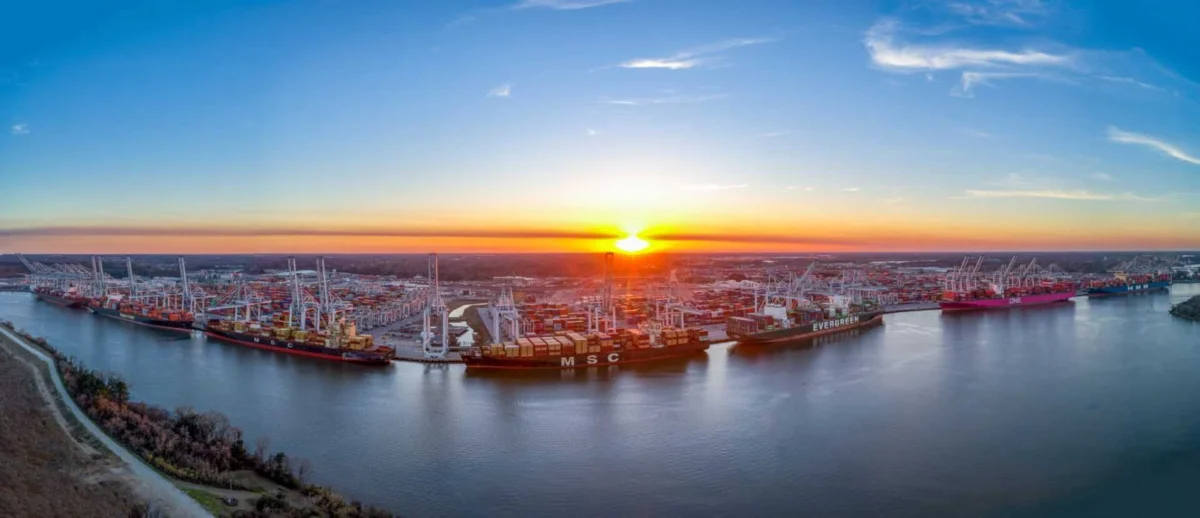
The Port of Savannah, a cornerstone of North American maritime logistics, has punctuated the close of its 2026 fiscal year with a robust performance. According to the latest data from the Georgia Ports Authority (GPA), the port processed 483,684 twenty-foot equivalent units (TEUs) in June alone—a staggering 18% increase over the same period in 2025. This surge, representing an additional 73,300 TEUs, serves as a high-velocity finish to a fiscal year marked by significant infrastructure maturation and a continued shift toward multi-modal logistics.
Main Facts: A Fiscal Year in Review
For the full fiscal year (FY) 2026, which spanned from July 1, 2025, to June 30, 2026, the Port of Savannah handled a total of 5.67 million TEUs. While this figure falls just short of the record-setting 5.7 million TEUs managed in FY2025, the consistency of the volume demonstrates the port’s resilience in the face of shifting global trade patterns and fluctuating demand.
The June spike is particularly notable, suggesting that supply chain managers and retailers are front-loading shipments to avoid potential mid-summer congestion and to prepare for the upcoming holiday retail cycle. By processing nearly half a million TEUs in a single month, the Garden City Terminal reaffirmed its position as one of the most efficient and high-capacity container terminals in the Western Hemisphere.
Chronology of Infrastructure Milestones
The impressive throughput figures of FY2026 are not merely the result of market demand; they are the fruition of a multi-year, multi-billion-dollar capital improvement plan designed to decongest the port’s surroundings and enhance its inland reach.
The Fiscal Year Timeline
- May 2026: The GPA officially inaugurated the $134 million Gainesville Inland Port. This facility acts as a critical rail-connected extension, bringing the port’s logistics capabilities directly into the heart of Northeast Georgia’s manufacturing and industrial corridor.
- June 2026: The port concludes the fiscal year with an 18% year-over-year increase in June throughput, cementing a strong finish.
- July 15, 2026: The Georgia Department of Transportation (GDOT) opened the Brampton Road Connector. This $130 million, four-lane highway infrastructure project provides a dedicated artery for port-bound truck traffic, linking the Garden City Terminal’s Gate 3 directly to the interstate system.
These developments were strategically sequenced to ensure that as volumes rose, the physical infrastructure—both on the terminal and in the hinterland—would be capable of handling the load without the bottlenecks that have plagued other major coastal ports.
Supporting Data: Rail and Intermodal Performance
While truck transport remains the primary mode for regional cargo distribution, the GPA’s strategic investment in rail continues to yield significant dividends. In FY2026, the GPA moved 541,405 containers via the Mason Mega Rail terminal. This marks the third consecutive year that the facility has exceeded the half-million-container milestone, highlighting the authority’s success in shifting long-haul freight from the road to the rail.
Rail cargo accounted for approximately 17% of Savannah’s total container trade throughout the fiscal year. This efficiency is further bolstered by the performance of the Appalachian Regional Port (ARP) in Northwest Georgia. The ARP handled a record-breaking 49,319 intermodal containers in FY2026, a 20% increase over the previous year. By moving more than 8,100 additional boxes compared to FY2025, the ARP has proven to be an essential tool in regional economic development, allowing Georgia manufacturers to access global markets with lower drayage costs and reduced carbon footprints.
Official Responses and Strategic Vision
The Georgia Ports Authority has framed these achievements as a vindication of its "inland-first" strategy. By extending the port’s footprint into the interior of the state, the GPA is effectively shortening the distance between the ship and the shelf.
"Our investment in inland connectivity is about more than just moving boxes; it’s about creating a frictionless supply chain for our partners," a spokesperson for the GPA noted following the release of the June figures. The opening of the Gainesville Inland Port, in particular, was described by officials as a "game-changer" for poultry processors and automotive manufacturers in the region, who now have a direct rail link to the deep-water terminal at Savannah.
The completion of the Brampton Road Connector also represents a victory for the local community and the state’s logistics sector. By separating port-related truck traffic from local commuter traffic, the GDOT and GPA have significantly improved safety and travel times for the residents of Savannah while simultaneously increasing the velocity of freight movement.
Implications: The Future of the Southeast Gateway
The data from FY2026 provides several critical insights into the future of maritime logistics in the U.S. Southeast.
1. The Resilience of the "Savannah Model"
The "Savannah Model"—characterized by massive terminal acreage, direct interstate connectivity, and a robust inland rail network—is proving to be a highly effective template. As other ports struggle with aging infrastructure and limited gate capacity, Savannah’s ability to move nearly 5.7 million TEUs while simultaneously undergoing massive construction projects signals a high level of operational maturity.
2. Diversification of the Logistics Ecosystem
The growth of the Appalachian Regional Port and the opening of the Gainesville Inland Port suggest that the future of port competitiveness lies in how far inland a port can extend its influence. By establishing these hubs, the GPA is insulating itself from the volatility of local drayage labor shortages and fuel cost fluctuations. Companies that choose to site their distribution centers near these inland ports gain a significant competitive advantage in terms of supply chain reliability.
3. Impact on Global Supply Chain Shifts
The 18% increase in June volume is a bellwether for the broader U.S. economy. As the manufacturing sector in the Southeast United States continues to expand—driven by the automotive, aerospace, and high-tech sectors—the Port of Savannah is increasingly becoming the preferred gateway for both imports and exports. The focus on rail connectivity is particularly important for export-heavy industries, which require the cost-efficiency of intermodal transport to remain competitive in international markets.
4. Environmental and Social Governance (ESG)
The shift of 17% of container volume to rail, supported by the new inland port infrastructure, has tangible environmental benefits. By reducing the number of heavy-duty trucks on the I-16 and I-95 corridors, the GPA is effectively lowering the carbon intensity of the freight moving through its gates. This aligns with the broader push by major retailers and manufacturers to reduce Scope 3 emissions in their supply chains.
Conclusion: A Platform for Continued Growth
As the Port of Savannah enters the 2027 fiscal year, the foundation has been laid for continued growth. With the Brampton Road Connector now fully operational and the inland port network showing double-digit growth, the GPA is well-positioned to recapture the momentum that saw it flirt with the 6-million-TEU threshold.
The June surge is a clear indicator that the market has confidence in the port’s capacity. For cargo owners, shippers, and logistics professionals, the Port of Savannah has transformed from a traditional port-of-call into a sophisticated, multi-modal logistics ecosystem. As trade lanes continue to shift toward the U.S. Southeast, Savannah’s ability to integrate road, rail, and sea into a cohesive, high-velocity network will likely define its success for years to come.
The record-breaking performance at the Appalachian Regional Port and the sustained volume at the Mason Mega Rail terminal demonstrate that the port is not merely reacting to growth—it is actively engineering the infrastructure to accommodate it. Whether the next fiscal year will see a return to the record-breaking heights of 5.7 million TEUs remains to be seen, but the data suggests that the port is not only ready for the challenge but is actively setting the pace for the industry.
About the Author